
Keisei: Skyliner, Access Express, Eight Series
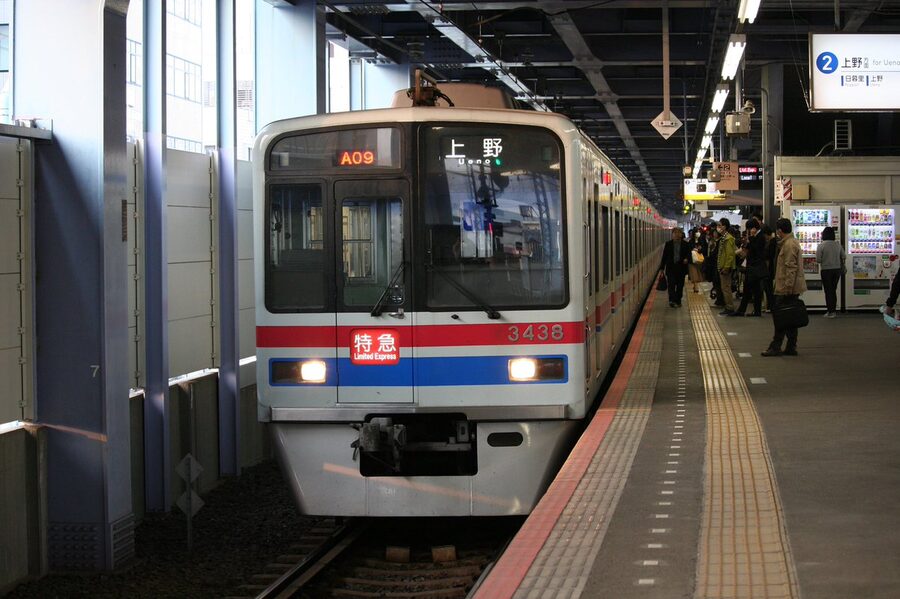
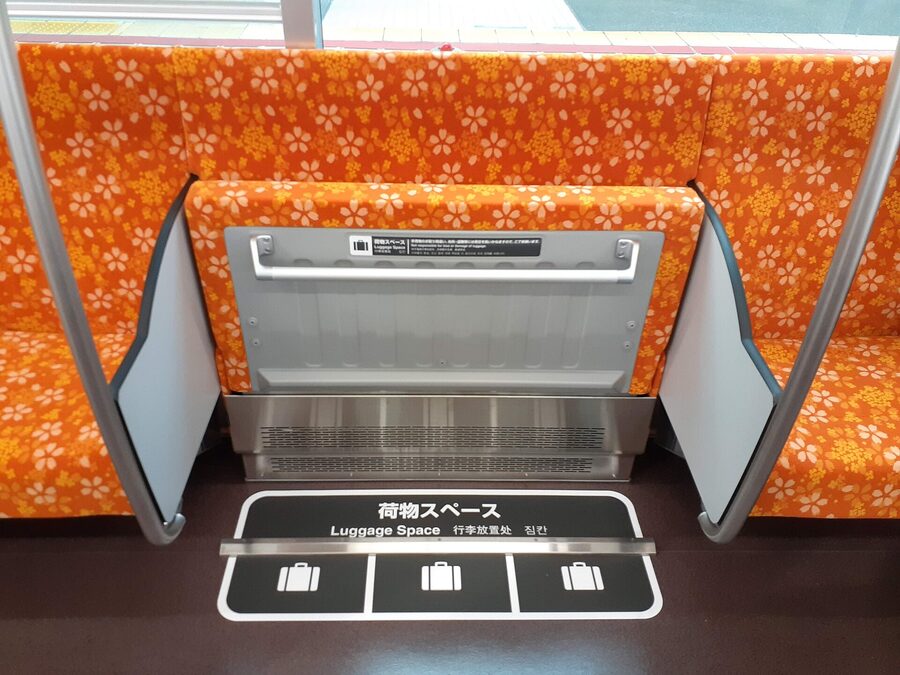
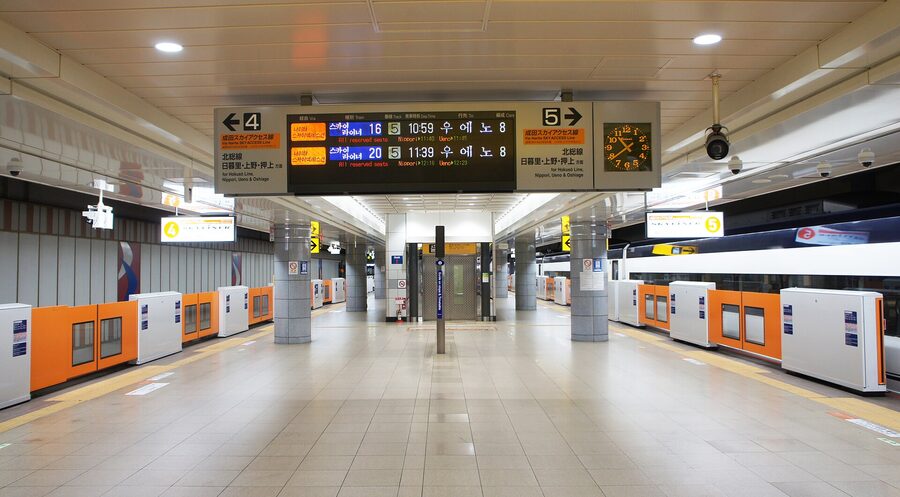
16:42 at Narita Airport Terminal 1, downstairs at the Keisei platform. Two trains are advertised on the same departure board, four minutes apart, both signed for central Tokyo. The first is a Skyliner: eight aluminium cars, AE form, single doors, reserved seats only, ¥2,580 plus base fare, 36 minutes nonstop to Nippori at up to 160 km/h. The second is an Access Express: a stainless 3100 series with three doors per side, longitudinal seats with a fold-down corner for luggage, no surcharge, 64 minutes via the same Sky Access tracks but with seven stops along the way and a through ticket that will eventually deposit you under Asakusa or Ginza without ever changing trains. If you have an IC card and you are heading to a hotel near the Tokyo Metro, the second train is the right one. The Skyliner is faster, but the Access Express puts you through the JR fare gate three minutes after you sit down and lets you walk straight off into central Tokyo with no transfer at Nippori at all.
In This Article
- Why the Keisei rolling-stock question is two questions
- One company, two airport products, one gauge that took fifty days to fix
- The cluster context: where Keisei sits in the Tokyo private-railway map
- The Skyliner, the AE form, and the 160 km/h question
- The original 1972 AE: arsoned, lengthened, then cannibalised
- The AE100: built for a tunnel that never came
- The current AE: 160 km/h, 36 minutes, Kansai Yamamoto
- The Kenty Skyliner and other liveries
- The Access Express and the eight-series commuter fleet
- The 3000 series and the 3050: the workhorse
- The 3100 series: the Access Express train
- The 3700: the long-haul commuter
- The 3500: the stainless original
- The 3600: chopper control, ten cars left
- The 3400 commuter and the AE inheritance
- The 3200 series is the new arrival
- The Sky Access Line and what 160 km/h actually buys
- The route, the operators, and the layered ownership
- What 160 km/h actually saves you
- Where the Access Express comes out ahead
- Through-running: how a Keisei train ends up in Yokosuka
- The four-railway alliance
- Aoto: the diagram, in real life
- Aoto stops on the Skyliner: a recent change
- The lines, the stations, and where the system meets the city
- The Main Line: 67.2 km, the original spine
- Nippori: the actual Tokyo terminus, in practice
- Keisei-Funabashi: the Chiba interchange
- Aoto, Takasago, and the gauntlet at Komaino
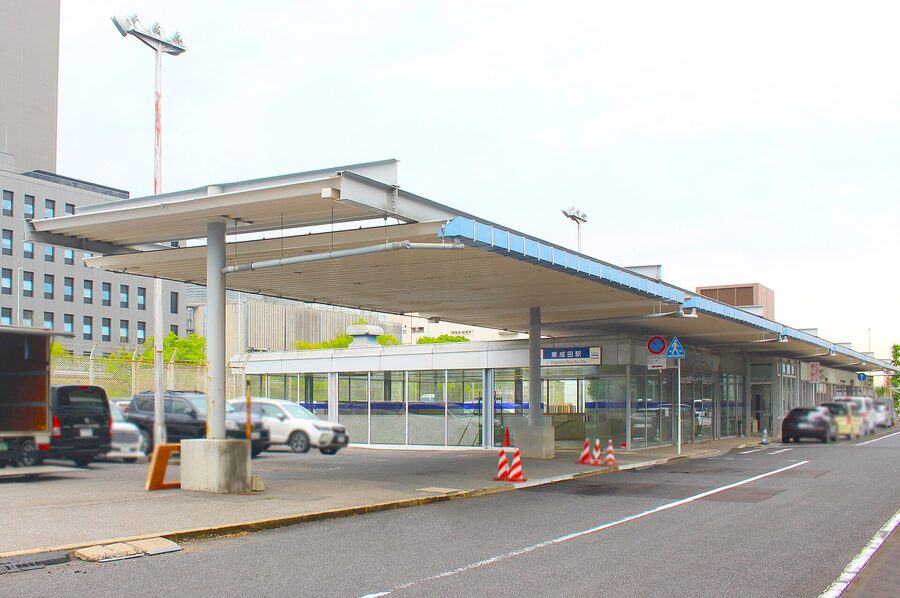
- Higashi-Narita: the airport station that is not the airport station
- Fares, tickets, and the practical question
- Skyliner: how to actually buy one
- Access Express: an IC card and you are done
- Morningliner and Eveningliner: the commuter Skyliner
- The discount tickets that actually save money
- Reading the destination board: a quick decoder
- The “via” question
- The Matsudo Line and the 2025 absorption
- If you are riding the Skyliner once: my standing recommendation
- Cross-references
- Aoto, again
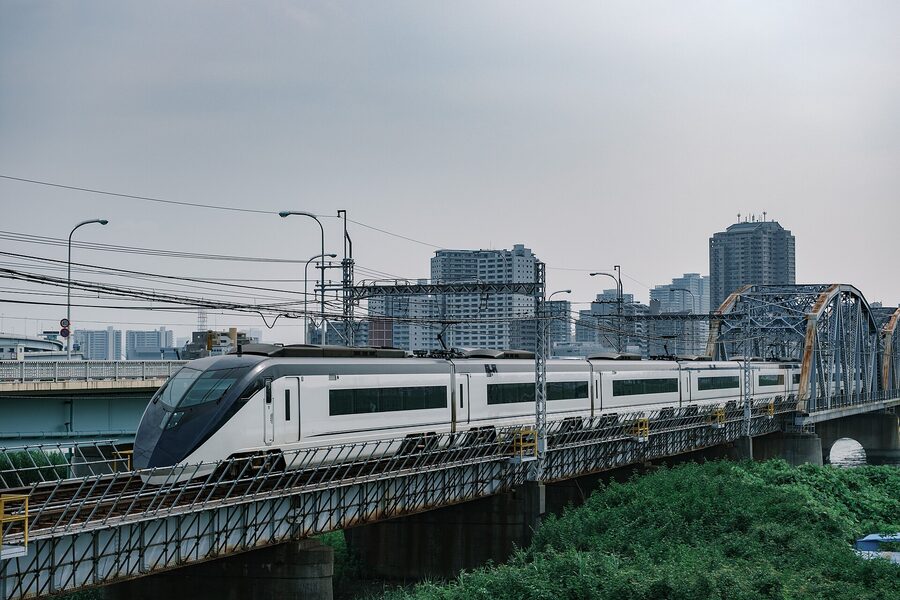
That choice between the Skyliner and the Access Express is the article in miniature. Keisei runs two airport products at the same time over partly the same track, with completely different rolling stock, completely different fare structures, and a network of through-running agreements that can put a single train from Narita Airport into the dock at Haneda without you ever changing a seat. The price you pay to understand it is one diagram of the Tokyo airport network and a quick read of the eight commuter series that share the Main Line with the AE. By the end you will know which yellow-and-blue stripe to look for, what the surcharge actually buys, and why the rolling stock that runs the Sky Access is, on a per-car basis, some of the most cosmopolitan equipment in Japan.
Why the Keisei rolling-stock question is two questions
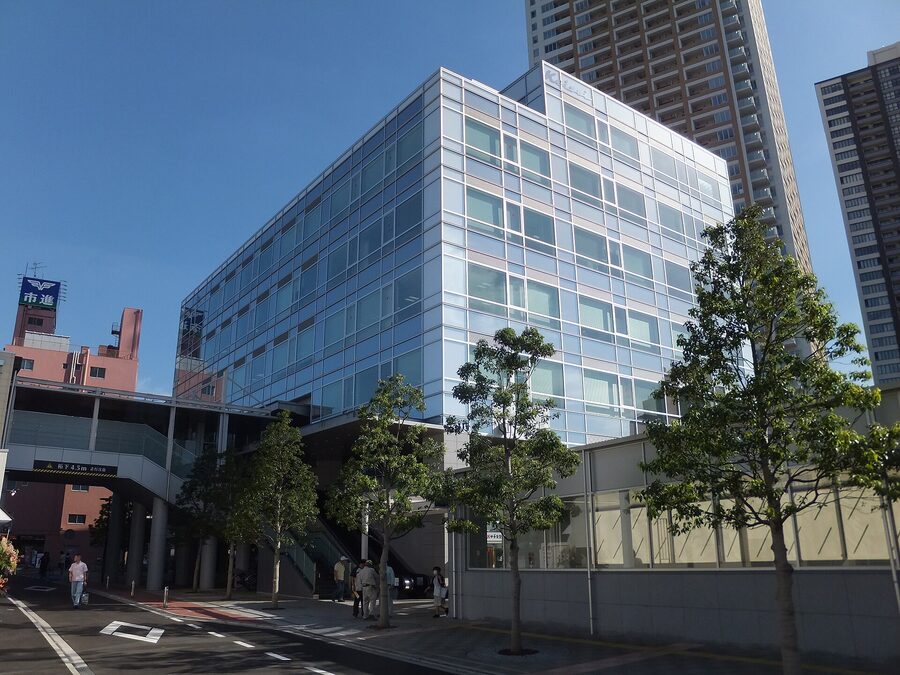
Most of Tokyo’s private railways have one fleet and one job: get commuters to work and shoppers to a department-store terminal somewhere in the central city. Keisei does both, and then it does a third thing, which is run the only standard-gauge limited express in Japan that maintains 160 km/h in regular service. The Skyliner is the second-fastest revenue train in the country after the Shinkansen, and it shares 1,435 mm rails with everyone from a 1972 stainless-steel commuter set to the Toei 5500 series and Keikyu N1000 stock through-running from the other side of Tokyo. So when you ask “what runs on the Keisei”, the answer depends on whether you mean the Main Line built in 1912, the Sky Access opened in 2010, or the joined-up airport-to-airport circuit through the Toei Asakusa Line that ties the two together.
One company, two airport products, one gauge that took fifty days to fix
The Skyliner and the Access Express share a track on the Sky Access section. They share a gauge. They do not share a rolling stock, a fare structure, a stopping pattern, or a marketing target. The Skyliner is what Keisei sells to a foreign tourist at the airport ticket counter. The Access Express is what Keisei sells to a salaryman with a Suica who is going home to Higashi-Ginza. Both are good at their jobs. They are not interchangeable. The 1,435 mm gauge they both run on, by the way, is the result of the largest re-gauging operation in Japanese rail history, conducted overnight in seven sections between 9 October and 1 December 1959. Keisei was originally a 1,372 mm “Scotch gauge” operator, the same as Tokyo’s tram system; the conversion was forced by the through-running agreement with Keikyu and the Toei Asakusa Line, both of which were 1,435 mm and refused to budge.
The cluster context: where Keisei sits in the Tokyo private-railway map
Keisei is the eastern member of the Tokyo private-railway big eight, but it is the airport member rather than the suburban one. Odakyu goes to Hakone. Tobu goes to Nikko and Asakusa. Keio goes to Mt Takao and the Tokyo dormitory belt to the west. Keisei goes to Narita and to Funabashi. Its closest analogue is Keikyu, which goes to Haneda and Yokohama, and the two are so closely linked operationally that the same 8-car commuter sets do the round trip Narita to Haneda in 92 minutes via the Toei Asakusa Line in central Tokyo. If you have read the Toei rolling-stock piece, the Toei 5500 series turns up in this article too: it is a participant in the through-running, not a guest.
The Skyliner, the AE form, and the 160 km/h question
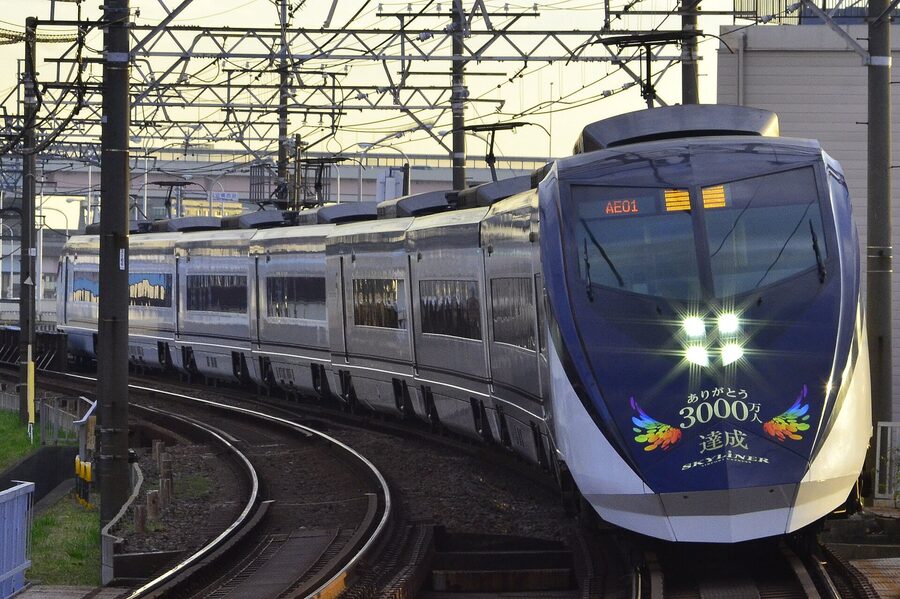
The AE form (in Japanese, AE 形, “Airport Express”) is the train you actually pay for when you buy a Skyliner ticket. The current generation, sometimes called AE-II to distinguish it from the 1972 original, was delivered between 2009 and 2010 by Nippon Sharyo and Tokyu Car Corporation, with a ninth set added in 2019. It is the third Skyliner train, and it is meaningfully different from the previous two.
The original 1972 AE: arsoned, lengthened, then cannibalised
The first AE form was Keisei’s bid to compete with the airport limousine bus when New Tokyo International Airport, now Narita, opened. Seven six-car sets were built between 1972 and 1978; service started in late 1973 on what was then a Ueno-to-Keisei Narita reserved-seat express, before Narita Airport even existed. Then, on 5 May 1978, sixteen days before the airport’s planned opening, an arson attack at Sogo Depot torched car AE29 of set AE30. The protest movement against the airport had been violent for a decade, and the AE was a visible target. The Skyliner started running to the original Narita Airport Station, now Higashi-Narita, on 21 May 1978 anyway, with one car short.
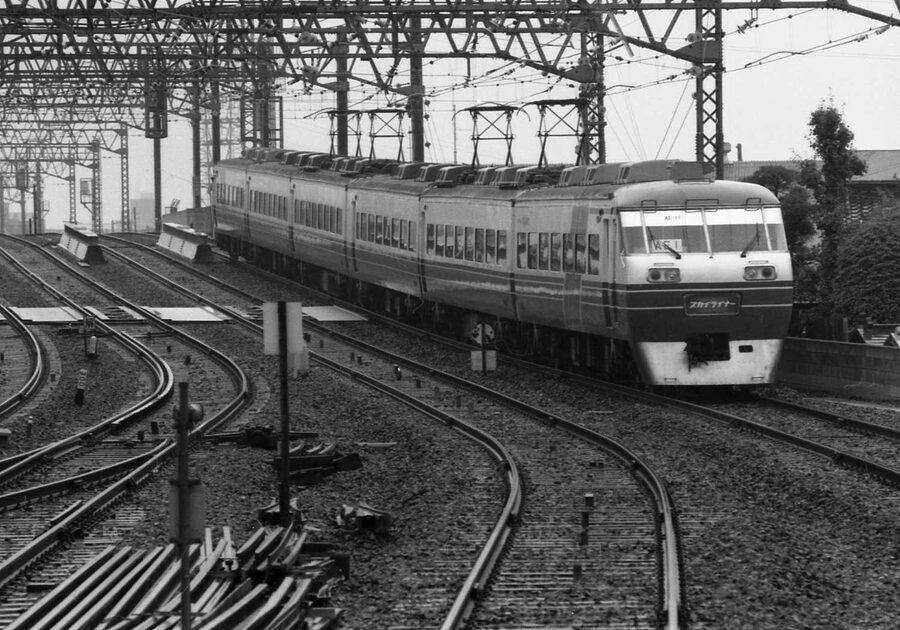
The first AE was scrapped in 1993 to make way for the AE100. Most of it, anyway. Keisei kept the running gear: the bogies, the chopper-control electrical equipment, the motors. New stainless-steel bodies were built at Tokyu Car, the bogies and control kit were transplanted underneath, and the result is the 3400 series, eight cars per set, five sets total. The 3400 has been running on the Main Line since 1993. If you ride one today and notice that it accelerates harder and rides quieter than the rest of the commuter fleet, that is because the bits that matter are forty-odd years old and were originally designed to do 105 km/h with a paying passenger inside.
The AE100: built for a tunnel that never came
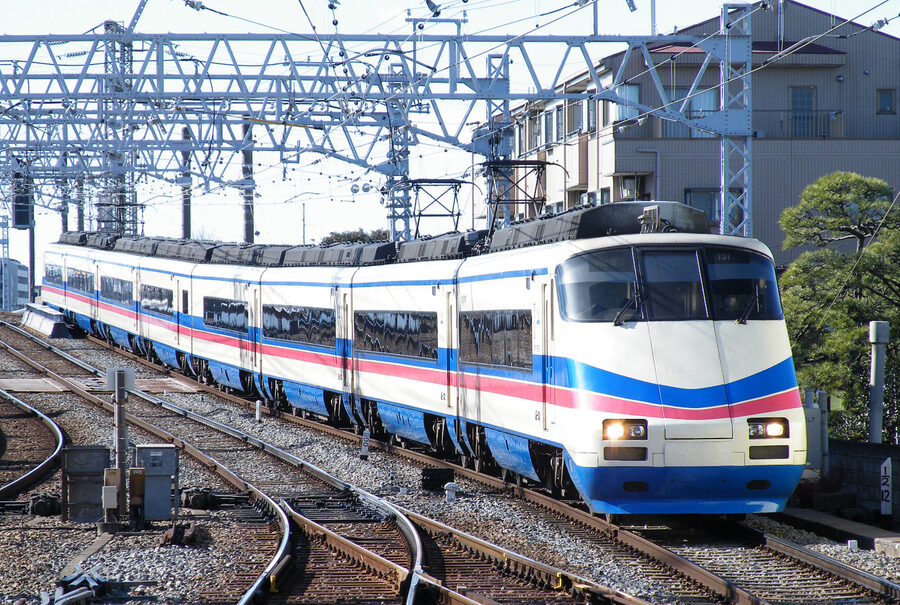
The AE100, in service from June 1990 to February 2016, was built on the assumption that the Skyliner would one day through-run to Haneda Airport via the Toei Asakusa Line. The Toei tunnel lacks side evacuation walkways, so a train running in it has to be evacuable through its end cabs, which is why every AE100 had a door at the front. The through-service never came, partly because of fare-and-revenue arguments between Keisei, Toei and Keikyu, partly because the AE100’s front-end aerodynamics were never as good as the redesigned cab on the new AE form. After the Sky Access opening in July 2010, the AE100s were demoted to the Main Line on a service called Cityliner, basically a slower Skyliner stopping at Funabashi and Sakura, before being retired in 2016.
The current AE: 160 km/h, 36 minutes, Kansai Yamamoto
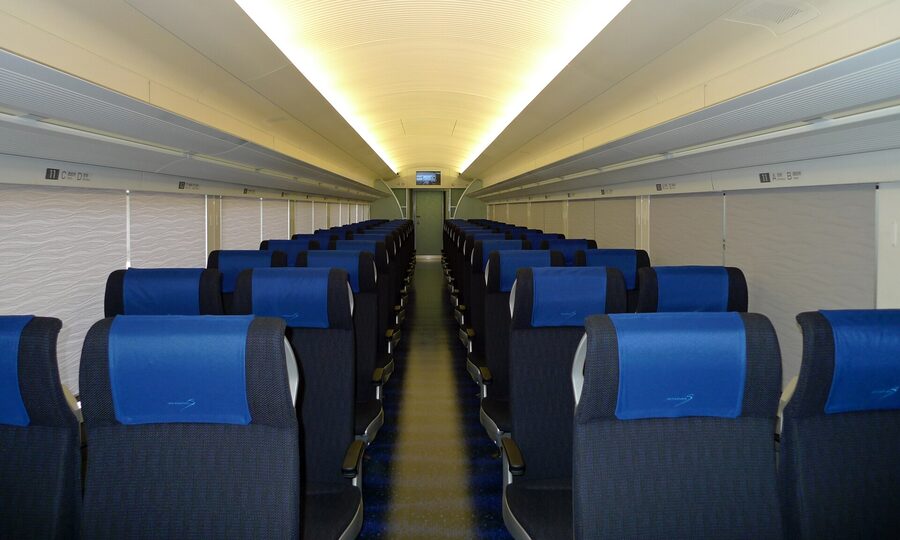
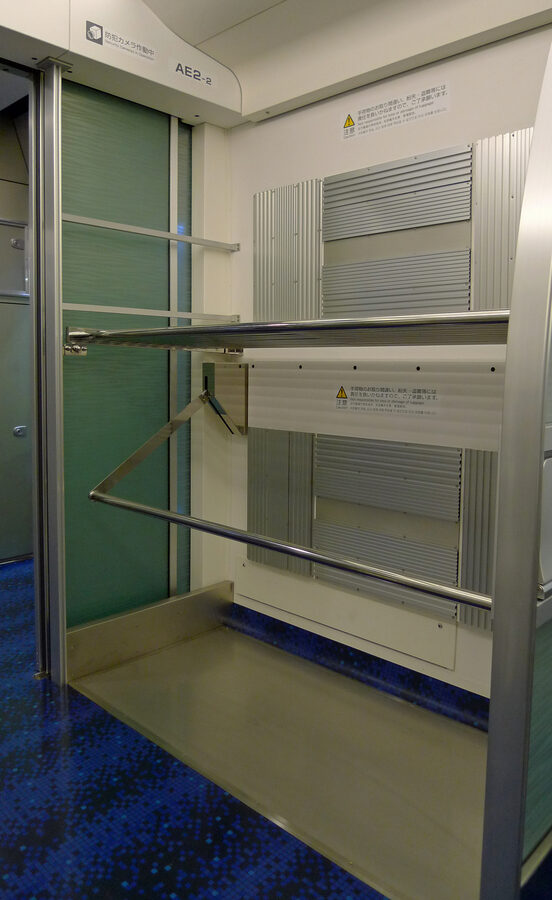
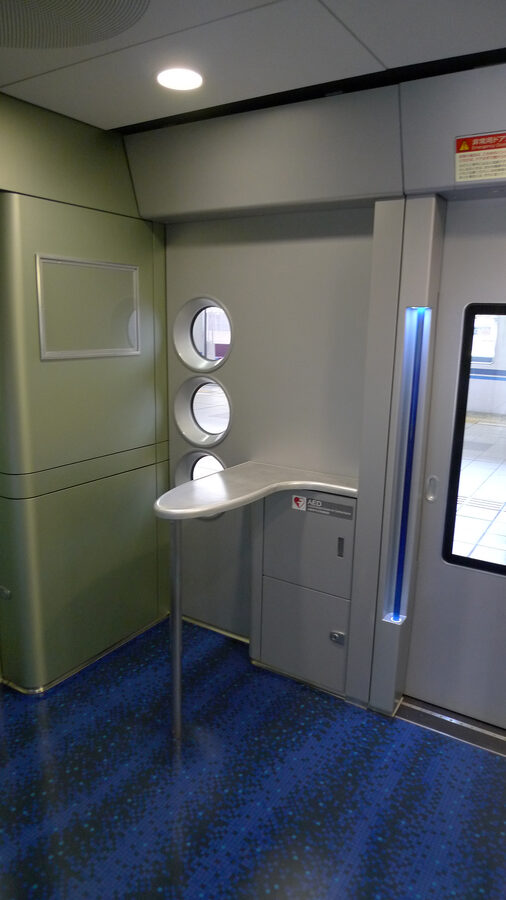
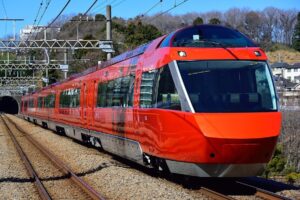
The AE you ride today is an aluminium-bodied eight-car set with twenty-four 175 kW three-phase induction motors, IGBT traction control, and an active suspension system in the end cars that takes the edge off the Sky Access viaduct section. Each car has a single door per side; you cannot move between platforms once you have boarded. Top speed is 160 km/h, which on a Japanese conventional line means the line itself has to be cleared by the Ministry to Class 1 standard, with continuous-welded rail and high-spec ATS protection. Outside the Shinkansen, only the Hokuhoku Line ever ran trains at this speed in regular service, and it stopped doing so in 2015. The Sky Access is the only mainland conventional line still running 160 km/h passenger trains in 2026.
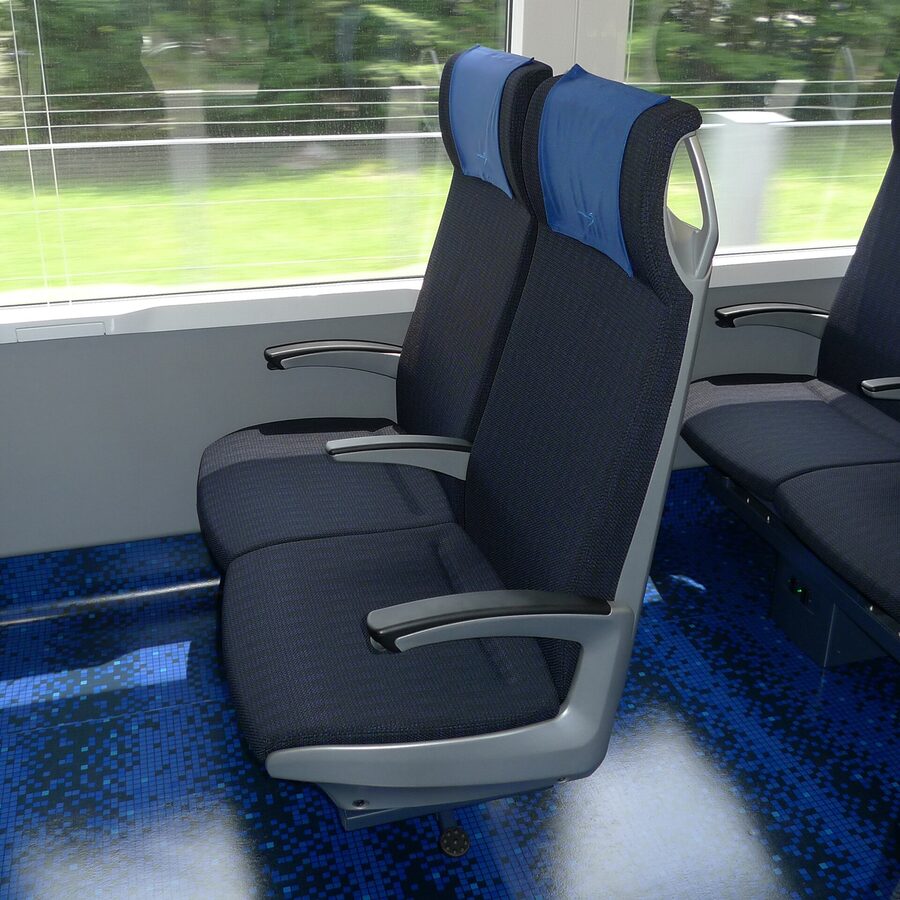
The styling came from Kansai Yamamoto, the fashion designer who did David Bowie’s Ziggy Stardust costumes; the in-train chime came from Minoru Mukaiya, the keyboardist for the fusion-jazz band Casiopea. Both choices read as 2009 Tokyo, and both have aged. The AE won the 54th Blue Ribbon Award from the Japan Railfan Club in 2011 and the Good Design Award in 2010, neither of which it was going to lose. Nine sets, 72 cars total, all eight-car formations, fleet numbers AE1 through AE9. AE9 was added in 2019, presumably for the Olympics that did not quite happen on time.
The Kenty Skyliner and other liveries
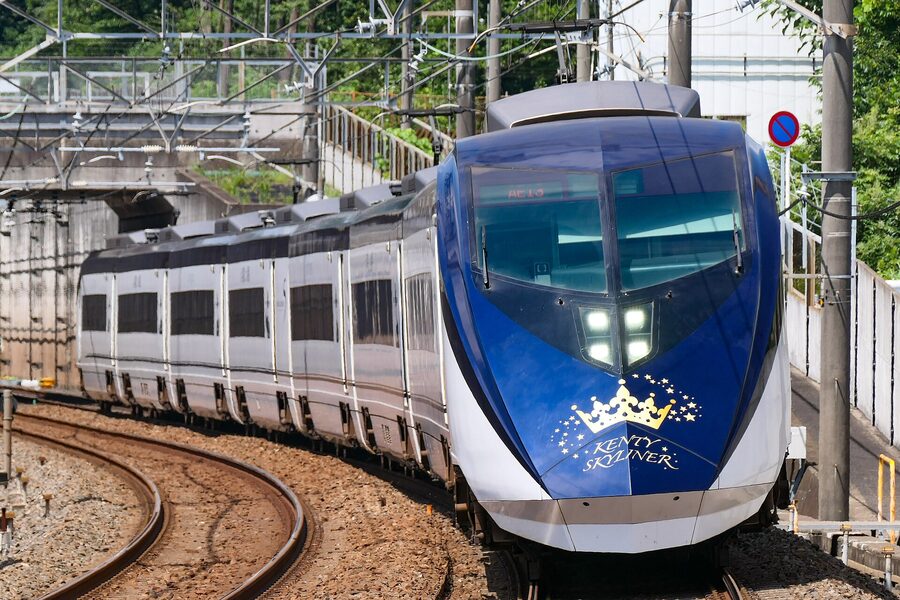
Keisei has wrapped the AE fleet several times for marketing tie-ups: the Kenty Skyliner, the Hello Kitty Skyliner, the City Liner. None of them changes the train. They are paint, and they all wash off in the standard Skyliner livery eventually. If you photograph a Skyliner on a given afternoon, you have a roughly even chance of getting a wrap and a roughly even chance of getting the original. The locomotive is exactly the same underneath.
The Access Express and the eight-series commuter fleet
If the Skyliner is the easy answer to “how do I get to Tokyo from Narita”, the Access Express is the one that rewards reading. Keisei runs eight commuter series in regular service, plus the four Shin-Keisei (now Matsudo Line) types it inherited in April 2025: 8800, 8900, N800, and 80000. The eight Keisei numbers are 3000, 3050, 3100, 3200, 3400, 3500, 3600, 3700. They look superficially similar; they are, in detail, four generations of train co-existing on one network.
The 3000 series and the 3050: the workhorse
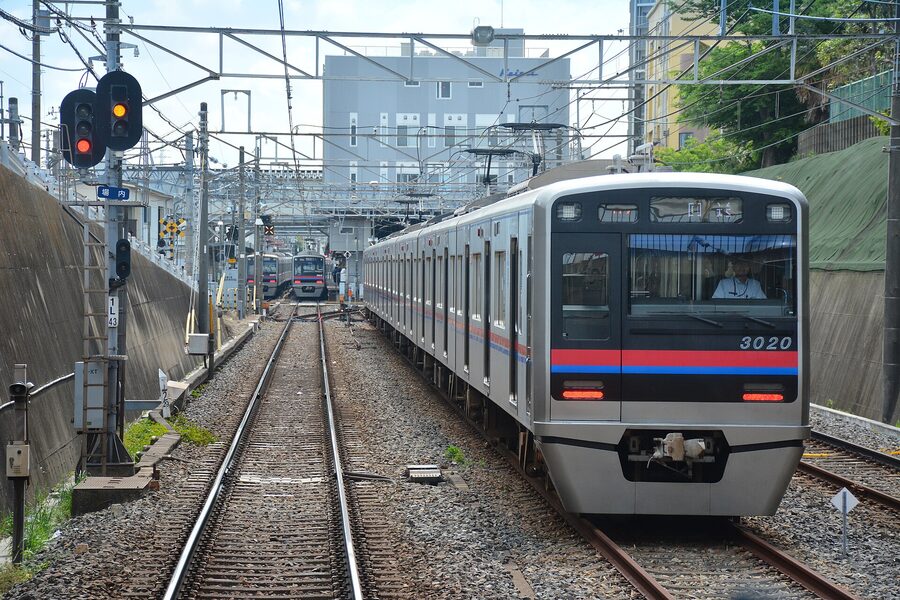
The 3000 series, sometimes labelled 3000 (II) to distinguish it from the 1958 original of the same name, has been Keisei’s standard commuter train since February 2003. J-TREC (the former Tokyu Car) and Nippon Sharyo built 326 cars across forty-eight sets between 2002 and 2019, in a mix of six- and eight-car formations. The eight-car sets do the through-running to Toei Asakusa and Keikyu Main Lines; the six-car sets are kept on the Main Line and the Chiba Line. Top speed is 120 km/h, but in commuter service it sits below that almost always. If you board a non-Skyliner, non-Access-Express Keisei train heading west out of Narita Airport, the answer is statistically a 3000 about half the time.
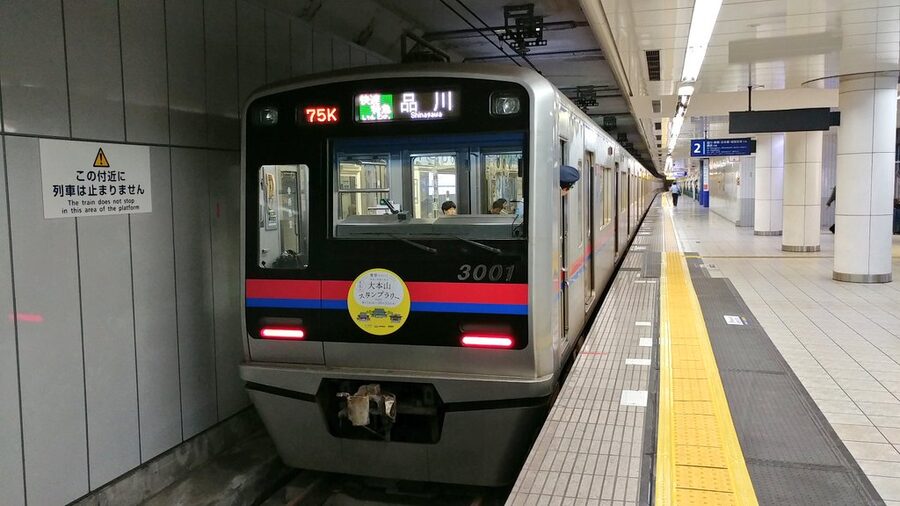
The 3050 sub-series, built into the seventh batch of 3000s, is functionally identical but liveried for the Sky Access service: white body with a sky-blue band rather than the standard 3000 red-and-blue scheme. It is the train you most commonly see on the Access Express that is not a 3100. Six sets, all eight-car. They are 3000s. They are written 3000 in the engineering documents. The 3050 designation is a customer-facing convention, not an engineering type.
The 3100 series: the Access Express train
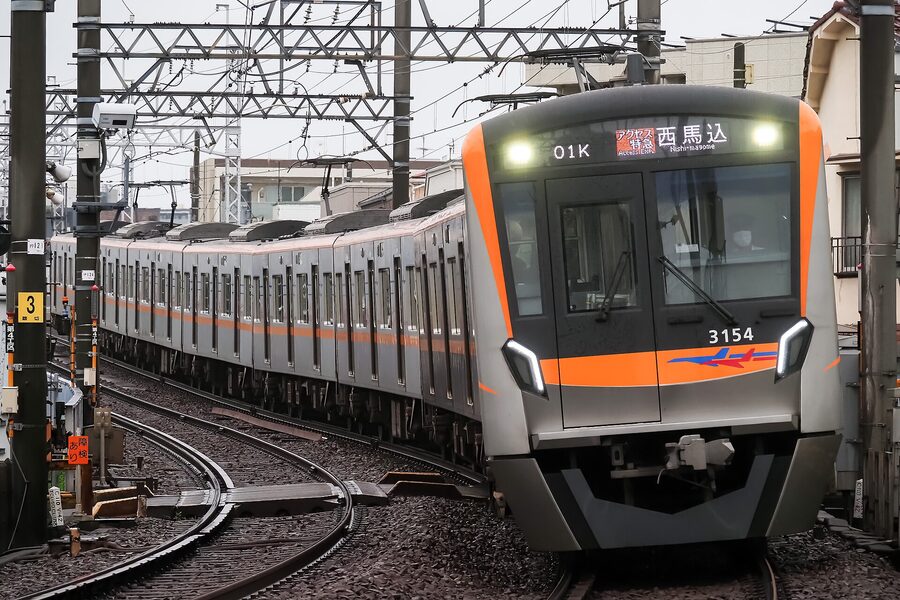
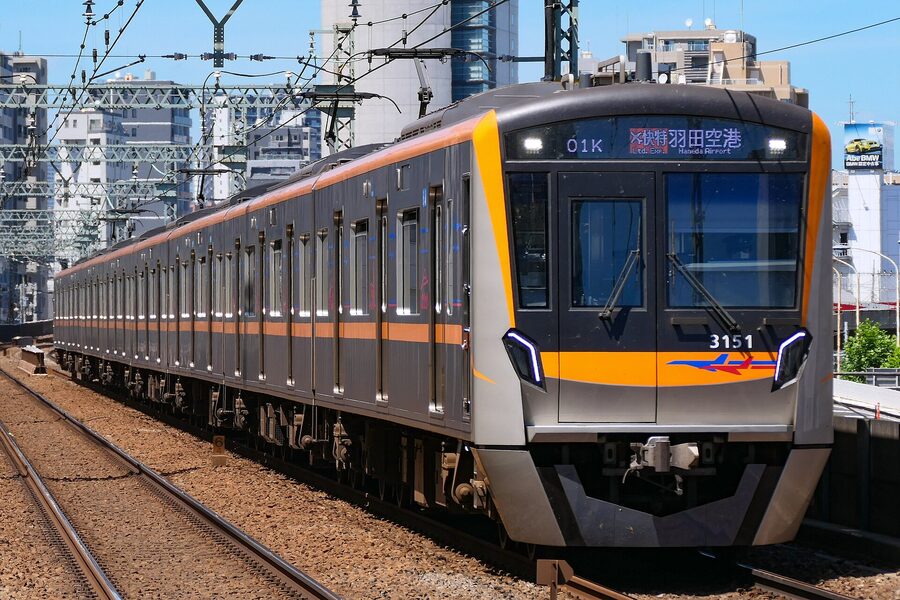
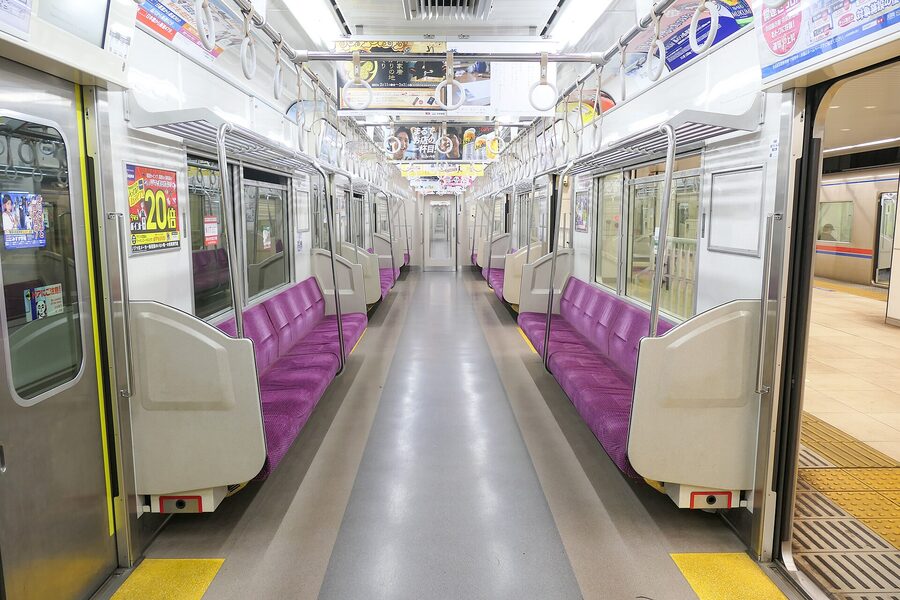
The 3100 series, in service from October 2019, was built specifically for the Access Express role on the Sky Access. The brief: longitudinal bench seats for capacity, but with a fold-down corner seat at the cab end of car 1 to free up a luggage zone for the airport flow; a Plasmacluster ion generator above each set of doors; and a 120 km/h top speed, which on the Sky Access line section is slower than it sounds because the Skyliner at 160 km/h is constantly catching up to it.
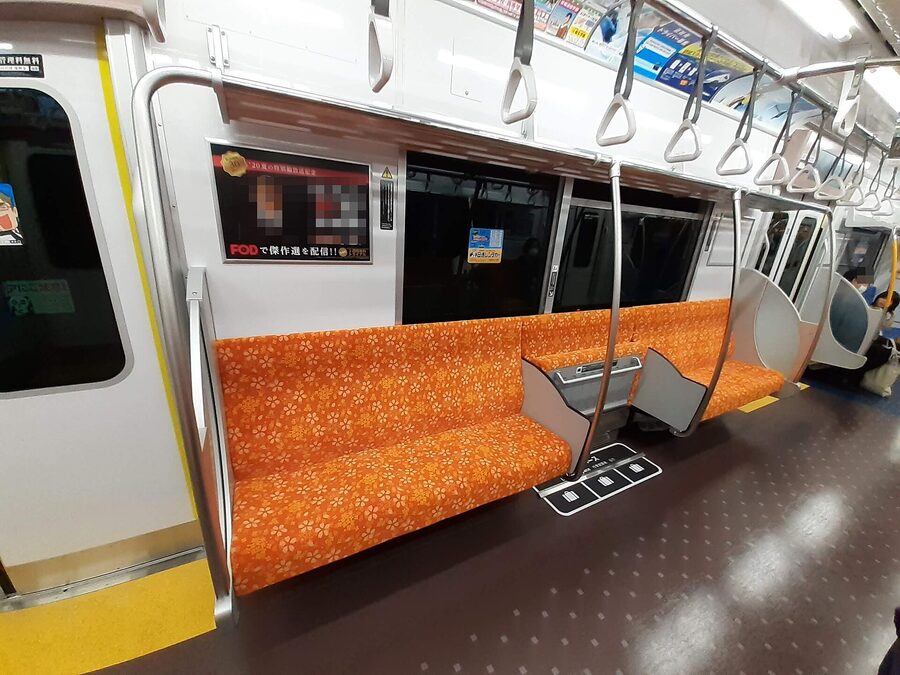
The 3100’s traction kit is a Toyo Denki SiC-hybrid IGBT inverter feeding 24 motors at 140 kW each, total continuous output 3.36 MW. SiC-hybrid is the generation between the GTO inverters of the early 1990s and the full silicon-carbide systems on the very newest stock. It runs cool, it accepts regenerative braking back into the line at higher voltages, and it has the side effect of being relatively quiet at speed. If the train you board has the orange band on the cab and the Plasmacluster green dots above the doors, it is a 3100. The interior is otherwise close enough to a 3000 that most commuters do not notice the difference.
The 3700: the long-haul commuter
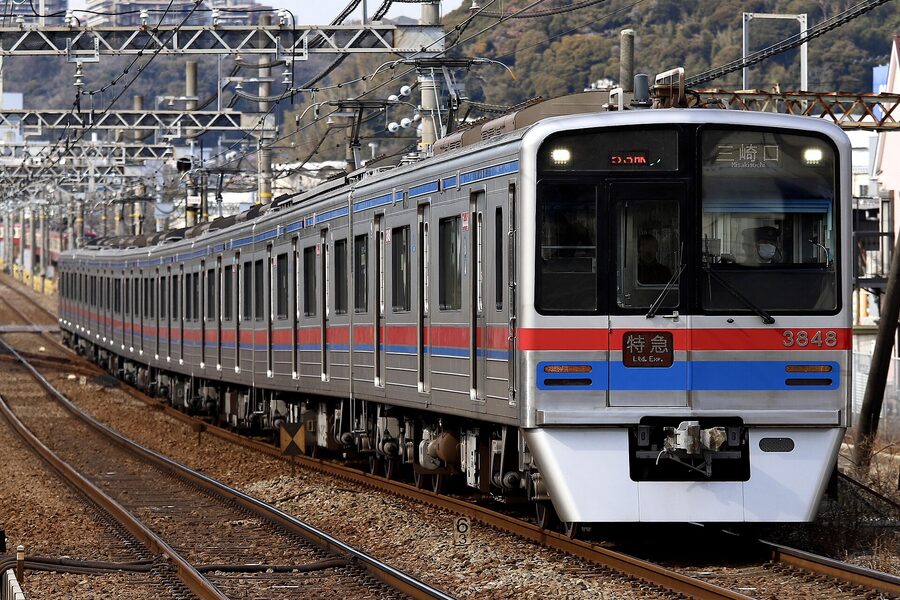
The 3700 series, built between 1991 and 2001 by Nippon Sharyo and Tokyu Car, is the train you actually ride if you are doing the airport-to-airport run by commuter service. 132 cars across seventeen sets, mostly eight-car, all fitted out for the Toei Asakusa Line through-running and the Keikyu electrical specification. It replaced the original 3000 series (the 1958 one, not the current 2003 stock) on long-distance runs. The 3700 is the one you most often see signed for Misakiguchi or Haneda Airport, fully 110 km away from the closest Keisei station.
The 3500: the stainless original
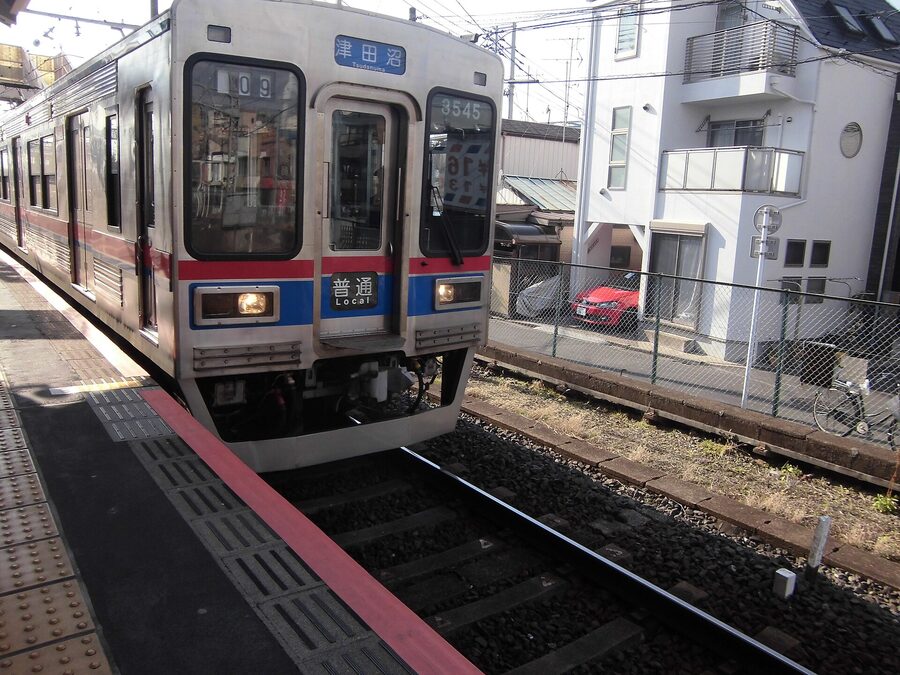
The 3500 series, in service since December 1972, was Keisei’s first stainless-steel train. Ninety-six vehicles in twenty-four four-car sets, later reformed into the present mix of eight-, six-, and four-car operations. By January 2024 only eight sets were left, plus a single set on the Shibayama Railway, which is the 4 km branch out of Higashi-Narita that Keisei operates jointly. The 3500 is now restricted to local services on the Main Line, the Chiba Line, and the Kanamachi Line. It does not through-run to Toei or Keikyu any more; the unrefurbished sets never had the spec for it, and the refurbished ones were taken off airport-corridor work in 2014 when the four-car formations were rationalised.
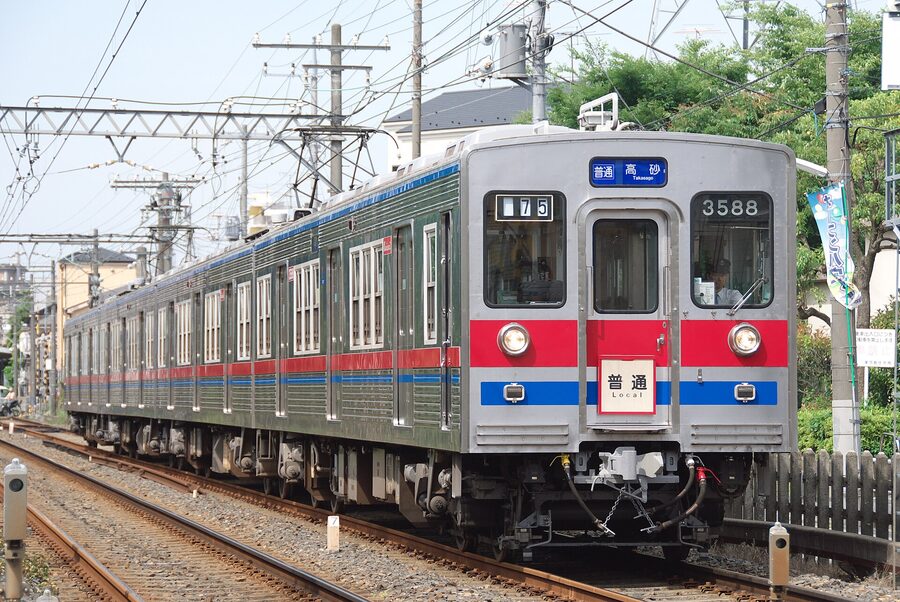
The 3600: chopper control, ten cars left
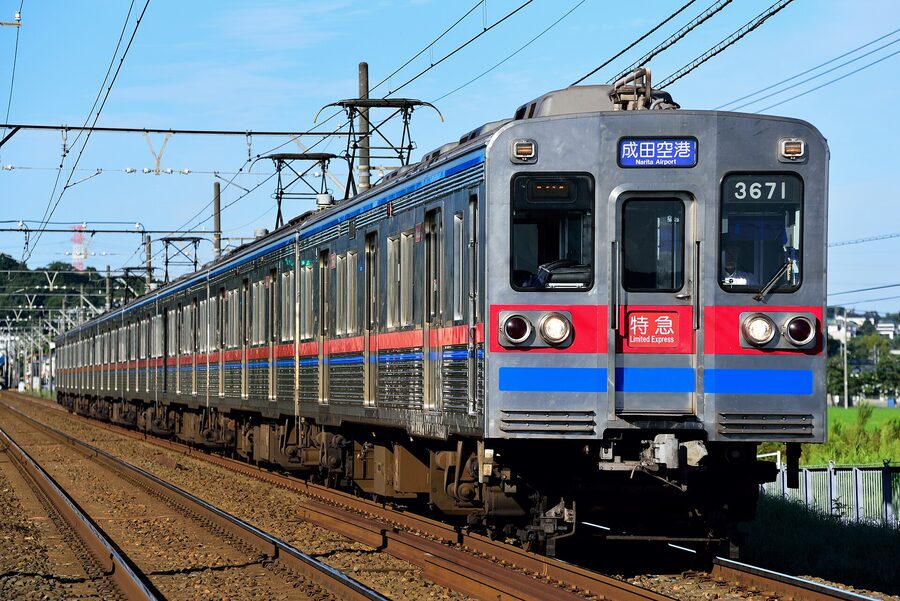
The 3600 series was Keisei’s first chopper-control train, built from 1982. 54 vehicles initially, now down to ten in two sets as of May 2024. The 3600 is what an enthusiast goes to Sogo Depot to photograph: the running gear is older than most of the 3500 fleet, the body is a square 1980s Nippon Sharyo design, and a “revival color” set, 3688F, was repainted into the 1980s livery in 2022 as a publicity exercise.
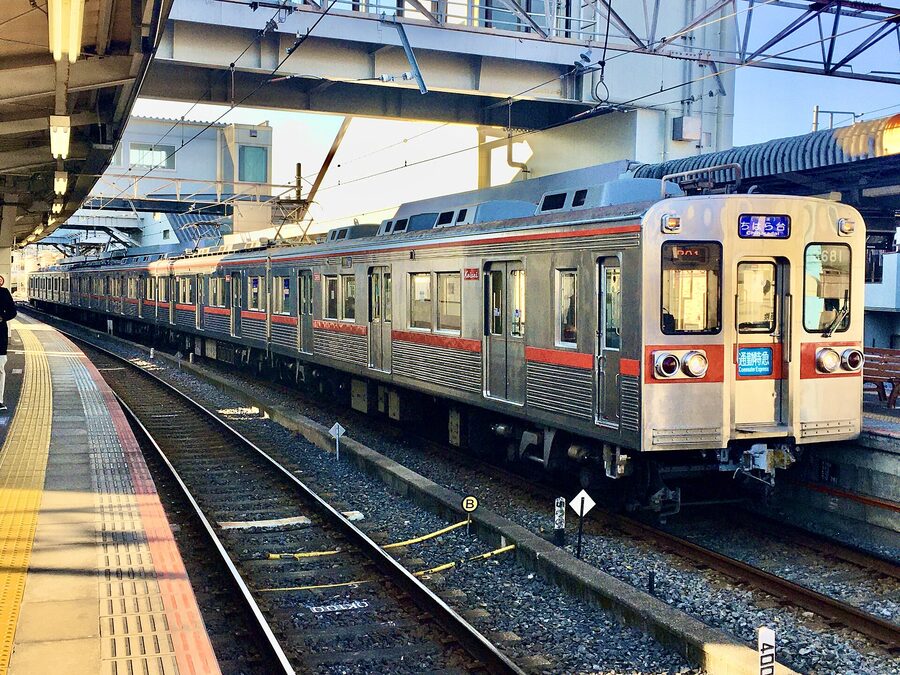
The 3600 has chopper control on most of the fleet and a VVVF-inverter conversion on a sub-set, the practical effect of which is that some 3600s sound like 1980s Tokyo trains and some sound like 2000s Tokyo trains, sometimes consecutively. The conversion was done in the late 1990s on selected motor cars; the rest were left as built. There is no easy way to tell which from the platform.
The 3400 commuter and the AE inheritance
The 3400 turns up here for the second time. As noted in the AE section, the 3400’s body was built fresh in the early 1990s but the running gear came out from underneath the 1972 AE Skyliners. Keisei spent a meaningful sum on those bogies and motors back in 1972; recycling them when the AE100 arrived was a logical decision. There are five eight-car sets, all built around 1993, all on the Main Line. The 3400 is mechanically the closest active Keisei train to the original Skyliner. The body is just a wrapper.
The 3200 series is the new arrival
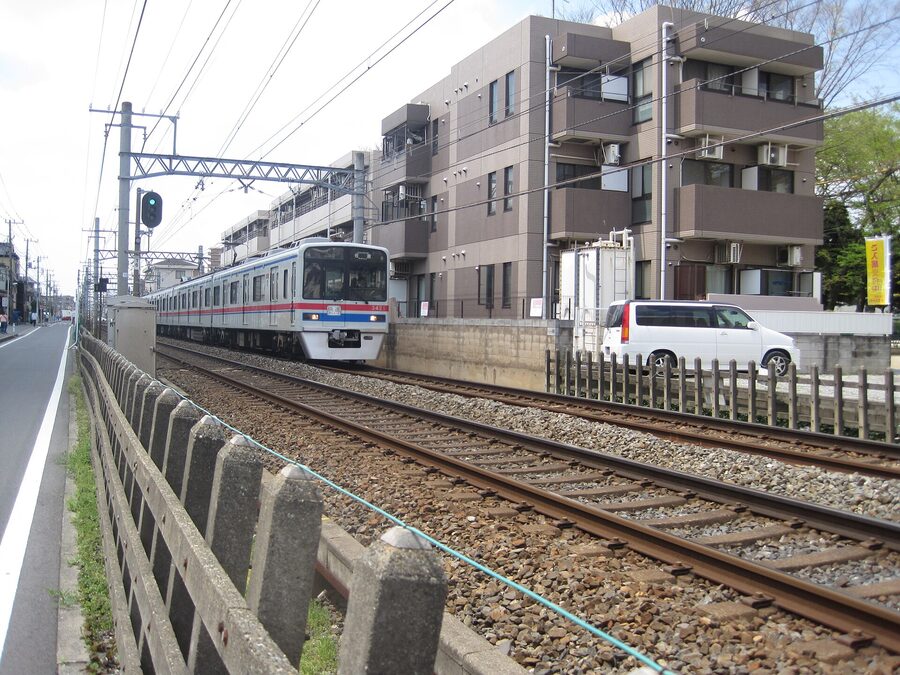
Keisei announced the 3200 series in early 2025 as a replacement for the older end of the commuter fleet (read: the 3500 and the 3600). The first units entered service in 2025 and a 4-car set is being delivered to Shibayama Railway from April 2026 to replace the 3500 currently leased there. The 3200 is the next train to look out for at Aoto in 2026 and 2027; specifications closely mirror the 3100, with a tighter focus on commuter routes that do not need the airport luggage spec.
The Sky Access Line and what 160 km/h actually buys
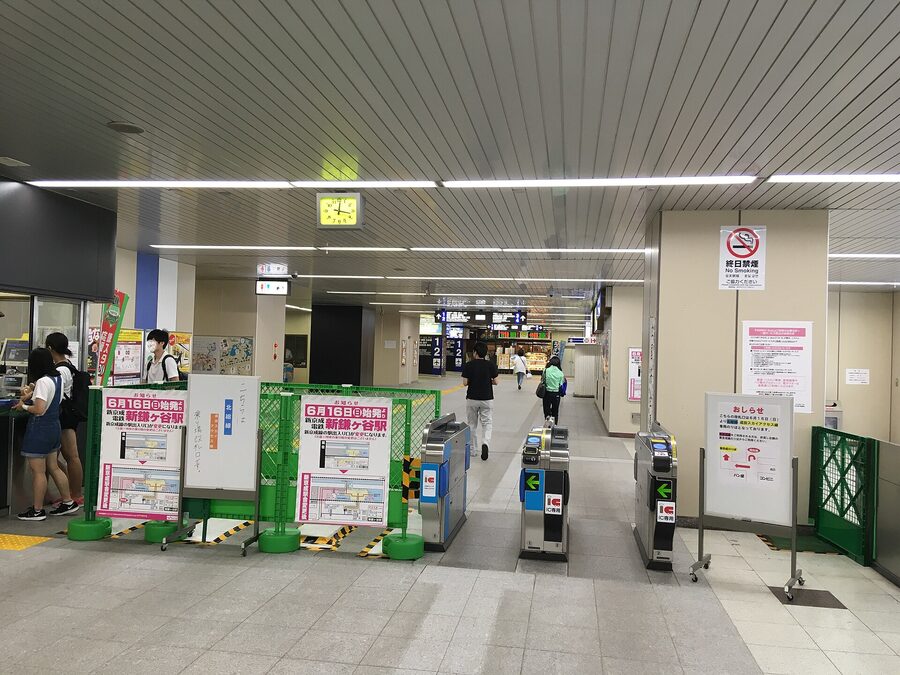
The Sky Access opened on 17 July 2010 as Keisei’s third bid at fixing the Narita-to-Tokyo problem. The first bid was the original 1978 Main Line route, which ended at Higashi-Narita, a kilometre from Terminal 2; the second was the 1991 underground tunnel under the airport itself, which got the train to the front door but added the slow run through Funabashi and Narita on the Main Line. The Sky Access was a new line to bypass the slow section: 51.4 km from Keisei-Takasago to Narita Airport Terminal 1, of which 19.1 km was new track on the cancelled Narita Shinkansen alignment, and 32.3 km was upgraded Hokuso Line trackage already in place since 1991.
The route, the operators, and the layered ownership
The Sky Access is, like several Japanese third-sector projects, owned and operated by different companies on different sections. Keisei runs the trains end to end. The track is owned, by section, by the Chiba New Town Railway, the Narita Rapid Rail Access, and the Narita Airport Rapid Railway. JR East owns one short section as a Type 2 carrier, which is why a JR Narita Express runs alongside the Skyliner for the last two stops into the airport. The line cost about ¥126 billion to build, of which the new-build 19.1 km accounted for the bulk.
What 160 km/h actually saves you
The fastest Skyliner does Nippori to Narita Airport Terminal 2·3 in 36 minutes. The same trip on the old Main Line route via Funabashi was 51 minutes. So the Sky Access saves 15 minutes outbound. On the Tokyo end you arrive at Nippori, where the Yamanote Line is across the platform. The total Tokyo Station-to-Narita-Airport door time using the Skyliner is roughly 50 minutes including the change.
Compared to the JR Narita Express the saving is bigger than the timetable suggests. The Narita Express runs every half hour, costs ¥3,070 reserved for an Ofuna-bound train via Tokyo, takes 53 minutes nominal Tokyo to Airport Terminal 2 but loses 5 to 8 minutes to JR’s signalling on the Sobu Line in mid-afternoon, and runs on JR’s much busier track that does not give it priority over commuter trains. The Skyliner runs every 20 minutes between 07:30 and 22:30, costs ¥2,580 plus ¥272 base fare so ¥2,852 total Nippori to Airport Terminal 2·3, and arrives on time within a minute almost without exception. If you have a JR Pass already, take the Narita Express. If you do not, take the Skyliner. The arithmetic is not subtle.
Where the Access Express comes out ahead
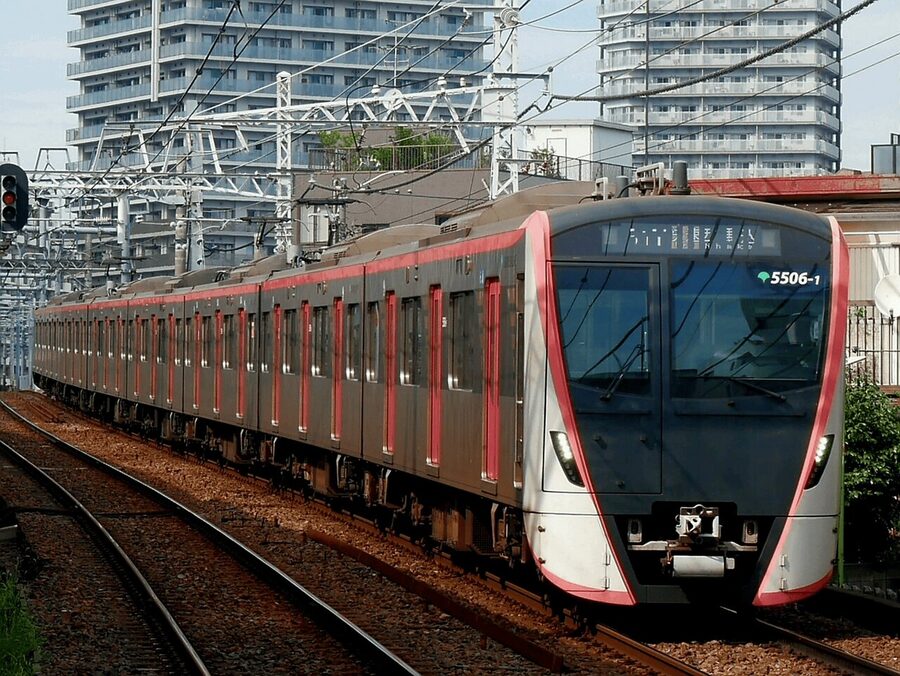
The Access Express is the secret of the Keisei system, and it is also the slowest of the Sky Access services on paper. 64 minutes Nippori to Airport Terminal 2·3, against the Skyliner’s 36. But it does two things the Skyliner does not. First, it accepts an IC card without an extra surcharge, which means you walk on at Nippori, sit down, and walk off at Higashi-Ginza or Asakusa or Nihombashi without ever queuing at a ticket counter. Second, it through-runs to the Toei Asakusa Line and on into the Keikyu Main and Airport Lines, which means a single Access Express can take you from Narita to Haneda in 92 minutes for ¥1,850. There is no faster public-transport option between the two airports. Even the Limousine Bus, in light traffic, takes 75 minutes; in actual Tokyo traffic, the Bayshore Route can add an hour at any given moment.
The frequency is the catch. Access Express runs at one to two trains per hour from the airport, against three per hour for the Skyliner. The first train from Terminal 1 reliably has seats; from Terminal 2·3, the queue can mean standing for the first twenty minutes. If you are doing it as a salaryman with a Suica and no luggage, the Access Express is the quiet, cheap, frictionless answer. If you have three suitcases, the Skyliner is worth the surcharge.
Through-running: how a Keisei train ends up in Yokosuka
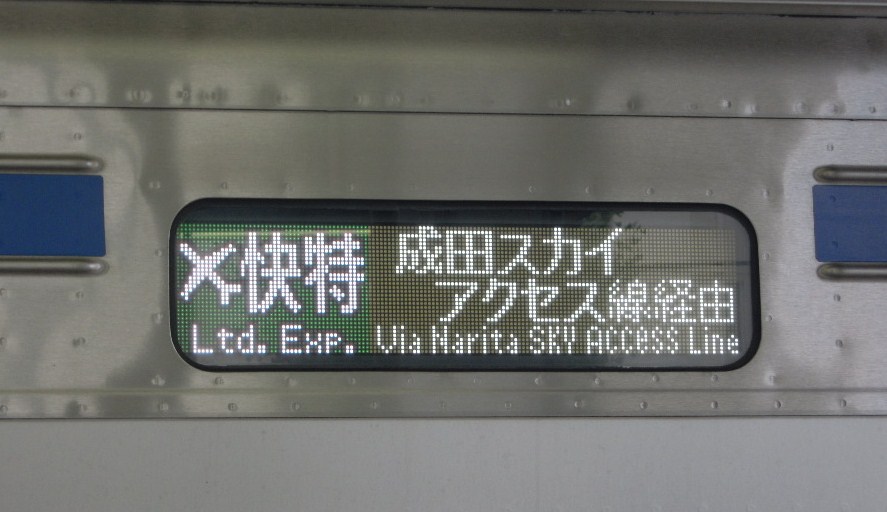
Through-running is what makes the Tokyo private network the Tokyo private network. The Toei Asakusa Line agreement, signed in 1960 and still running today, is the oldest such arrangement in Japanese rail history. Keisei was the first private operator to do it, ahead of Tokyu, Tobu, and the Tokyo Metro lines. The arrangement is the reason Keisei adopted 1,435 mm gauge in the first place: the Asakusa Line is 1,435 mm because Keikyu was 1,435 mm, and the Toei contract required everyone playing on the line to share a gauge.
The four-railway alliance
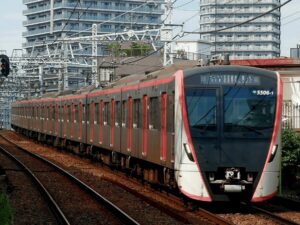
Through-running on the Asakusa Line involves four operators sharing one set of tracks: Keisei, Hokuso, Toei, and Keikyu. Each has its own commuter rolling stock, each is interoperable, and the formal name for the spec is the “Asakusa Line through-running standard”. Toei 5500 series, Keikyu 600 series, Keikyu N1000 series, Keisei 3000 series eight-car sets, Keisei 3100 series, Keisei 3700 series, and Hokuso 7300 / 7500 / 9100 / 9200 / 9800 trains all run together on the same diagram. A trainspotter at Sengakuji on a weekday morning can document twelve different liveries inside an hour without leaving the platform.
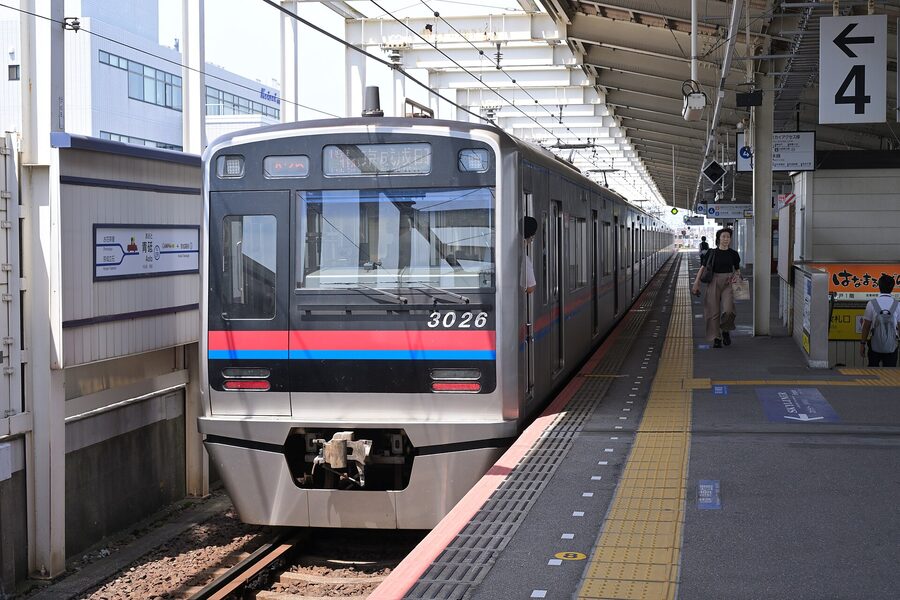
Aoto: the diagram, in real life
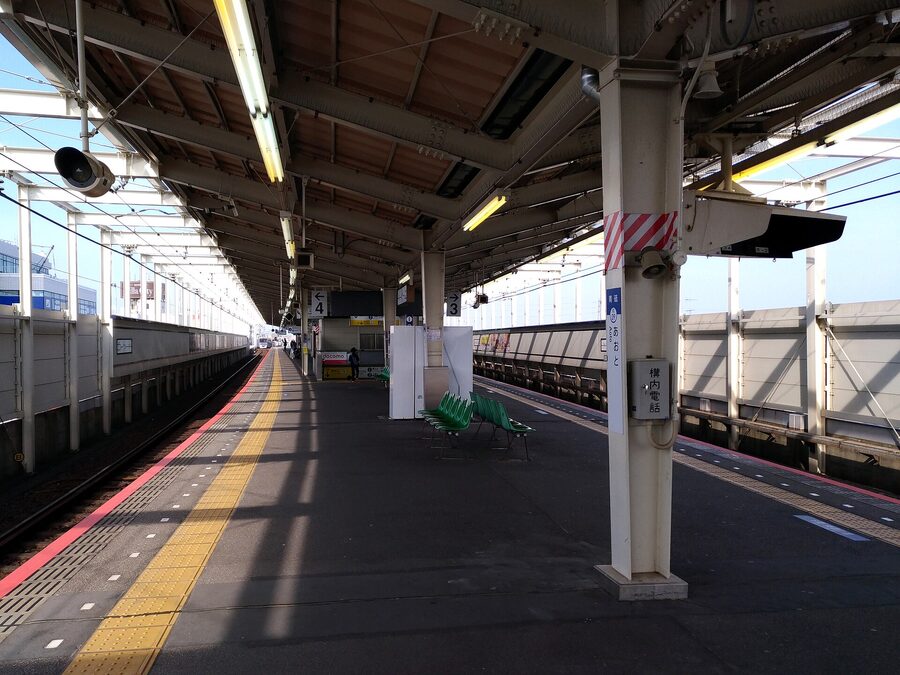
Aoto is where the network’s geography becomes physically obvious. The Main Line comes in from the east, the Oshiage Line peels off west towards the Toei tunnel, and the Sky Access continues straight through Takasago. A 3000 set bound for Misakiguchi will be on platform 1; a 3700 bound for Imba-Nihon-Idai will be on platform 2; the next Skyliner will hold platform 3 and not stop. If you have only twenty minutes at Aoto, stand at the Takasago end of platform 4 and watch the Skyliner come in: it slows from 110 km/h on the Main Line approach, holds at platform-side maybe 18 km/h while passing, then accelerates onto the Sky Access flyover and is away to Narita with a power-electronic note that nothing else in the fleet quite matches.
Aoto stops on the Skyliner: a recent change
From 11 April 2020, Keisei added an Aoto stop on selected Skyliner services to give passengers a connection to the Oshiage Line, the Toei Asakusa Line, and the Keikyu services towards Haneda Airport. The pattern as of late 2022: Narita-bound Skyliners stop at Aoto once an hour from 07:35 to 16:33, Ueno-bound Skyliners from 10:50 to 18:50 and on every train after 21:00. From 26 November 2022 a similar arrangement added Shin-Kamagaya as a Skyliner stop, on the same set of trains. If you are travelling to Asakusa from the airport and the Skyliner you have just bought a ticket for is one of the Aoto-stopping ones, get off at Aoto and switch to the Asakusa Line direct. The connection is across the platform.
The lines, the stations, and where the system meets the city
The Main Line: 67.2 km, the original spine
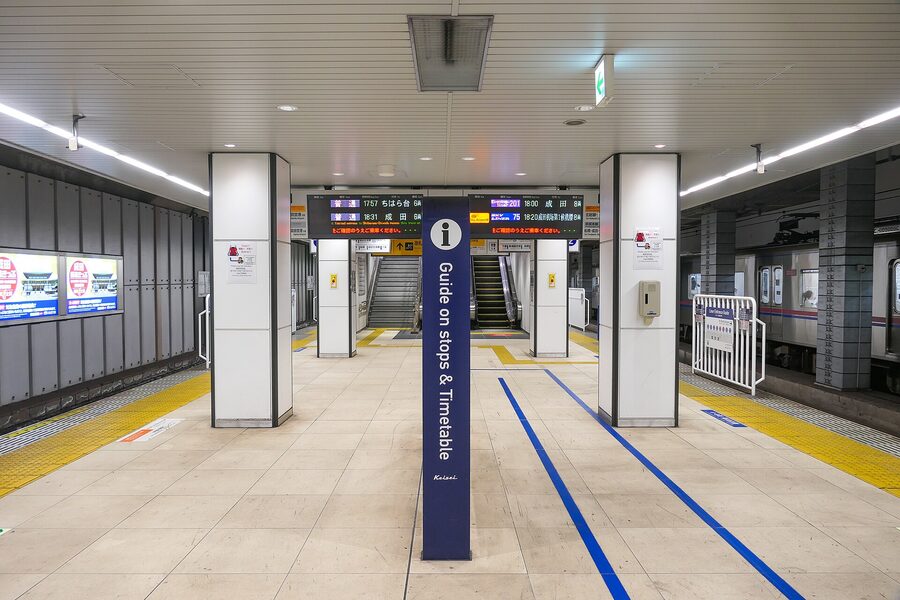
The Main Line runs 67.2 km from Keisei-Ueno to Komaino Junction near Narita, plus a 2.1 km Type 2 segment from Komaino Junction to Narita Airport Terminal 1. It opened in stages from 1912 onwards, reached Narita in 1930, and reached Ueno in 1933. Until 2010, every Skyliner ran on it. After 2010, the Skyliner was diverted to the Sky Access and the Main Line was left with the Morningliner, the Eveningliner, the rapid limited expresses, and the local commuter services.
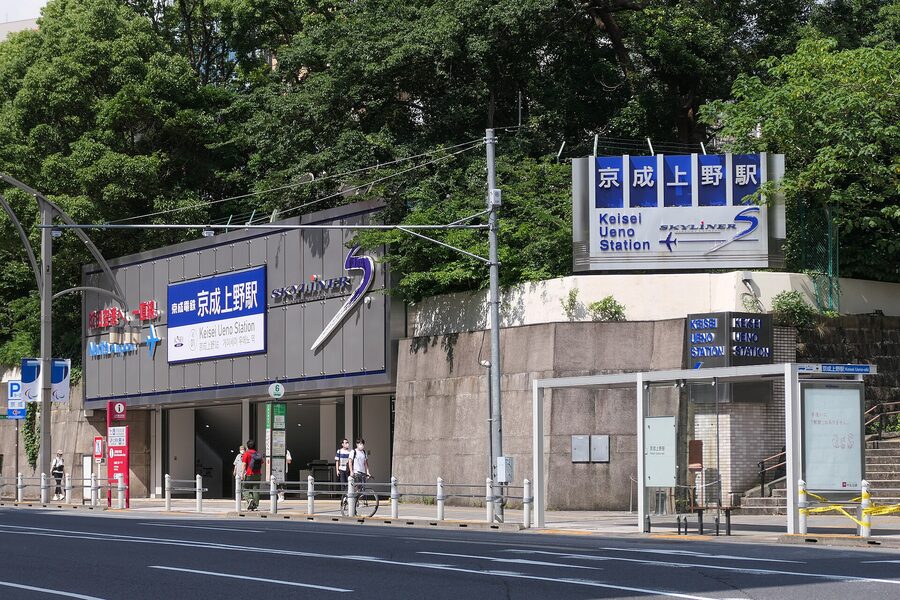
Nippori: the actual Tokyo terminus, in practice
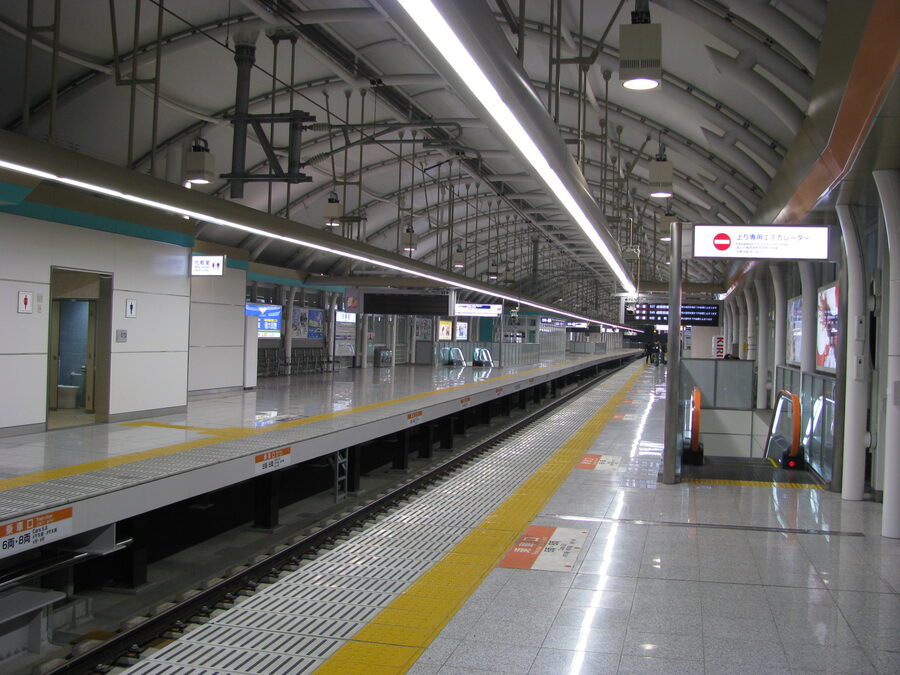
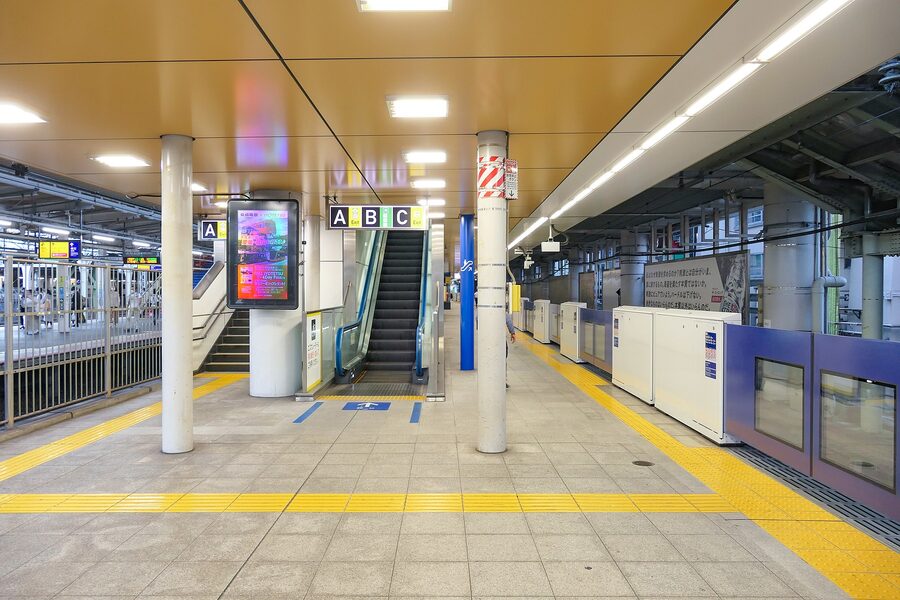
Nippori is where the Skyliner actually empties out. Keisei-Ueno is the legal terminus, but Nippori is one stop closer to the Yamanote Line in the direction most travellers want to go: south to Tokyo Station, east to Akihabara, west to Shinjuku and Shibuya. The walk from the Skyliner platform to the Yamanote platform is around 90 seconds, including the gate scan. Most foreign tourists buy through to Keisei-Ueno and then stand up at Nippori; if your hotel is anywhere on the Yamanote, this is where you get off.
Keisei-Funabashi: the Chiba interchange
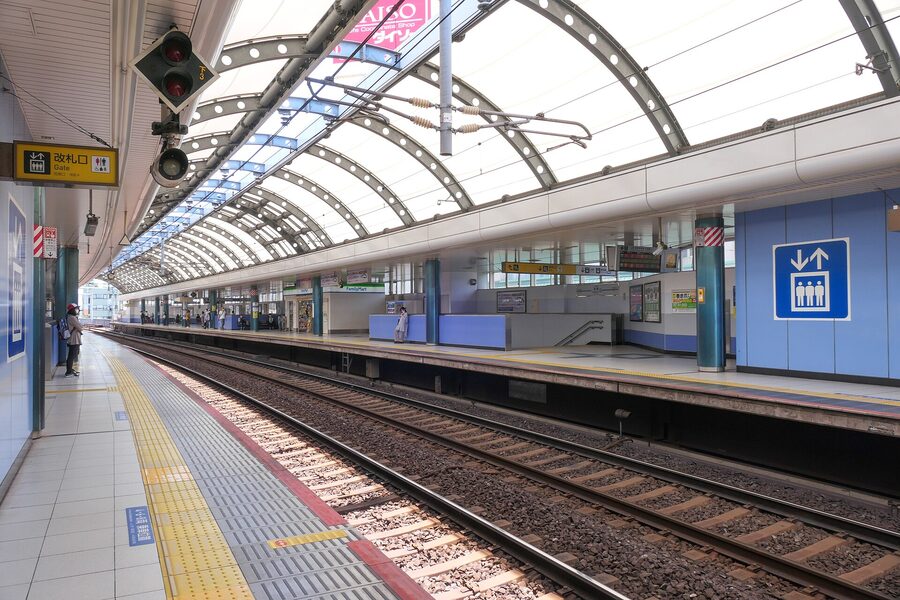
Keisei-Funabashi handles around 100,000 boardings a day and is the largest non-Tokyo station on the network. Most rapid limited expresses stop here, and from December 2006 some Skyliners did too, although the 2010 Sky Access opening removed all Skyliner service from the Main Line. The station sits about three minutes’ walk from JR Funabashi on the Sobu Line, which is one of the better cross-line transfers in eastern Tokyo.
Aoto, Takasago, and the gauntlet at Komaino
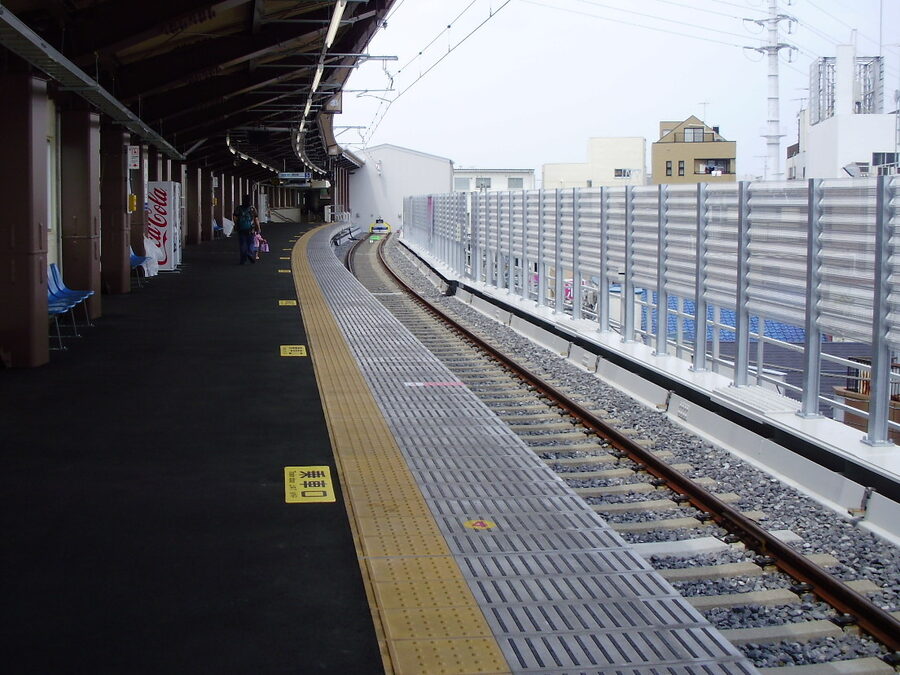
Takasago is the formal junction between the Main Line and the Sky Access. From a passenger perspective Aoto is more relevant, because that is where the through-running trains from Toei and Keikyu enter the Keisei timetable. But Takasago is the legal switching point: the Sky Access tracks owned by Chiba New Town Railway start at Takasago, the Main Line tracks owned by Keisei continue east. Komaino Junction, three stops further on near the airport, is where the two lines reunite into the airport approach.
Higashi-Narita: the airport station that is not the airport station
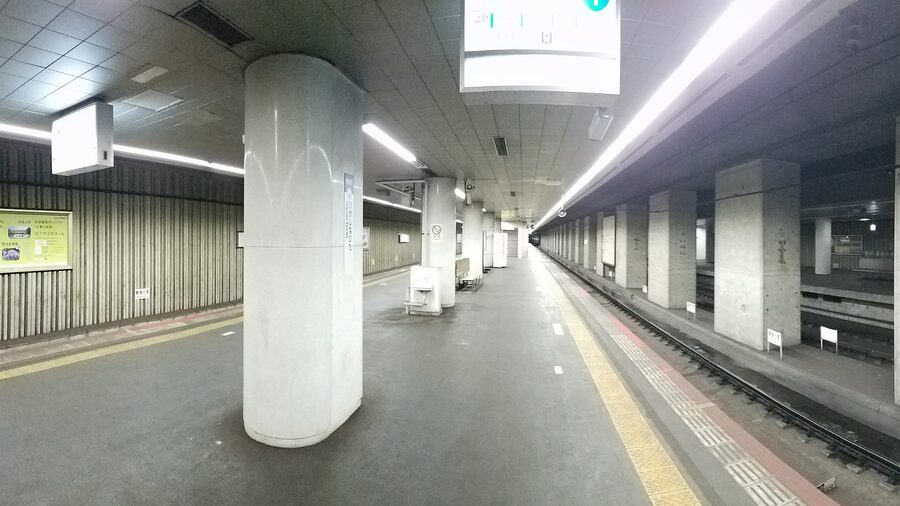
Higashi-Narita is the historical curiosity. From 1978 to 1991 it was Narita Airport Station, full stop; passengers got off here and took a free shuttle bus the kilometre or so to Terminal 1 or Terminal 2. After the underground extension to the airport in 1991, the station was renamed Higashi-Narita and the shuttle was withdrawn. It now serves the small Higashi-Narita Line, a 7.1 km branch from Keisei-Narita that connects to the Shibayama Railway, plus a short underground passageway into Terminal 2 that you can use as a luggage-friendly walk if you happen to be passing.
Fares, tickets, and the practical question
Skyliner: how to actually buy one
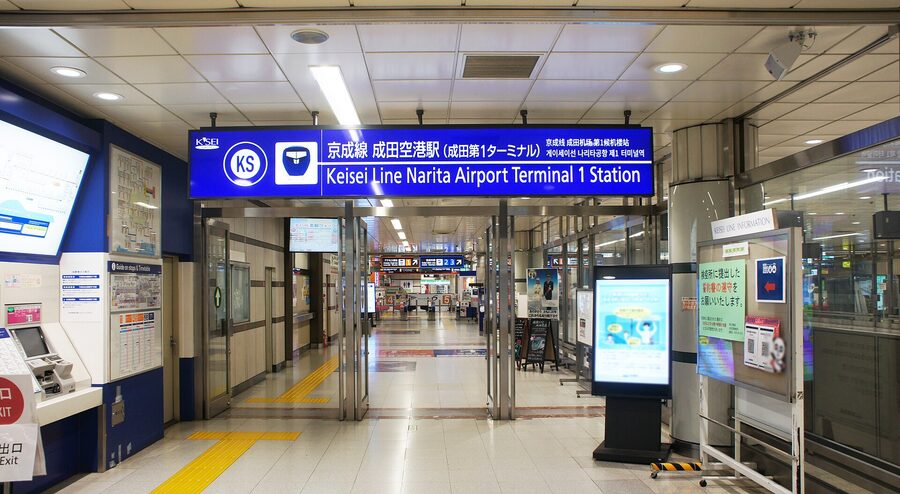
The Skyliner fare is ¥2,580 for the limited-express surcharge, plus ¥272 base fare on top, total ¥2,852 from Nippori or Keisei-Ueno to Narita Airport. The Skyliner e-ticket sold to foreign passport holders ahead of arrival is cheaper, ¥2,300 one way or ¥4,480 return; you redeem it at the dedicated counter on Terminal 1 basement, or you tap your booking QR through the e-ticket gate. From late 2024, Keisei has run a face-recognition system called “Skyliner e-ticket Face Check in Go” that cuts the boarding queue significantly. Of the three options, the e-ticket return is meaningfully better value than the round-trip walk-up.
Access Express: an IC card and you are done
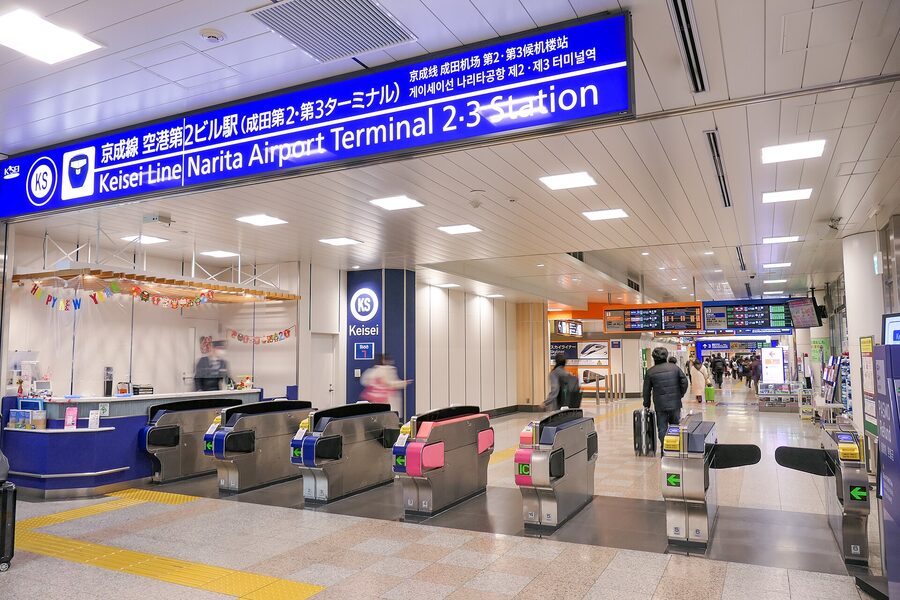
The Access Express does not require a paper ticket. From Narita Airport Terminal 2·3 to Nippori, an IC card pays ¥1,280 (paper ¥1,280, no IC discount on long Keisei runs). From the same Terminal to Asakusa, the fare is ¥1,490 IC. From Terminal 2·3 all the way through to Haneda Airport on the through-running service, the fare is ¥1,850 IC, paid through a single tap-in at Narita and a single tap-out at Haneda.
The Mobile Suica app, which Apple Wallet on iOS and Google Pay on Android both support, is the cleanest way to pay for the Access Express if you are travelling in 2026. You set it up before you fly, charge it from a foreign credit card, and tap your phone at the Keisei gate. The Mobile Pasmo app does the same job and works at exactly the same gates.
Morningliner and Eveningliner: the commuter Skyliner
The Skyliner has two cousins on the Main Line that the Sky Access does not touch. The Morningliner runs Tokyo-bound from Narita Airport in the morning peak; the Eveningliner runs Narita-bound from Tokyo in the evening peak. Both use the AE form, both stop at every major station along the Main Line, and both charge a flat ¥420 reserved-seat supplement on top of the base Keisei fare. They are the train you take if you live in Yachiyodai or Sakura and work in central Tokyo, and they are basically the only situation where a foreign tourist might genuinely benefit from the limited-express service to a non-airport stop.
The discount tickets that actually save money
Keisei sells two foreign-tourist combo tickets that earn their place. The Skyliner + Tokyo Subway 24/48/72-hour pass bundles a Skyliner one-way with the Toei + Tokyo Metro flat-fare pass; if you were going to buy both anyway, the saving is roughly ¥500 on the 24-hour pass and more on the longer ones. The Greater Tokyo Pass is a 3-day flat-fare pass on every Kanto-area private operator and tram, including all of Keisei: ¥7,200 for the train-and-bus version. It is good only if you are doing a heavy Tokyo private-railway tour with multiple operators in three days; it is overkill for an airport-only trip.
Reading the destination board: a quick decoder
The Keisei destination signage uses colour codes that map onto the service tiers. White-on-blue is the Skyliner. White-on-orange is the Access Express. Red is the rapid limited express on the Main Line. Yellow is the regular limited express. Green is the rapid. Plain white is a local. The Toei and Keikyu trains coming through Asakusa Line keep their own through-running liveries, so a 600 series in Keikyu red can sit on the same platform as a Keisei 3000 in white-and-blue and both might be heading to Narita Airport.
The “via” question
The single most important word on a Keisei destination board is “via”. A train to Narita Airport via Sky Access uses the new line and the high-speed track. A train to Narita Airport via Funabashi uses the Main Line and is twenty minutes slower. From central Tokyo, both are signed for “Narita Airport”. You read the small print to find out which way it is going. Skyliner-only is not a thing here; some commuter services are signed Sky Access from Aoto and these are the ones you actually want.
The Matsudo Line and the 2025 absorption
From 1 April 2025, Keisei absorbed Shin-Keisei Electric Railway, the long-time subsidiary that operated 26.5 km of track north of Funabashi. The line was rebranded the Keisei Matsudo Line on the same day. Four Shin-Keisei rolling-stock types came across in the merger: 8800 series, 8900 series, N800 series, and 80000 series, mostly built between the late 1980s and 2019. They keep the lavender Shin-Keisei livery for the moment, although that will change. From a passenger perspective the practical effect is mostly about ticket interchanges; the Matsudo Line now accepts Keisei IC fares and Keisei discount passes that previously required two transactions.
If you are riding the Skyliner once: my standing recommendation
Take the Skyliner outbound from Narita to Nippori. Buy the e-ticket online before you fly. Sit on the right-hand side of car 1 or car 2 if you can, because the Sky Access flyover gives you a long view across the airport perimeter and the rice fields east of Inba; the left side faces back over Chiba New Town and is mostly suburb. Reserve any car except 4 and 5; car 4 has the vending machine and the foot traffic, car 5 has the toilet. If you have heavy luggage, board car 1 or car 8, which have the deepest end-of-car luggage racks; the middle cars have only narrow shelves above the seats.
For the return trip to the airport, if you are flying out of Narita on the morning of the next day, take a normal Access Express the night before and pre-clear at the airport hotel. The morning Skyliner from Ueno fills up with cherry-blossom-season tour groups in late March and early April, and that is the one departure of the day where the e-ticket reservation will not save you a queue.
If you are travelling to Asakusa, Nihombashi, Higashi-Ginza, or Shimbashi, do not buy a Skyliner at all. Tap a Mobile Suica at Terminal 1 and ride the Access Express straight through the Toei Asakusa Line to your stop. You will save ¥1,572, you will not change trains, and you will arrive twenty minutes later than the Skyliner-and-subway combination. Twenty minutes is the cost of avoiding a queue, a transfer, and a paper ticket. On any reasonable travel day it is worth it.
Cross-references
This article is the rolling-stock-and-fares half of the Keisei coverage. The history of the operator, including the gauge change, the airport opening, and the Sky Access genesis, sits on the companion piece about the operator’s decisive eras. The sister piece on Keikyu, which covers the Haneda end of the same airport-to-airport circuit, is at Keikyu trains; the matching Keikyu history piece is here. The Toei Asakusa Line, which Keisei pioneered through-running with in 1960, is covered in the Toei rolling-stock article. For comparison with the other Tokyo private operators, the matching Odakyu, Tobu, and Keio rolling-stock pieces are the natural companions.
The JR Narita Express, which is the Skyliner’s only meaningful competitor between the airport and central Tokyo, is rolled into the JR East rolling-stock piece; the Tokyo Metro lines that the Toei Asakusa Line interfaces with on the city side are at Tokyo Metro trains.
Aoto, again
Back to Aoto. The 16:42 Access Express I started this article on departs every weekday afternoon. It has stopped at platform 4 for thirty seconds, picked up the airport-bound salaryman with one cabin bag, and now it is pulling away west onto the Sky Access flyover. Two minutes behind it, on platform 3, the Skyliner is just clearing the platform too, doing maybe 18 km/h, the AE driving cab silent and the air-conditioning lit yellow against the platform tile. Both will arrive at Narita Airport Terminal 1 within a minute of their booked time. One will charge ¥2,852 for the privilege, one will charge ¥1,280, and the difference between them, in the end, is twenty-eight minutes and a queue. Pick the train that is right for the day. Then go and find your seat.


_cabin.jpg)
_seat.jpg)
_luggage_space.jpg)

_deck.jpg)

.jpg)


.jpg)


