
Tobu Railway: How One Family Built Kanto
In 1905 the Tobu Railway Company was, by its own subsequent admission, a mess. The line ran 39.9 km from Kita-Senju up to Kuki and not much further. Twelve British steam locomotives ordered from Beyer, Peacock & Co. of Manchester were finally hauling freight and the occasional passenger, but the company had failed to extend the concession to Ashikaga the way the original 1895 plan had promised, the receipts were terrible, and the share price was poor enough that contemporaries were calling it the “blank-paper company” (空引会社, karahiki gaisha). Then a 45-year-old former village headman from Yamanashi, with an instinct for buying broken corporations, took 780 shares and the chairman’s seat, and almost everything that Tobu does today flows from what he did next.
In This Article
- Why Tobu is its own kind of operator
- The two networks that don’t connect
- The number that explains the rest
- The 1906 escape
- What Nezu did with his second chance
- The piece that went missing: the Saitama gap
- The day Asakusa Station opened, with a department store on top
- The terminal department store, made up by Tobu
- The Nikko Line and a railway-versus-railway war
- Why JNR cared about a private operator
- The first DRC and the response from Ueno
- The 1720 DRC: the train that decided the Nikko market
- The wartime decade and the consolidations Tobu came out with
- Three absorbed operators that became today’s Tobu lines
- The bombing that took out the Asakusa side
- 1946 to the 1980s: the long unfashionable middle
- Through-running with the Hibiya Line, 1962
- Asakusa to the four-track suburbs
- The 8000 series and the workhorse decade
- Real estate becomes the engine
- 1990: the Spacia and the start of Tobu pulling its weight
- The 1990 decisions that mattered most
- The Skytree gambit
- The financing nobody else could have done
- Why the line got a new name
- Riding Tobu today: where to actually start
- The Spacia X, if you can get a seat
- The original 100 Spacia, while you still can
- The 500 Revaty for the Aizu through-runs
- The SL Taiju at Kinugawa
- The TJ Liner on the Tojo side
- The Hibiya Line through-runs from Kita-Senju
- The 2020s and the new generation
- The fleet replacements quietly underway
- The 6050 Nikko stock and the long phase-out
- Where Tobu sits in the Tokyo private-rail landscape today
- What Tobu actually owns now
- Through-running, the metric that matters most
- What Nezu actually built
- The institution as a portrait of the man
- The closing scene at Asakusa
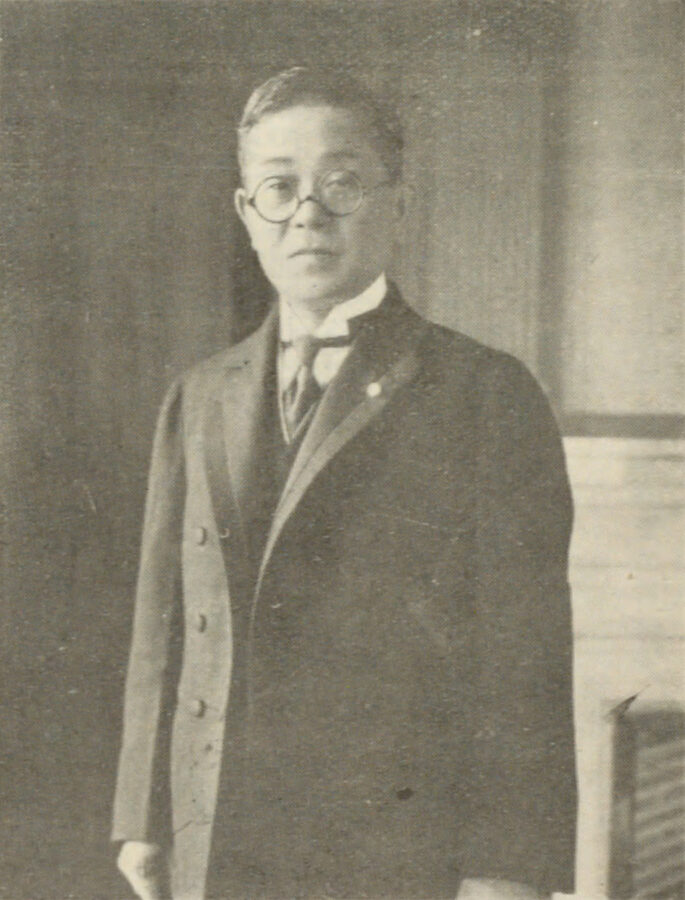
That man, Nezu Kaichiro, the contemporary press knew as 鉄道王 (the railway king) when they were being polite and ボロ買い一郎 (Junk-buyer Ichiro) when they weren’t. He held interests in 25 separate railway companies in his lifetime; Tobu was the one he chose to actually run. He held the chairmanship until he died in 1940. His son inherited the role in 1941 and held it for 52 years and 12 months, the longest tenure ever recorded for a CEO of a Tokyo-listed company. By the time the family stepped back from operational leadership in 2023, the Nezus had run Tobu for 118 of its 126 years. None of the other big Kanto private operators have anything like that continuity, and it shows in the company.
Why Tobu is its own kind of operator
The first thing to know about Tobu Railway Co., Ltd. is that almost every comparison with the other Tokyo-area private railways breaks down somewhere. Tobu is not Odakyu (one core line, one famous limited express, a Hakone marketing engine). It is not Tokyu (real-estate developer that happens to run trains in southwest Tokyo, see Tokyu’s railway-as-property-arm history for the contrast). It is not Keio (commuter spine into Shinjuku, neat and self-contained, see the Keio history). Tobu is the largest of them by route length, 463.3 km across one metropolitan prefecture and four neighbouring ones, second-longest of any non-JR operator nationwide after Kintetsu. And it is the oldest of them by registration date: founded as Tobu Railway Co. on 1 November 1897, never renamed in the 128 years since.
The two networks that don’t connect
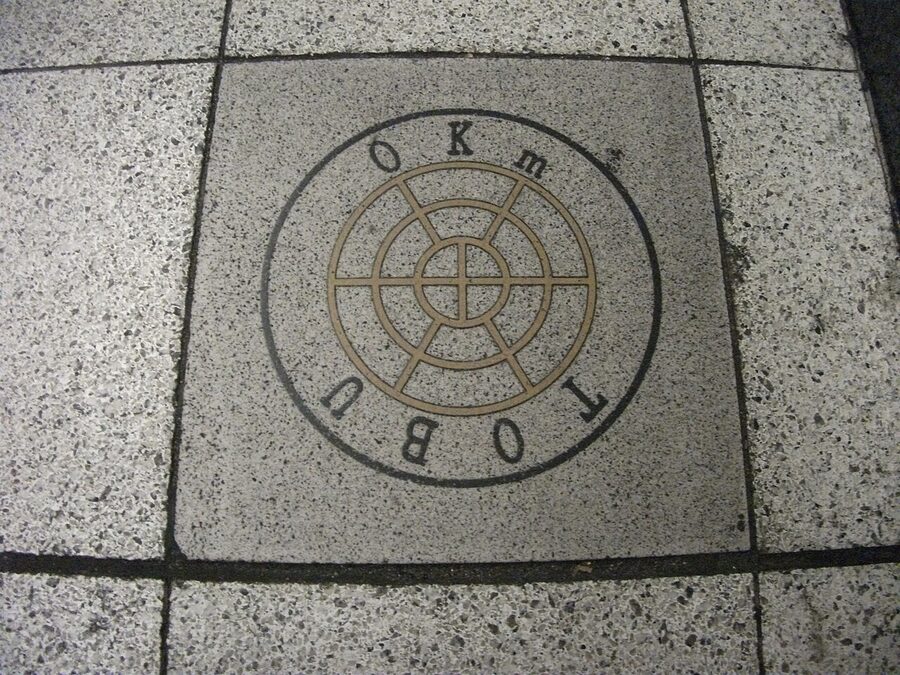
The route map looks like two operators glued together, because it is. Tobu’s “Main Line” group, anchored on the Isesaki Line out of Asakusa with the Nikko, Noda, Kinugawa, Kameido, Daishi, Sano, Kiryu, Koizumi, and Utsunomiya branches off it, came from the original 1897 Honjo-to-Ashikaga concession. The “Tojo Line” group, anchored on the Tojo Honsen running 75.0 km from Ikebukuro to Yorii with the Ogose branch, came from a separate 1911 company called Tojo Railway that opened Ikebukuro–Tamenosawa in May 1914. Tobu absorbed Tojo on 27 July 1920 in what remains the only equal merger in Tobu’s history.
The two networks have never been physically connected. To this day, Tojo Line stock that needs maintenance at the South Kurihashi works runs over the Chichibu Railway main line through Yorii to get to it, hauled at the front by a Chichibu electric locomotive, because Tobu’s own internal rails do not link the two halves of its own railway. A staff division ran out of West Ikebukuro until 2015 to keep the Tojo administratively separate from the Main Line. Decades after the merger, the Tojo Line still uses different limited express ticketing rules than the Main Line. The TJ Liner reserved-seat product on the Tojo Line, for example, takes a flat ¥510 or ¥660 supplement; the Main Line’s specials charge fares calculated on a different table.
The number that explains the rest
Tobu’s longest CEO ran the company for nearly 53 years. That is unusual to the point of being structural. While JR East, Tokyu, Odakyu, and Tokyo Metro cycled through five or six chief executives between 1941 and 1994, Tobu had one. Nezu Kaichiro II’s tenure, 1 July 1941 to June 1994, covered the GHQ occupation, the post-war reconstruction, the Showa boom, the bubble, the bust, and the first murmurings of the revival. The strategy changes that the rest of the Tokyo private-rail industry made in stop-start chunks under different leaders, Tobu made on one consistent through-line. That is why the company often looks slow, and why when it finally moves, it moves on a 30-year timeline rather than a five-year one.
The 1906 escape
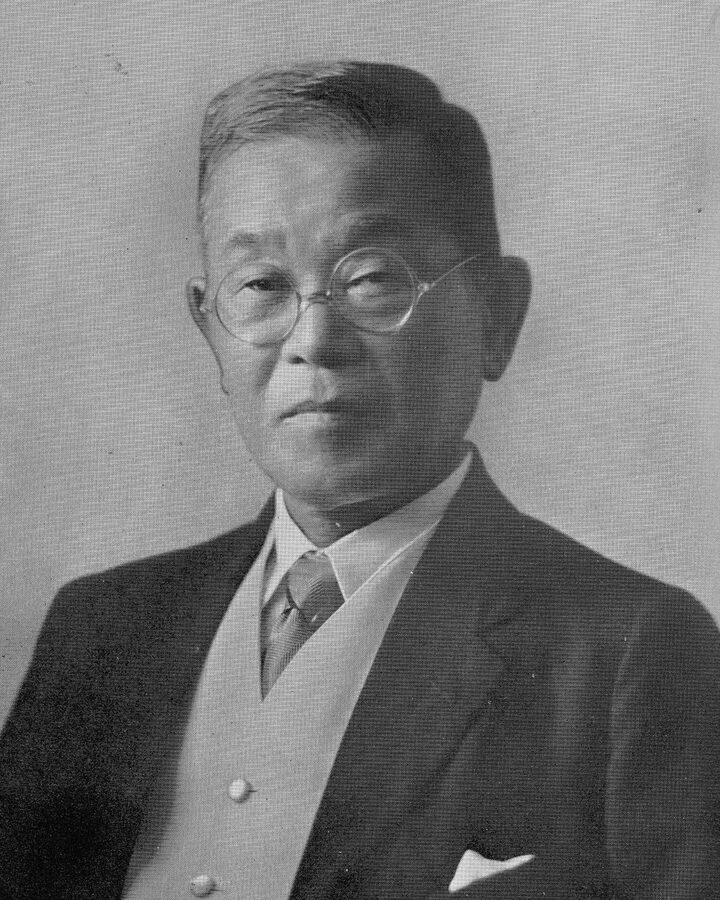
The single most consequential year in Tobu’s existence is probably 1906, and the consequence was that nothing happened. The Imperial Diet was passing the Railway Nationalisation Act (鉄道国有法), which by that December would put 17 private railways and roughly 4,800 km of track under state ownership and create the institutional ancestor of today’s JR network. The original House of Representatives version of the bill, passed on 16 March, included Tobu in the schedule of companies to be bought out.
Nine days later, on 25 March, the House of Peers (the upper house) amended the schedule, and Tobu came off the list. The bill was promulgated in that form. Out of the 17 nationalised railways, the survivors were the operators the upper house decided were too short, too local, or too commuter-suburban to be worth swallowing. Tobu was kept. Without that amendment, none of what follows in this article would have happened: no Nezu dynasty, no Asakusa terminal building with the Matsuya department store inside it, no Spacia, no Skytree.
What Nezu did with his second chance
Nezu had taken the chairmanship just months earlier, in October 1905, with the company in receivership-grade trouble. The freight terminus in 1899 had stopped at Kuki, the company had run out of money to push the line further north, and revenue per train-kilometre was so weak the contemporary press joked that Tobu’s stock certificates were as good as blank paper. Nezu’s response was simple in the way the early-twentieth-century railway barons could be: extend the route until it pays.
The Kuki–Kawamata segment opened in April 1903, taking the line up another 12.1 km. By August 1907 he had pushed it 16.3 km further, finally connecting to Ashikaga the way the original 1895 application had specified. Freight, mostly silk, copper from the Ashio mines via the Watarase, and stone from the quarries around Sano, immediately moved off the carts and onto Tobu’s rails. The Asakusa-Kanegafuchi double-tracking project of 1912 doubled the southern volume capacity. By the time the Sano Railway and Ohta Light Railway were absorbed in 1912 and 1913, Tobu had stopped being the kind of company that needed a chairman to bail it out and become the kind that could bail others out instead.
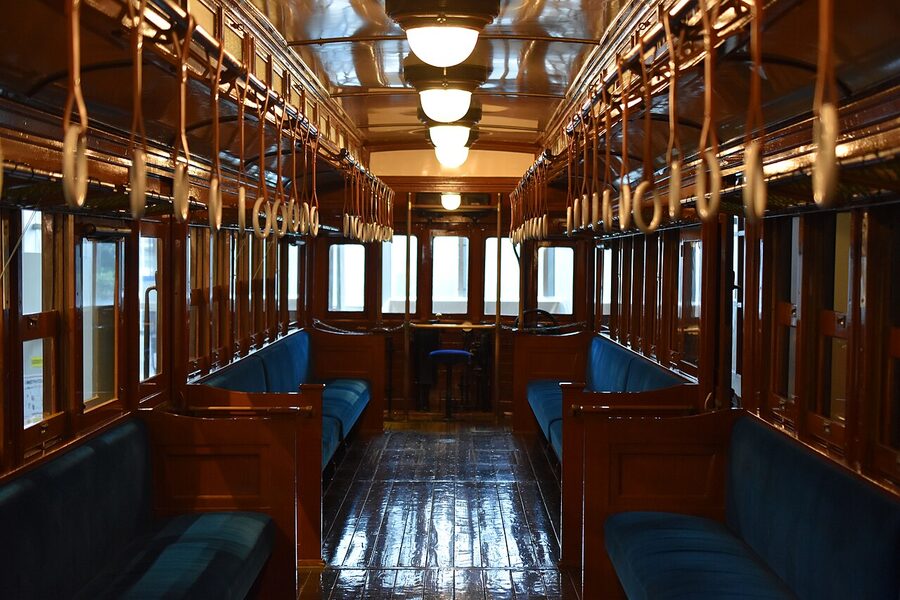
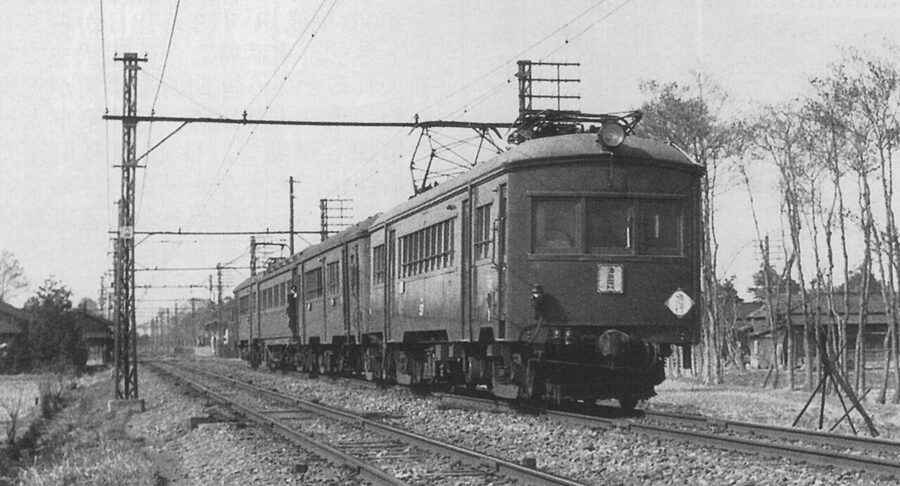
Electrification at the Tokyo end came in October 1924 between Asakusa and Nishiarai, with rolling stock built by Nippon Sharyo classified as the DeHa 1 series. By 1927 the Tatebayashi–Isesaki section was electrified too. Tobu also bought the Tokyo Electric Light Company’s Ikaho Tramway operation in October that year, which gave the company a second-tier business in the Gunma hills that it would run, profitably, until 1956.
The piece that went missing: the Saitama gap
The thing Nezu wanted but could not build was a tram link between Daishimae on the Daishi Line and Kamiitabashi on the Tojo Line, designed to physically connect the two halves of the network for the first time. The route, called the Nishi-ita Line (西板線), was authorised in the 1920s. Construction stalled after the 1923 Great Kanto earthquake redirected reconstruction money. Only the Nishiarai–Daishimae section opened, on 20 December 1931, as a 1.0 km branch. The rest of the route was abandoned in 1932 and the licence formally lapsed in 1937. The two-network shape Tobu still has today is a reconstruction-era accident: a tram line that should have connected them and didn’t.
The day Asakusa Station opened, with a department store on top
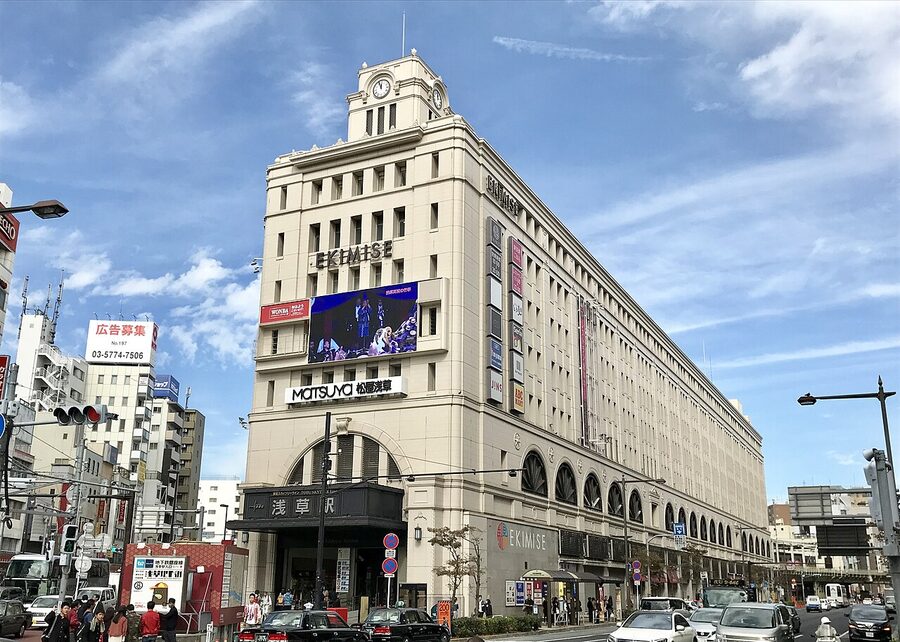
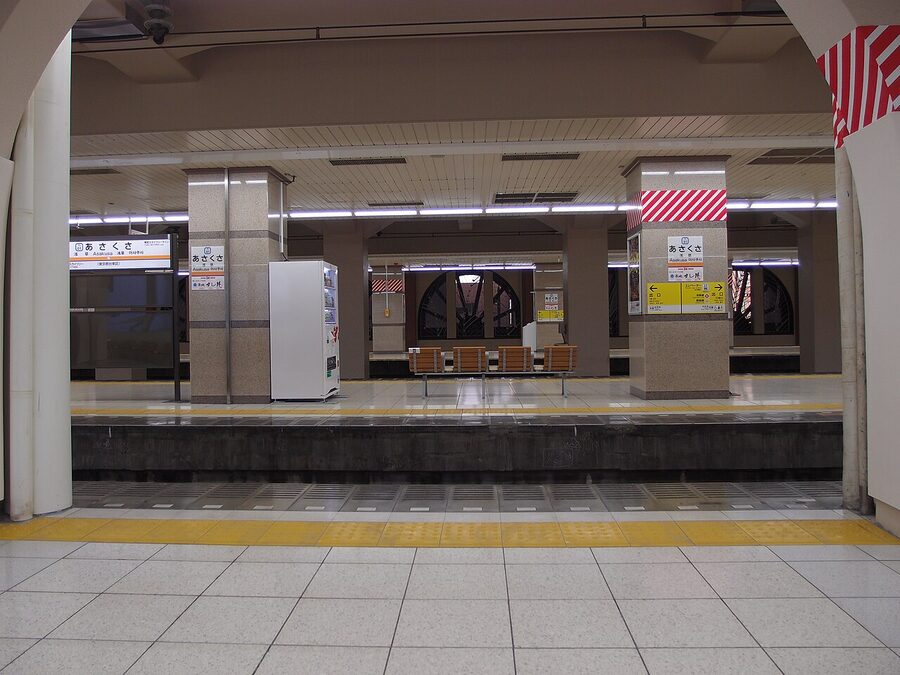
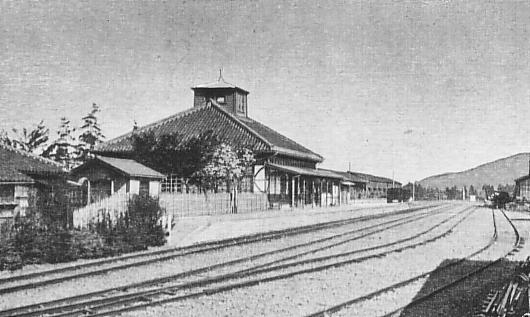
Until May 1931 Tobu’s Tokyo terminal was at Azumabashi (later renamed Narihirabashi, today Tokyo Skytree Station), on the wrong side of the Sumida River for the actual centre of Tokyo. The Asakusa Kaminarimon terminal, opened on 25 May 1931 and renamed simply Asakusa in 1947, finally put Tobu directly into one of the city’s busiest commercial districts. Two days later it connected to the Tokyo Underground Railway’s Ginza Line, the country’s first subway, at Asakusa Station; the Tokyo Underground Railway had been founded in 1927 by Hayakawa Tokuji, a fellow Yamanashi native whom Nezu had personally backed.
The terminal department store, made up by Tobu
The really original idea was what Tobu put on top. The Asakusa terminal building was completed on 1 November 1931 as a multi-storey commercial structure with the train concourse on the ground floor and Matsuya Department Store occupying the floors above. This was Japan’s third terminal-station-as-department-store, after Hankyu’s Umeda (Hakubotan, November 1920) and Ikegami Electric Railway’s Gotanda (Hakubotan, December 1928), but the model has stuck more lastingly to Tobu than to either: Matsuya Asakusa is still in the building, still trading, 95 years on.
The format Tobu refined here, terminal as concourse plus retail plus offices, became the dominant template for Japanese private railway stations and remains so today. Walk through any major private-railway terminus in Tokyo, the Odakyu side of Shinjuku, Tokyu’s side of Shibuya, Keio’s side of Shinjuku, and the building you are walking through is downstream of what Tobu did at Asakusa in 1931.
The Nikko Line and a railway-versus-railway war
Tobu had been in the Nikko business almost from the beginning, but the Nikko Line as it stands today, 94.5 km from the Tobu-Doubutsu-Koen junction in Saitama up to Tobu-Nikko in Tochigi, opened on 1 October 1929. It was, on the day it opened, the longest electrified single-operator passenger service in Japan, the first to run over 100 km of catenary in continuous service. The branch up to Kinugawa via the absorbed Shimotsuke Electric Railway followed in 1943.
Why JNR cared about a private operator
The relevant fact for understanding what Tobu did over the next 30 years is that the Japanese National Railways, the state operator that survived the 1906 nationalisation, also ran a Nikko service, on the Nikko Line out of Ueno via Utsunomiya. Two operators, two routes, the same destination and a steadily growing tourist market: it was the only line-versus-line market battle in Kanto that the state had not nationalised away by some legal manoeuvre. Tobu had to win on service or lose on price, and the trains the company built in the 1950s and 1960s reflect exactly that calculation.
The first DRC and the response from Ueno
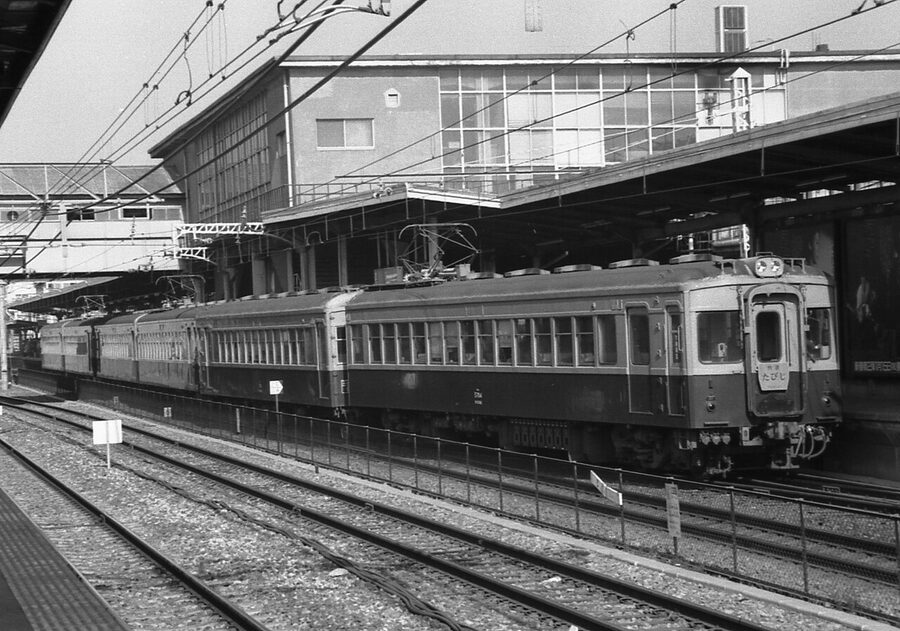
Tobu’s first dedicated Nikko limited express, the 5700 series, entered service in 1951 with crossed seats, chandelier-style interior lighting, and the marketing name “Romance Car” (the Odakyu-trademarked term hadn’t yet been pinned down to a single operator). It cut the Asakusa-to-Tobu-Nikko time to 137 minutes. The JNR competing service from Ueno took roughly 122 minutes. The 1957-build 1700 series brought the Tobu time below two hours for the first time and added Western-style toilets. JNR responded by sending the Romance-Car-1 (later 157) electrification onto the Nikko Line out of Ueno. Tobu replied with the 1720 series.
The 1720 DRC: the train that decided the Nikko market
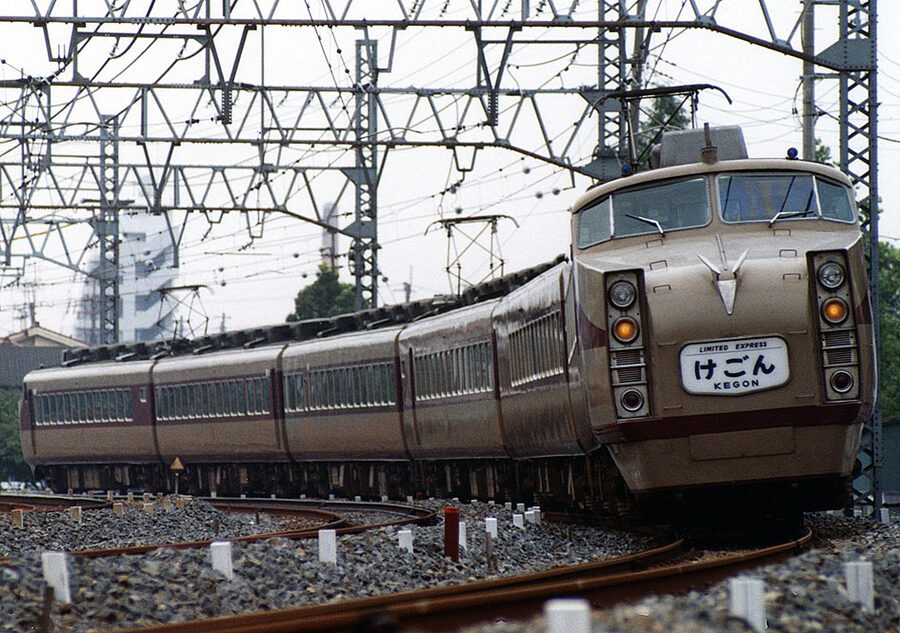
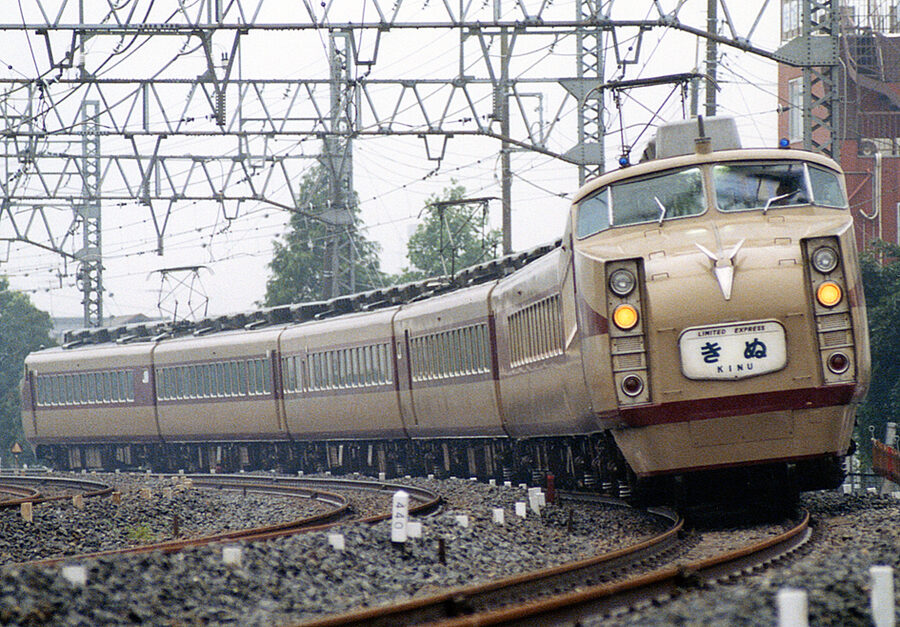
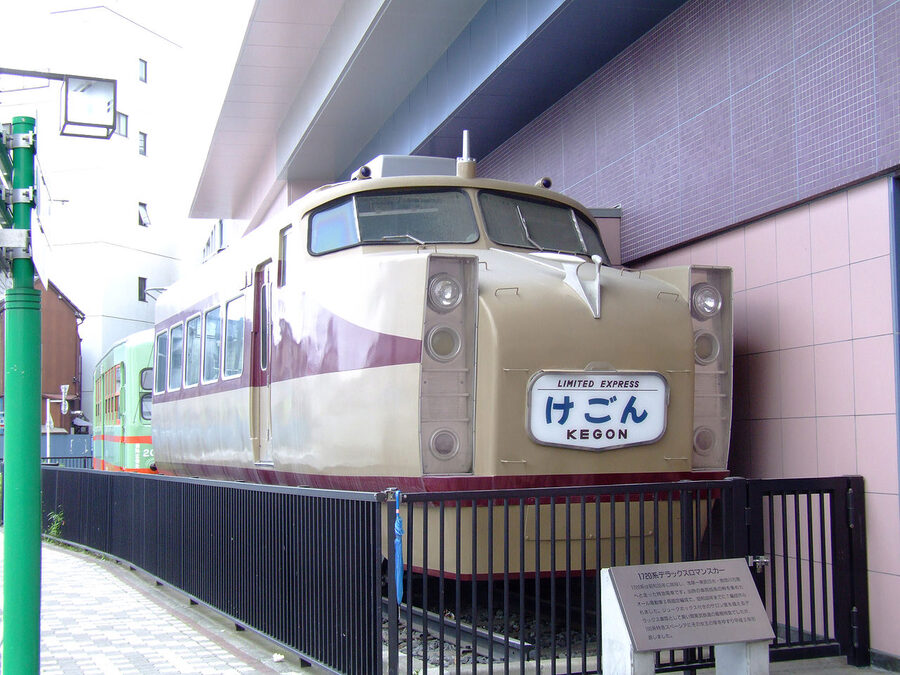
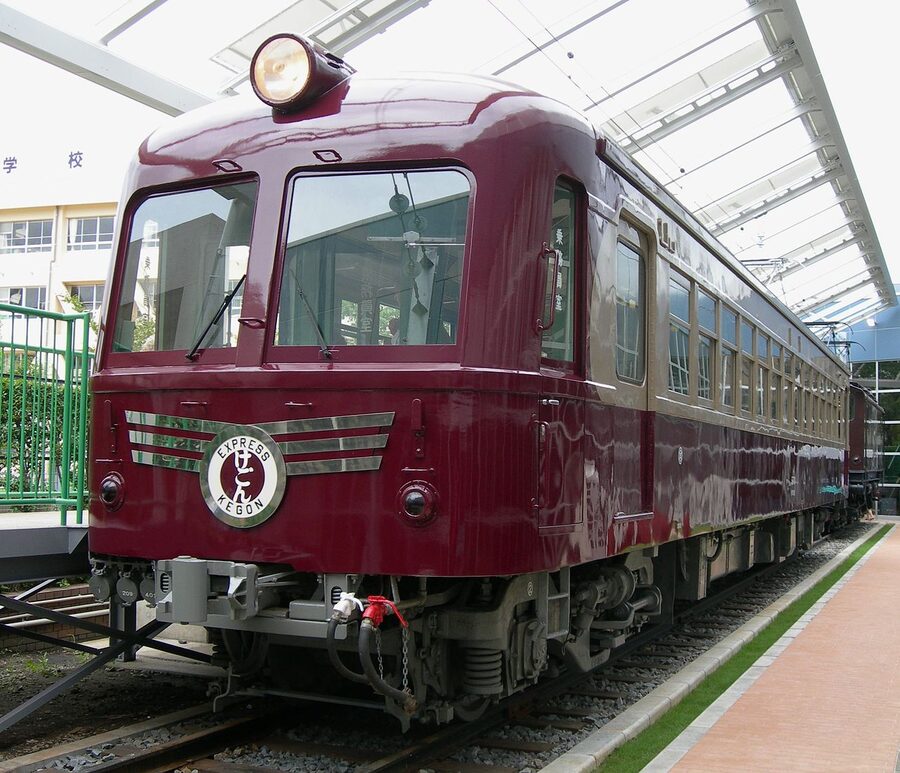
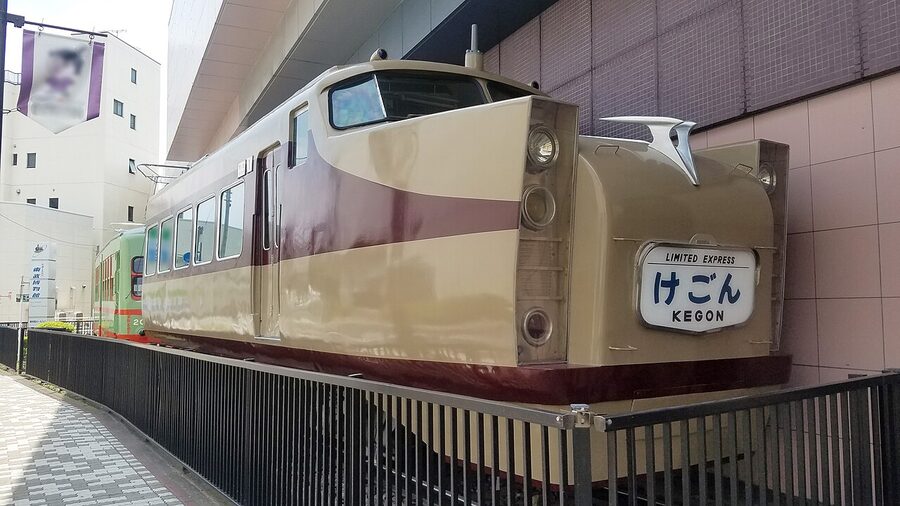
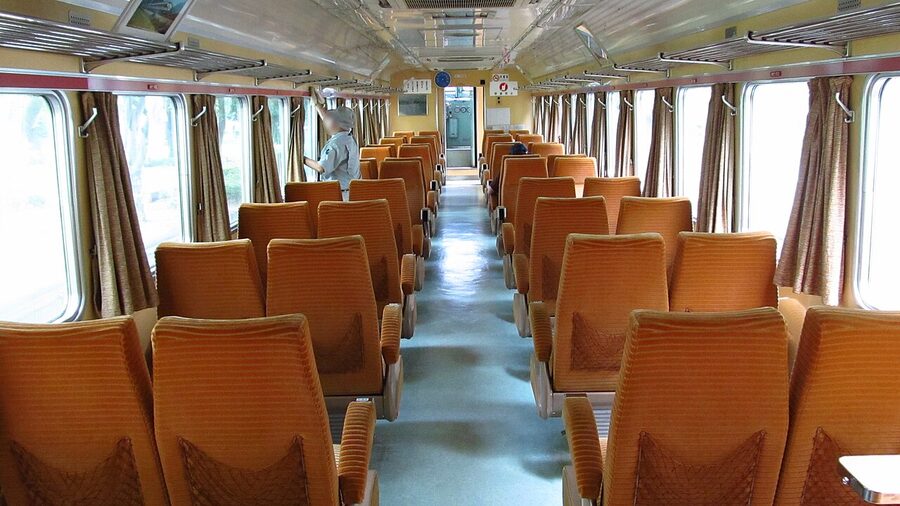
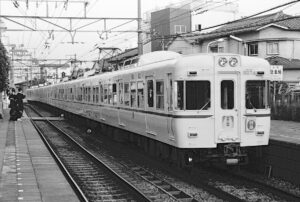
The 1720 series, marketed as Deluxe Romance Car (DRC), started running between Asakusa and Tobu-Nikko in October 1960. Air-conditioned cars in Japan were uncommon, and Tobu’s were among the first. The interior had a separately bookable salon room with a telephone (an actual landline, billed by the minute, on a service that ran 135 km up the Sumida-Watarase corridor). Seats were spaced 110 cm apart in 2+2 configuration, generous even by today’s measure. The Blue Ribbon Award, the prize the Japan Railfan Club gives every year for the most-improved new express train, went to the 1720 in 1961.
The 1720 ran the Kegon and Kinu services until June 1991. Through the same period JNR’s Nikko service went into slow decline, became JR East’s after 1987, and was eventually withdrawn altogether as a limited express in 1982. From the early 1980s onwards there was no Ueno-to-Nikko competing service worth calling a competitor; Tobu had decisively won the corridor.
The wartime decade and the consolidations Tobu came out with
The 1938 Land Transportation Business Adjustment Act (陸上交通事業調整法) was the regime that compressed Japanese private rail between the late 1930s and 1945. The cabinet wanted fewer, larger operators that could be coordinated for the war economy. Tobu was designated the consolidation hub for the entire North Kanto region. That decade is when the Tobu network you ride today actually got assembled.
Three absorbed operators that became today’s Tobu lines
The absorptions ran through Tobu in three significant tranches: Shimotsuke Electric Railway in May 1943, which became today’s Kinugawa Line; Ogose Railway in July 1943, which became today’s Ogose Line; and Sobu Railway in March 1944, which became the Noda Line, today’s Tobu Urban Park Line. Several smaller absorptions, the Joshu Railway in January 1937, which became the Koizumi Line, and the Tojo Railway equal merger of July 1920 already mentioned, brought the rest. Almost every line on the Tobu map that wasn’t a direct extension of the original Isesaki concession came into the company between 1920 and 1944, mostly under wartime regulatory pressure.
The bombing that took out the Asakusa side
The Tokyo air raids in March and April 1945 hit two of Tobu’s most important corridors at almost the worst possible moment. The 10 March raid devastated the Asakusa end of the Isesaki Line, taking out goods sheds, stations, and rolling stock the company would not be able to replace for years. The 13 April raid destroyed the Ikebukuro end of the Tojo Line, which lost two stations outright (Tobu Horinouchi, later restored as Kita-Ikebukuro in 1951, and Kanaikubo, gone forever). Track repair began the day the bombs fell. Service resumed on most of the Main Line within months, but the rolling-stock backlog took years to clear, and Tobu was not the same kind of operator afterwards.
1946 to the 1980s: the long unfashionable middle
What I find most interesting about Tobu in the post-war period is how unfashionable it was. While the rest of the Tokyo private-rail industry was being praised for sleek post-war commuter expansion, mountain holiday-home developments, and rebuilt station-area plazas, Tobu spent thirty years quietly running a freight-and-tourism railway that looked, by 1970s standards, distinctly old-fashioned. Reading rail-press accounts of the period, the constant comment is that Tobu felt like a “miniature JNR” (ミニ国鉄) rather than a modern private operator: standard-pattern country stations, JNR-style platform layouts, paper tickets with fare-stage rules that mirrored the state regulations almost exactly.
Through-running with the Hibiya Line, 1962
The one really decisive operational change of the immediate post-war decades was the start of through-running between the Isesaki Line and the Teito Rapid Transit Authority’s Hibiya Line on 31 May 1962. The Tobu service from Tobu-Doubutsu-Koen now ran straight through Kita-Senju onto the Hibiya Line and on to Naka-Meguro. From a commuter point of view it transformed what had been a peripheral Asakusa-terminating railway into a one-seat ride into the centre of Tokyo. The Hibiya Line through-running has continued, in modified form, ever since; if you read the history of the Tokyo subway piece, this is the relationship that defines the entire eastern half of the Hibiya Line’s service profile.
Asakusa to the four-track suburbs
Steam ended on the Tojo Line in April 1959 and on the Main Line in July 1966. Buses had been moved to a separate subsidiary in 1959 and reintegrated as a commercial wing through the 1960s and 1970s. The first quadruple-tracking, between Kita-Senju and Takenotsuka on the Isesaki Line, opened on 2 July 1974, the first quadruple-tracked private railway section in Kanto and one of the engineering achievements of post-war Tobu.
The 8000 series and the workhorse decade
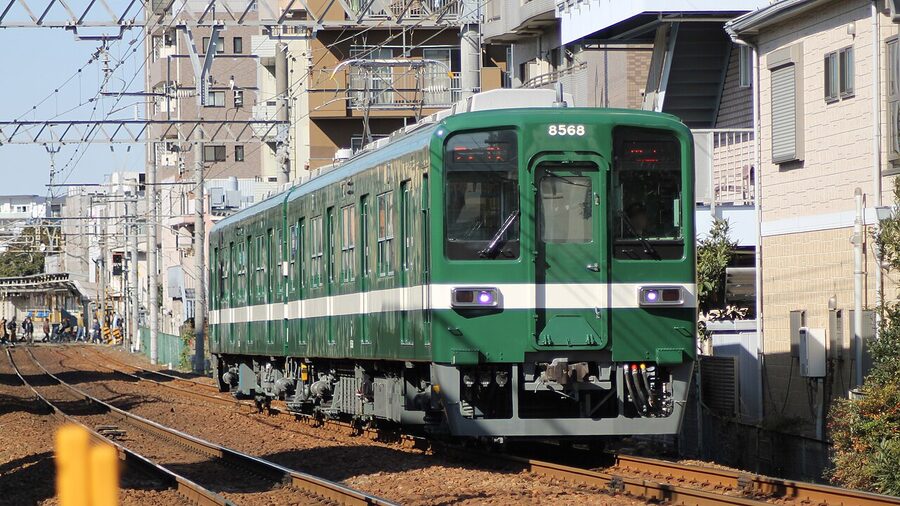
The 8000 series, introduced in 1963 as a four-car unit, ended up in production for 20 years across multiple subtypes, with a final fleet count of 712 cars across the network. As of 2026 a handful are still in service on the shorter branches (Kameido, Daishi, Sano, Kiryu), but most have been displaced by the 60000 (Noda Line, from 2013) and the newly delivered 80000 series (Noda Line, from March 2025). The 8000 is the train that defined Tobu’s 1970s and 1980s commuter operation: solid, plain, slightly behind the curve. Tobu rode them for half a century because it could; nothing required them to be replaced earlier, and Tobu’s 53-year management didn’t see a reason to.
Real estate becomes the engine
The 1970s oil shocks were brutal for the operating side of the business. Energy costs spiked. Rail revenues stagnated. The bus division ran at a loss almost continuously after 1975. The internal numbers tell the story: by 1974 the railway division was carrying a substantial deficit. Real estate, by contrast, was newly profitable. Tobu’s land-bank along the lines, especially around Tobu-Doubutsu-Koen and the Tojo Line outer suburbs, had appreciated through the post-war urbanisation; the company started turning that into condominium developments and shopping centres at scale through the 1980s.
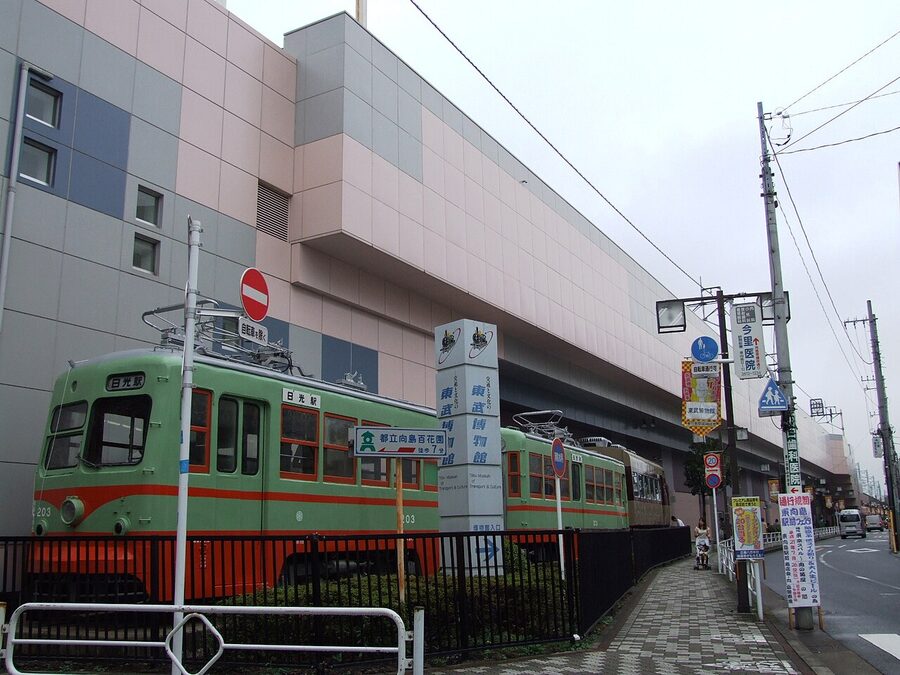
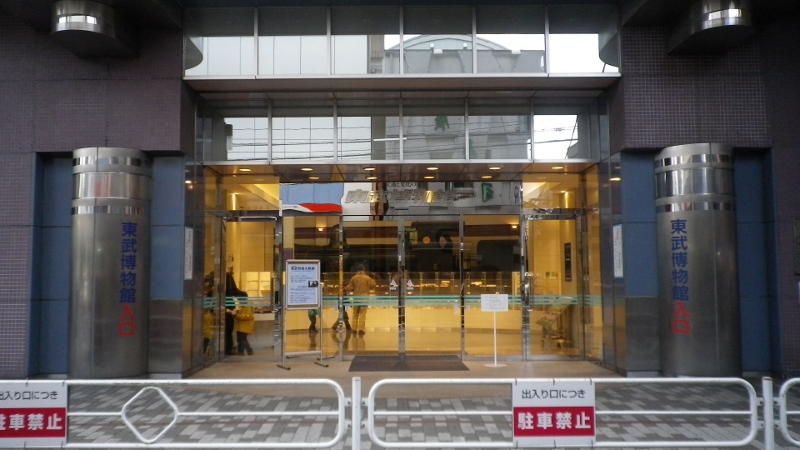
The 1981 opening of Tobu Zoo Park, a multi-day theme park complex at Sugito on the Isesaki Line, was the first big leisure-tourism asset. Tobu World Square, the 1/25 scale model-buildings theme park near Kinugawa Onsen, opened in April 1993 and is still operating today. The 1989 Tobu Museum, opened on the company’s 90th anniversary, sat directly under the Tobu Skytree Line viaduct at Higashi-Mukojima and pulled the heritage rolling-stock collection into a single venue.
1990: the Spacia and the start of Tobu pulling its weight
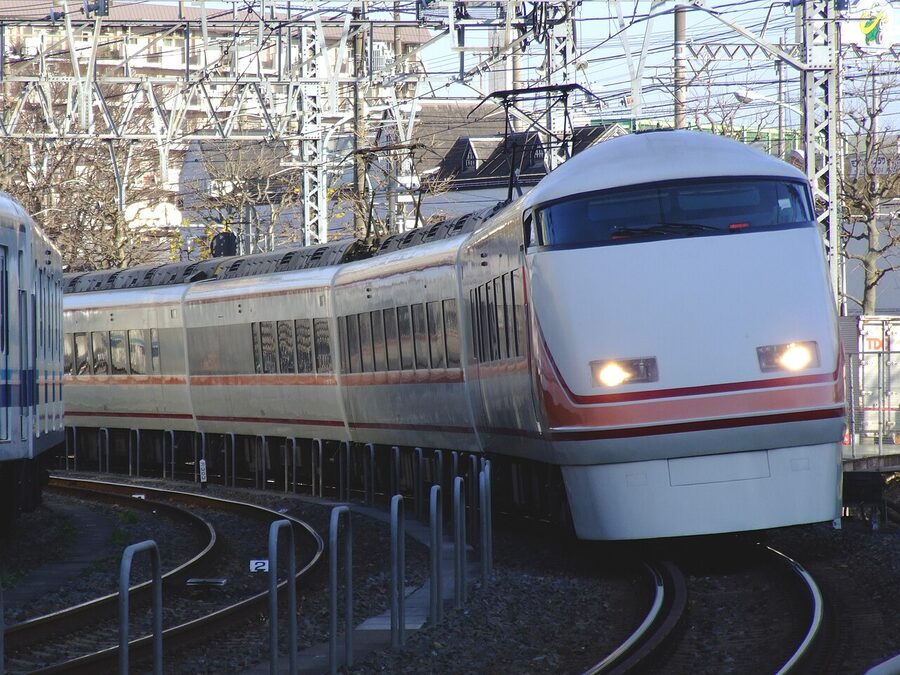
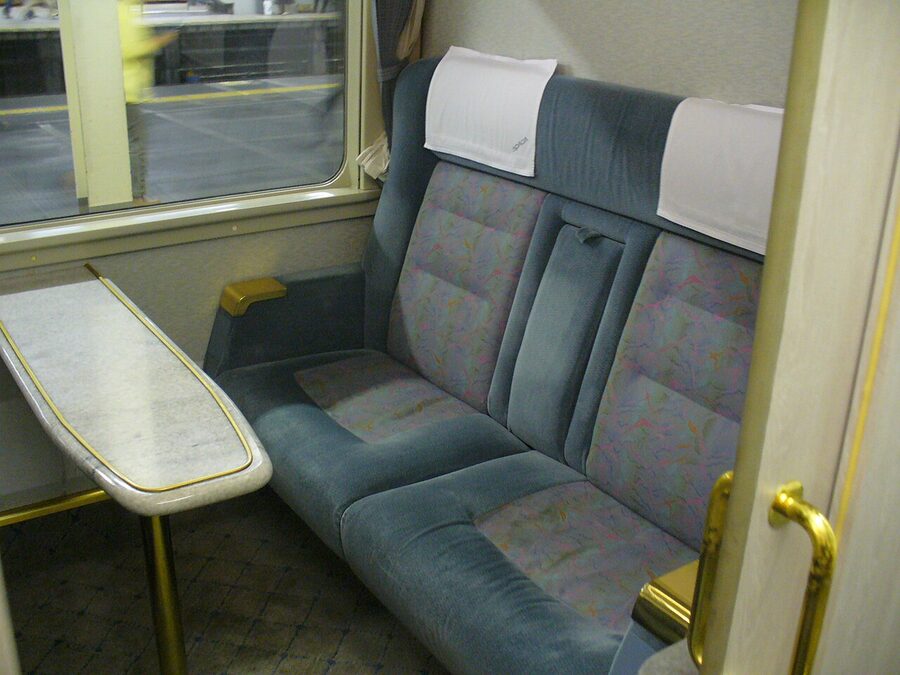
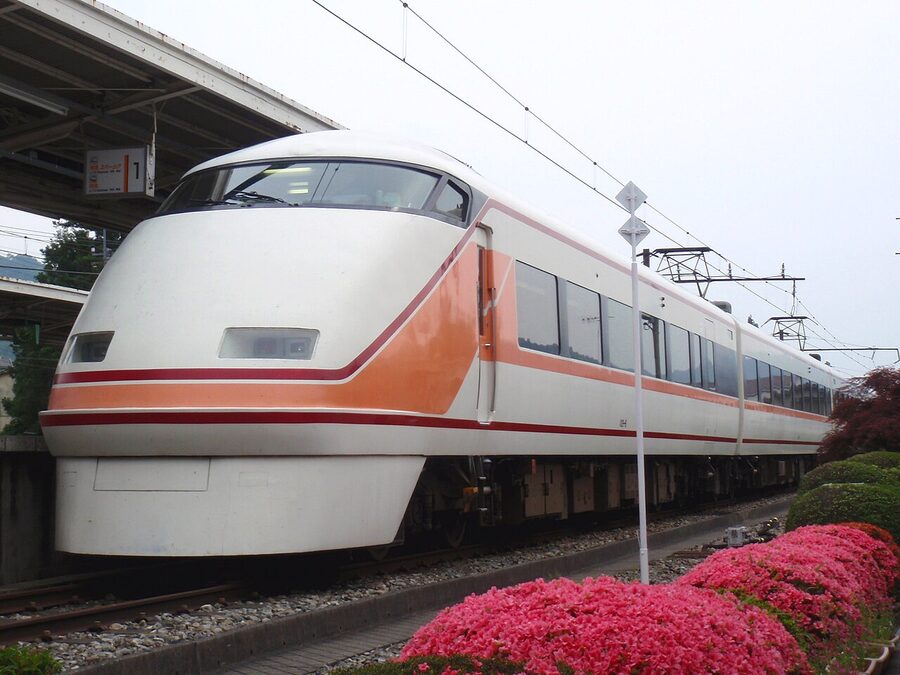
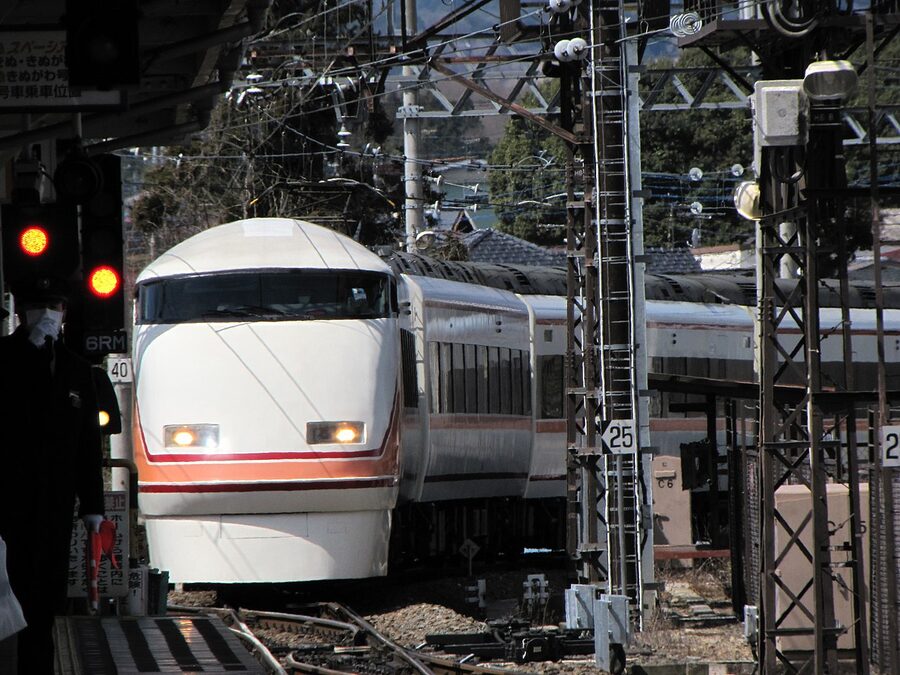
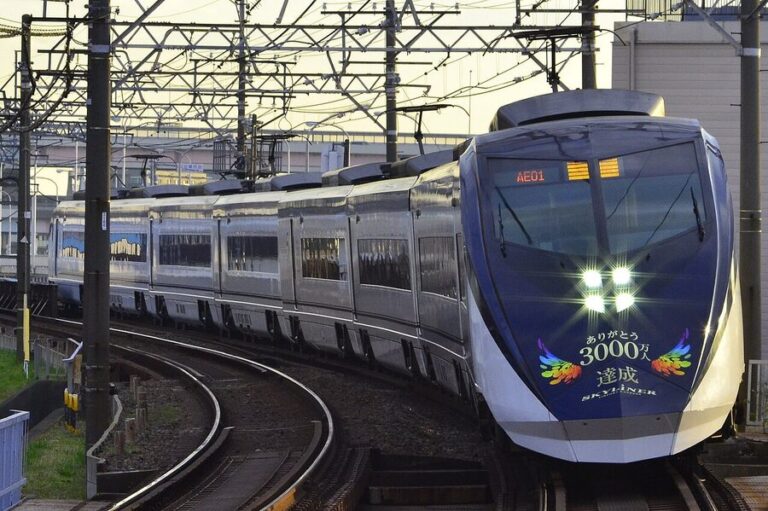
The 100 series Spacia entered service on 1 June 1990 and replaced the 1720 DRC as the Nikko-Kinugawa limited express. Designed under the slogan “Fast & Pleasure” by GK Industrial Design Associates, it had a private box compartment in car 6, a buffet car (car 3), and in-seat speakers wired to four selectable audio channels. Reclining 2+2 seats spaced 1,100 mm apart ran the length of cars 1, 2, 4, and 5. Top speed was 130 km/h. The original 1990-build cars are still in service in 2026 across the Kegon, Kinu, Kirifuri, and (from 2006) the JR-direct Nikko/Kinugawa runs.
The 1990 decisions that mattered most
The Spacia is the train Tobu likes to talk about, and rightly so, but the more consequential decisions of 1990 happened off the rails. The land-bank had been valued at maybe 300 billion yen in 1980; by the bubble peak it was several times that, and Tobu started using the rolling property income as a hedge against railway-side losses, almost permanently. The financing flexibility this gave the rail division is what funded the 1991 introduction of through-running with the Yurakucho Line on the Tojo Line side, the 1995 fully air-conditioned Main Line fleet, and the 1997 Kita-Senju station rebuild that gave Tokyo’s commuters a transfer hall the right size for what the line was actually carrying.
The Skytree gambit
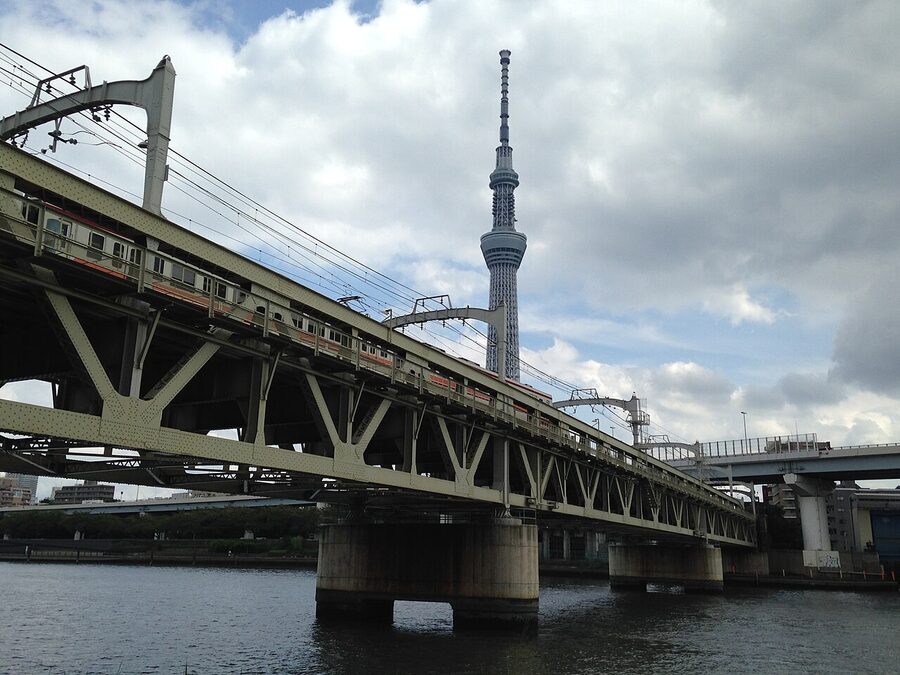
If you want to know why Tobu owns Tokyo Skytree, the answer is essentially about freight. The plot at Narihirabashi (today’s Tokyo Skytree Station, formerly Azumabashi, the original 1902 Tobu terminal) was the company’s main goods yard until 2003, when Tobu finally retired its freight operation, by then the last freight service of any private railway in Japan. The yard was suddenly a redundant 36,800-square-metre site in central Tokyo with frontage on the Sumida River. NHK had been looking for a partner for a planned next-generation digital broadcast tower. The two bidders for the Sumida site, Tokyu and Tobu, both put forward proposals; Tobu’s, with the freight-yard site already in hand and no need to acquire land, won.
The financing nobody else could have done
Tobu Tower Skytree Co., Ltd. was set up in 2006 with Tobu Railway as the controlling shareholder. Construction began on 14 July 2008 with the official ground-breaking on the Narihirabashi site, demolished and rebuilt as the tower’s foundation. Tokyo Skytree topped out at 634 metres on 1 March 2011, was opened on 22 May 2012, and at the time of opening was the tallest broadcasting tower in the world (it has since been surpassed by Merdeka 118). The total construction cost was around 65 billion yen; the entire project was financed off Tobu’s land-bank balance sheet, in a way no other Tokyo private rail operator could have matched.
Why the line got a new name
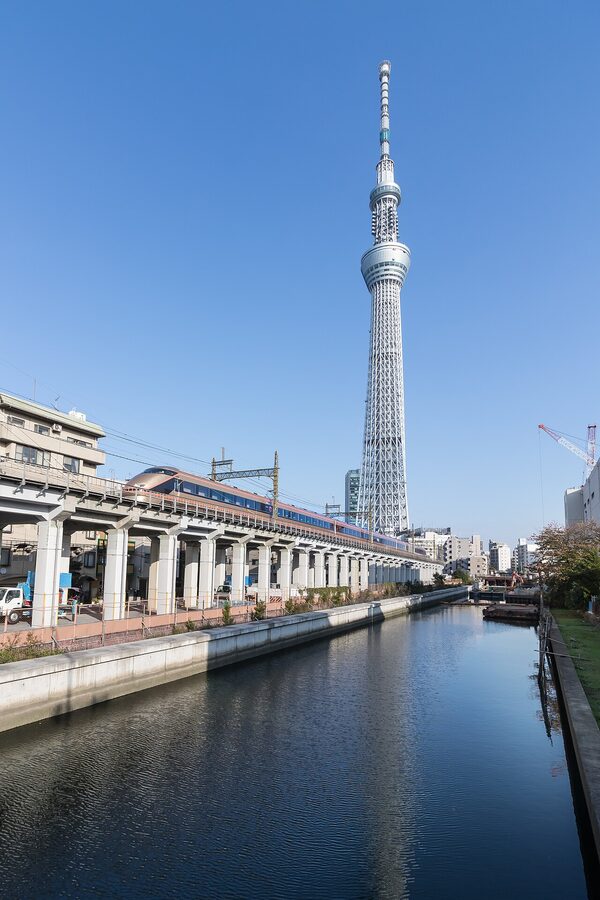
On 17 March 2012, Tobu rebranded the Asakusa-to-Tobu-Doubutsu-Koen segment of the Isesaki Line, plus the Oshiage-Hikifune cut-off, as the Tobu Skytree Line (東武スカイツリーライン). The Isesaki Line still officially exists from Hikifune all the way to Isesaki, but the marketing on the Asakusa side flipped to Skytree-aligned identity. Station numbering was rolled out network-wide on the same date. The corporate “T-mark” logo, with four lines radiating outward in Future Blue (a Tobu-trademarked Pantone), was applied to most rolling stock starting in 2011 and is now the visual signature of the operator.
Riding Tobu today: where to actually start
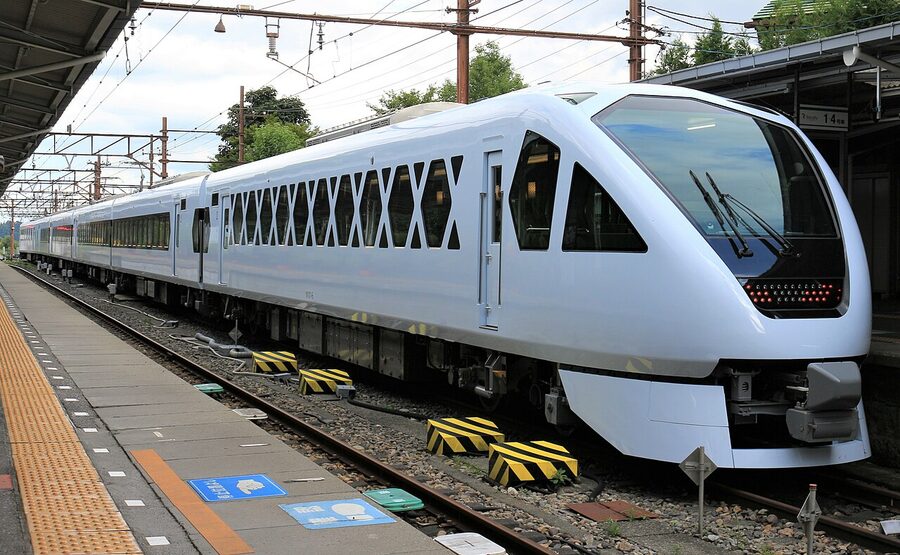
The current Tobu services that make a tourist case rather than a commuting case run almost entirely off the Asakusa terminal up the Skytree Line and onto the Nikko Line. They are the most concrete way to see what 128 years of company strategy has built. Working through the rolling-stock options the modern Tobu offers, in the order I would actually recommend riding them:
The Spacia X, if you can get a seat
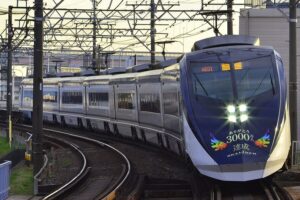
The N100 series Spacia X entered service on 15 July 2023 between Asakusa and Tobu-Nikko/Kinugawa-Onsen. Six cars, top speed 130 km/h, and a service reset specifically aimed at the inbound foreign tourist market. Standard reserved seats start at ¥1,940 supplement on top of the Tobu base fare; premium ¥2,940; private compartment seats from ¥14,000 for the four-person box. Reservations open three weeks ahead on the Tobu app, which now sells limited-express seats to non-Japanese-resident credit cards (this was not true of the 100 Spacia until late 2022). Book the cafe car (car 6); the Tochigi-craft-beer-and-coffee menu is the only one of its kind on a Japanese limited express.
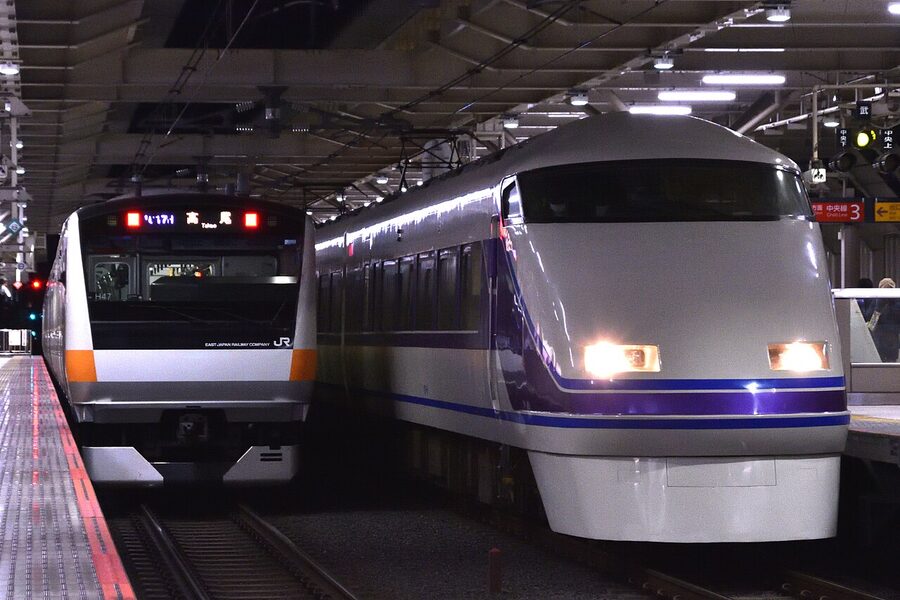
The original 100 Spacia, while you still can
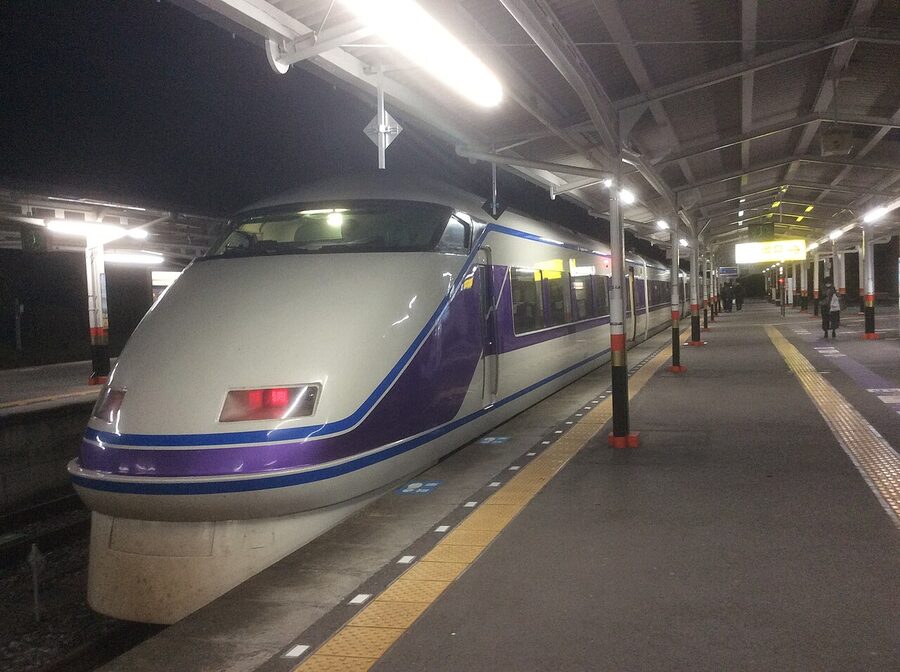
The 100 series Spacia is now 36 years old, has been refurbished twice, and remains the workhorse on the secondary Nikko/Kinugawa runs that the Spacia X cannot cover. If you can pick a Spacia 100 working with the Nikko-mode purple-and-gold livery (sets 106F or 109F; check the day’s working on the rail-fan blogs), the colour scheme alone is worth riding once. Compartment in car 6 is bookable separately, ¥3,090 supplement on top of the limited-express fare, sleeps four. It is the only Japanese limited-express compartment a tourist can book without the operator phoning you.
The 500 Revaty for the Aizu through-runs
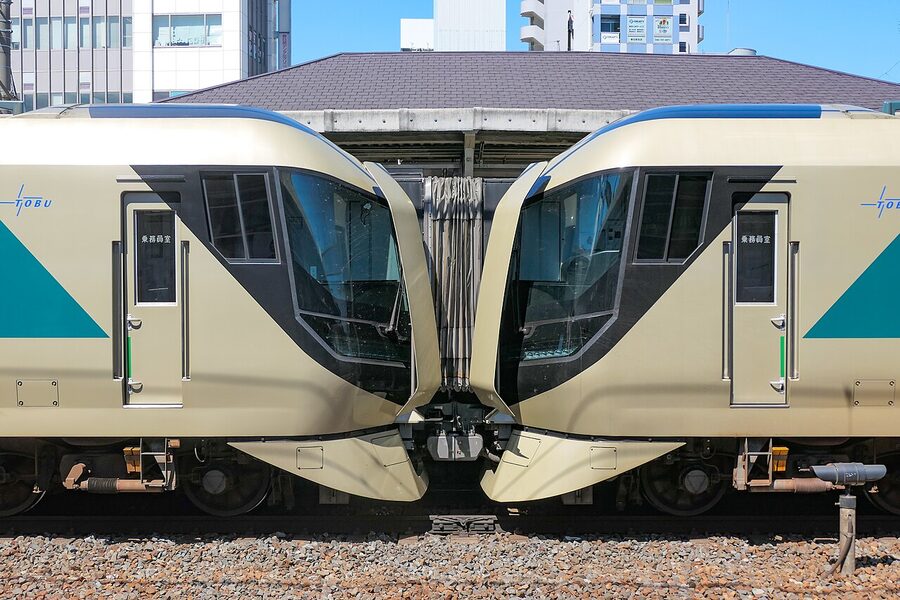
The 500 series Revaty, in service since 21 April 2017, runs the Liberty Aizu services that go beyond Kinugawa Onsen onto the Yagan Railway and the Aizu Railway, ending at Aizu-Tajima. It is the only practical rail route from Tokyo into south Aizu, a corner of Fukushima Prefecture you cannot easily reach any other way. Three-car sets that can couple in 1, 2, or 3-set formations make it the most operationally flexible Tobu limited express ever built. Reserved seat ¥3,820 from Asakusa to Aizu-Tajima, total ride about 3 hours 40 minutes.
The SL Taiju at Kinugawa
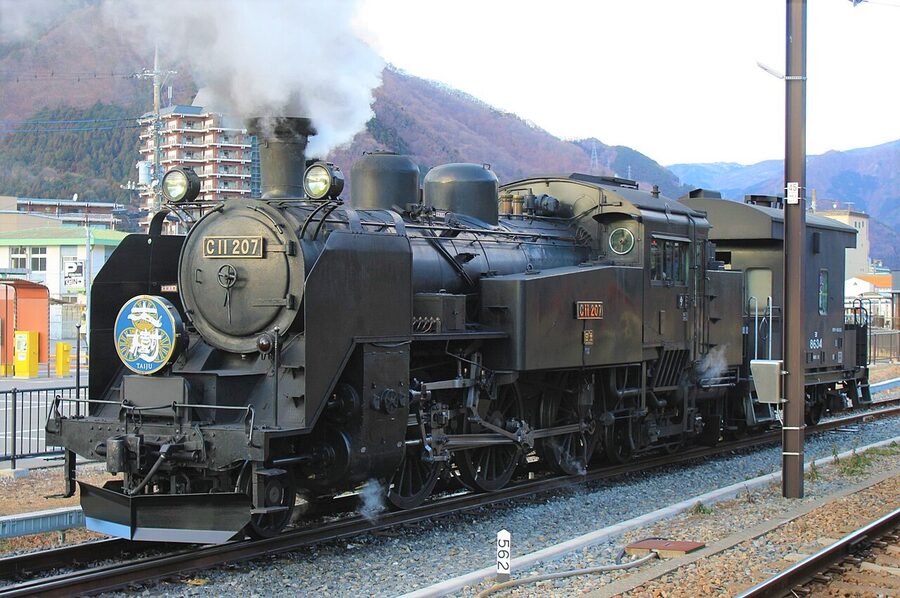
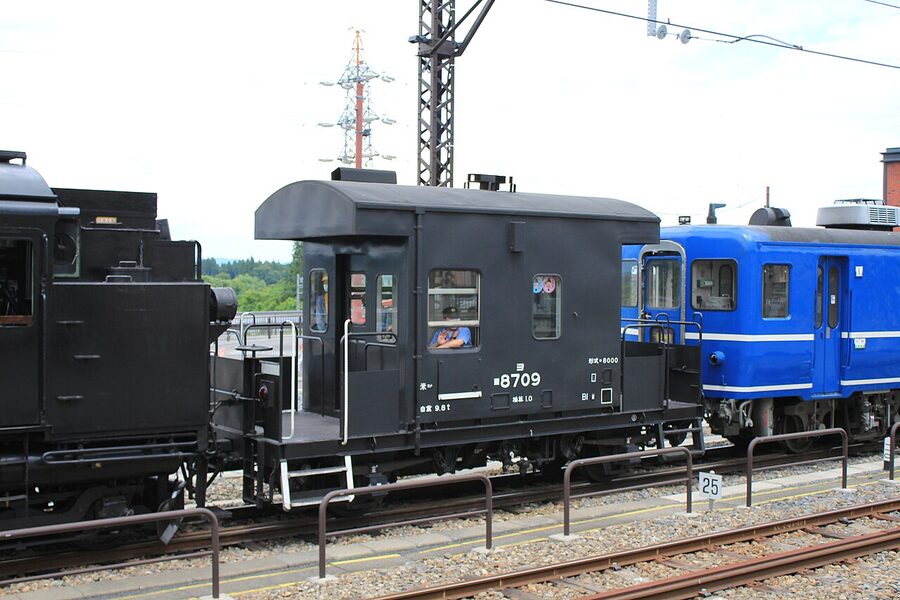
SL Taiju started running on 10 August 2017, the first regular steam-hauled passenger service on a Japanese private railway in 51 years. Tobu had to source the locomotive (C11 207) on lease from JR Hokkaido, the brake van (yo 8709) from JR West, and the carriages from JR East. The whole operation runs Shimo-Imaichi to Kinugawa Onsen, 12.4 km, three round trips a day on operating days. As of 2026 there are now two engines in the fleet: C11 207 and the restored C11 123, brought back to working condition in December 2021 after a 73-year retirement, and renumbered 123 to mark Tobu’s 123rd anniversary.
The TJ Liner on the Tojo side
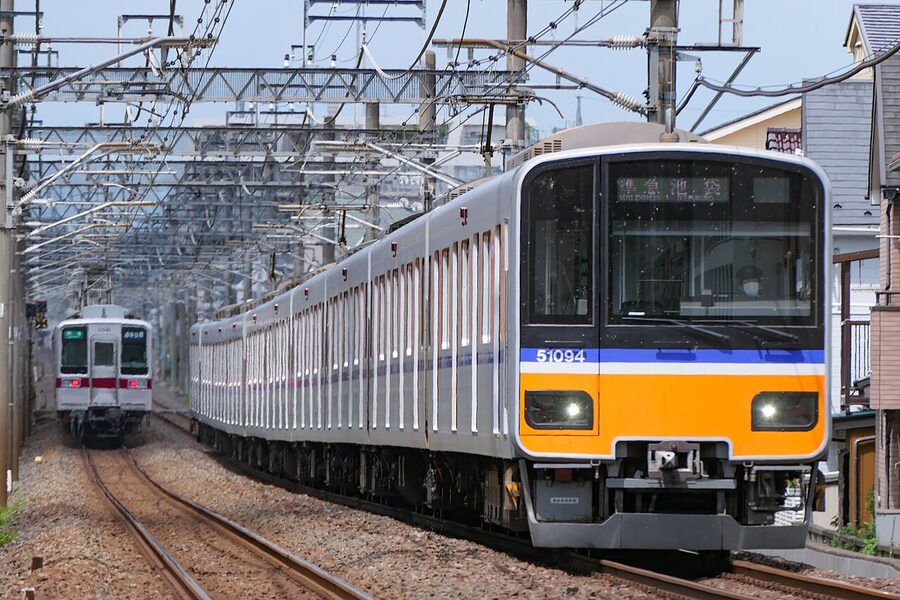
The Tojo Line product offering is much more commuter-shaped than the Main Line. The TJ Liner reserved-seat service runs from Ikebukuro outward through the day, currently 8 services per weekday in the down direction, fewer back. Through-running with the Tokyo Metro Yurakucho Line started in 1987, with the Fukutoshin Line in 2008, and (via the Fukutoshin and the Tokyu Toyoko Line) onto the Sotetsu network in March 2023. From a single TJ Liner reserved seat you can now ride straight through from Kawagoe to Yokohama Naka-ku across six different operators’ tracks. This is the most extreme through-running result in Tokyo. Read the Tokyu history for what the south-west end of the line looks like.
The Hibiya Line through-runs from Kita-Senju
For ordinary commuters the most-used Tobu service is not a limited express; it is the Hibiya-direct trains. Mornings, every other Asakusa-bound stopping service from the northern Saitama suburbs continues straight through Kita-Senju on the Hibiya Line and runs as a Naka-Meguro working. The current rolling stock is the 70000 series (introduced 2017, jointly developed with Tokyo Metro 13000 stock to share interior dimensions). The supplement is zero; the same Suica or Pasmo tap that gets you onto Tobu reads through onto the Hibiya Line.
The 2020s and the new generation
Three things define Tobu in the 2020s. The first is the end of the Nezu family management. Nezu Yoshizumi, the great-grandson of Nezu Kaichiro I, stepped down on 23 June 2023 and Tsuzuki Yutaka became the seventh president of Tobu Railway. The Nezu family stayed on as senior advisers and significant shareholders, but the operational chair passed out of the family for the first time since 1941. Three weeks later, on 15 July 2023, the Spacia X started running. The two transitions happened back to back, deliberately.
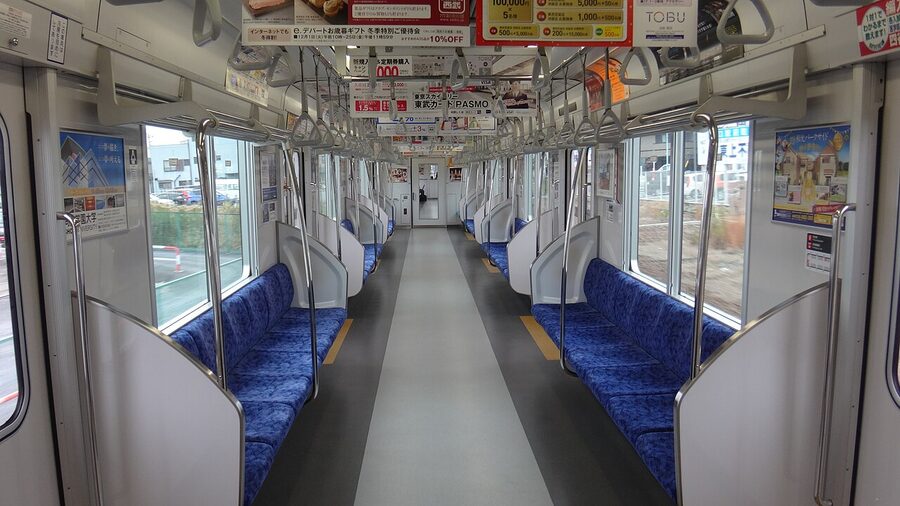
The fleet replacements quietly underway
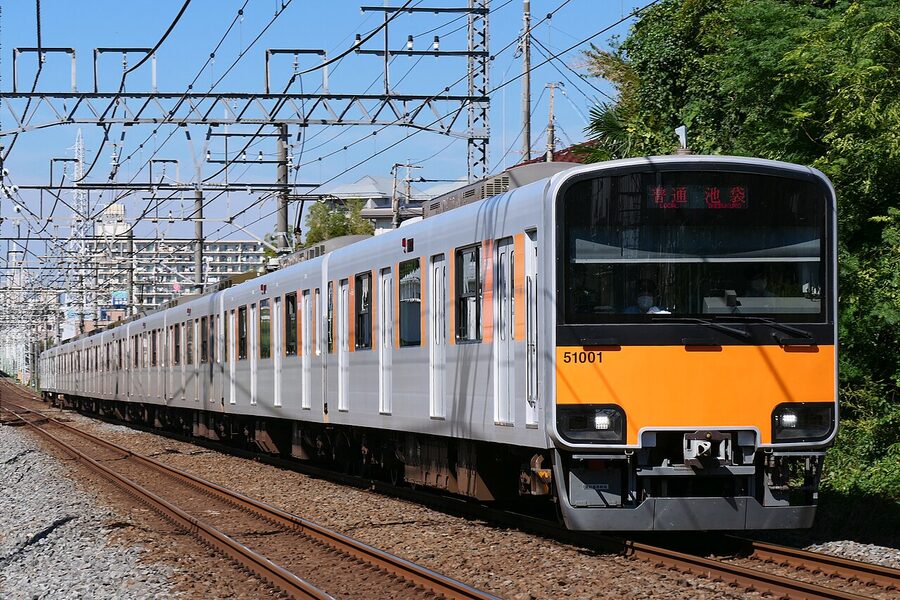
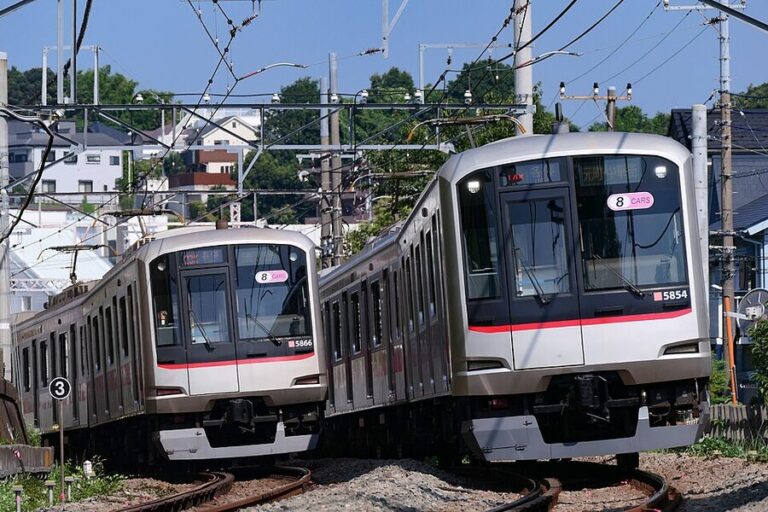
The second is fleet replacement. The 80000 series for the Noda Line entered service on 8 March 2025; sets 85551F through 85554F+ were photographed in the Tobu Animal Park sidings during early 2026 testing. The Noda Line had been running 8000 series stock for 60 years. The 80000 is built around partial 60000 conversions (some interior cars are reused) plus new powered cars. Tojo Line replacements are scheduled to follow. By the late 2020s the Tobu commuter fleet will be entirely stainless-steel and entirely 21st-century, a thing it was not three years ago.
The 6050 Nikko stock and the long phase-out
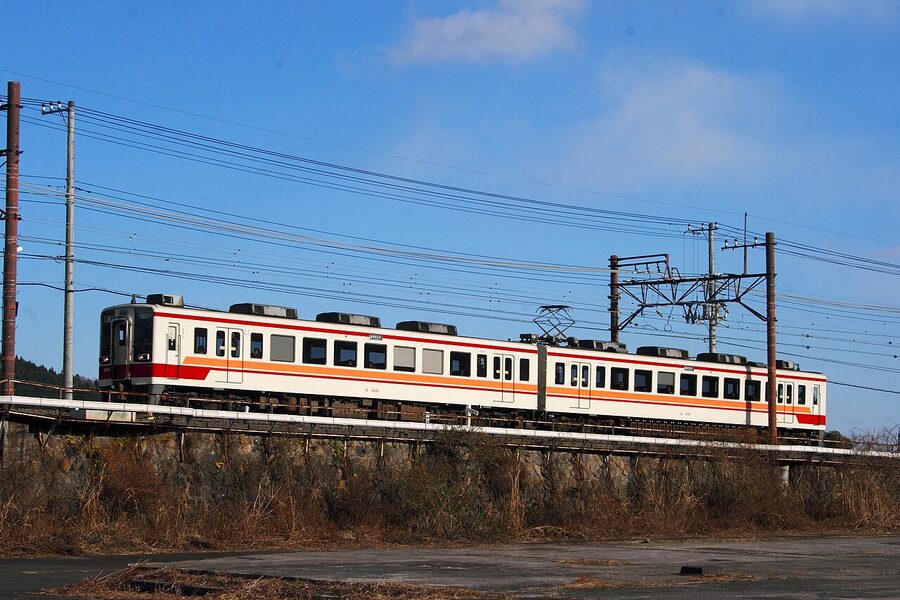
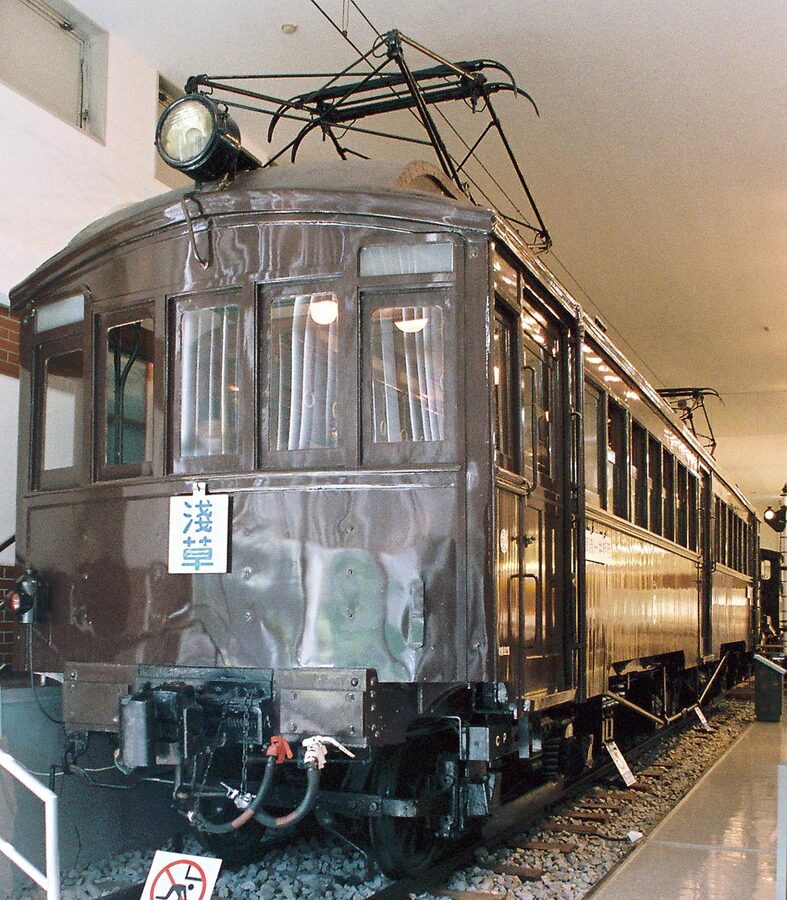
The third theme is rationalising the heritage stock. The 6050 series, the long-distance commuter unit that ran the Nikko Line and the Yagan Railway / Aizu Railway through-runs, is now mostly retired. The 1720 DRC has been preserved (set 1721 at the Tobu Museum, set 1726 at Iwatsuki Castle Park). The 5700 cab is preserved. The DeHa 1 No. 5, built 1924, is also at the Tobu Museum, the oldest surviving Tobu electric passenger car. For the rolling-stock-led complement to this article, including the full current fleet roster across every Tobu line, see the dedicated Tobu Railway trains piece.
Where Tobu sits in the Tokyo private-rail landscape today
The most useful framing for understanding modern Tobu is to set it next to the other Kanto private operators. Each of them has a defining era; Tobu’s is just longer than most. Odakyu’s was the post-war Hakone tourism push (read the Odakyu history). Tokyu’s was Goto Keita’s bay-area land-bank strategy in the 1920s and 1930s. Keio’s was the post-war Tama New Town development. The Tokyo Metropolitan subway, which Tobu through-runs into via the Hibiya, Yurakucho, and Fukutoshin lines, is its own story (the Tokyo subway history piece walks through the public-private balance that Tobu has always sat on the private side of).
What Tobu actually owns now
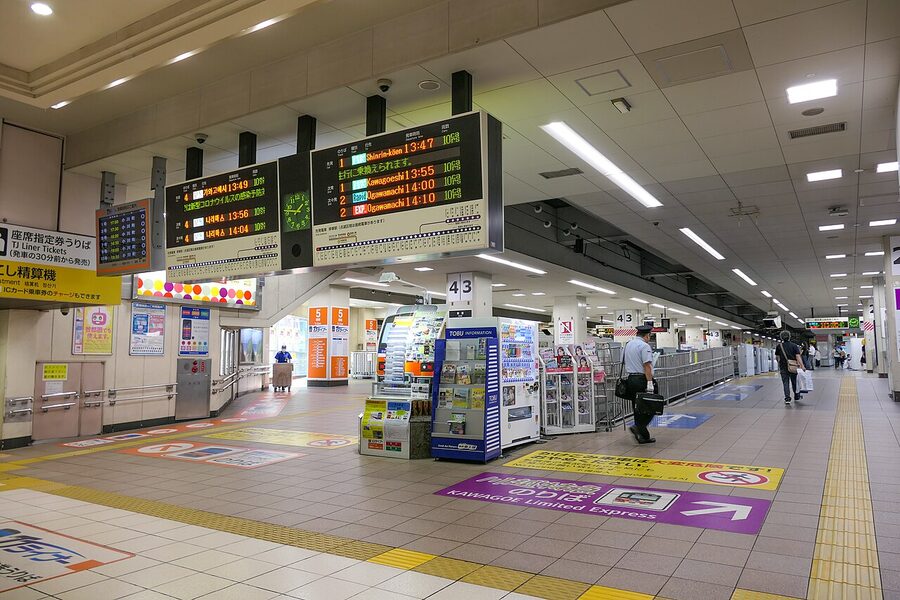
The Tobu Group as a holding entity has grown to about 80 listed and unlisted companies. The rail operator is the listed parent (Tokyo Stock Exchange Prime Market, Nikkei 225 component); around it are the bus subsidiaries (Tobu Bus Central, Tobu Bus West, Tobu Bus East, Tobu Bus Nikko since the 2002 reorganisation), the real-estate division (Tobu Properties, Tobu Land, Tobu Town Sugito), the leisure division (Tobu Zoo Park, Tobu World Square, Tobu Hotels), and Tokyo Skytree Town (the operating company for the Skytree complex itself). The 2023 group revenue, before the new president took the chair, was about 232 billion yen on the rail side and roughly 600 billion yen group-wide.
Through-running, the metric that matters most
If I had to pick one thing that distinguishes today’s Tobu, it would be how through-run-heavy the operation is. The Skytree Line through-runs onto the Hibiya Line (since 1962) and the Hanzomon / Tokyu Den-en-toshi / Sotetsu network (since 2003). The Tojo Line through-runs onto the Yurakucho Line (since 1987), the Fukutoshin Line, the Tokyu Toyoko Line, the Minatomirai Line, and the Sotetsu network (since 2023). The Nikko Line has had JR-direct trains via Kurihashi to Shinjuku since March 2006. Tobu sells more through-run kilometres than any other Tokyo private operator. That is what it is for, on a normal weekday morning: it carries you to and from Tokyo without you ever needing to know which operator’s track you are on.
What Nezu actually built
The interesting thing about Nezu Kaichiro I is that he was, by his own choice and the family’s, a one-railway operator. Nezu held interests in 25 other railways during his lifetime, in Korea, Manchuria, the Kansai region, Tokyo’s southern suburbs (he was the financial backer of Hayakawa Tokuji’s Tokyo Underground Railway, the first subway in Japan). All of those were investments. Tobu was the one he put his name to, kept buying shares in, lobbied for in the Diet, and bequeathed to his son. The other 25 are footnotes in the history of railway capitalism. Tobu is the railway he chose.
The institution as a portrait of the man
Nezu put it more bluntly than most: 「社会から得た利益は社会に還元する義務がある」 (the duty of those who get their wealth from society is to give it back to society). He used Tobu’s profits to fund the founding of Musashi Higher School in 1922, today’s Musashi University. He built the Nezu Museum, in Minami-Aoyama, to house the antique pottery and Asian art he had collected. He served as a member of the House of Representatives for 13 years and the House of Peers from 1926 until his death.
The blunt corporate fact is that today’s Tobu is what the man left behind. The 463.3 km network is downstream of the routes he and his son extended, the absorptions they negotiated, the tunnels they built, the terminals they fought for. The Spacia X livery’s maroon paint is a callback to the 1924 DeHa 1, which Nezu commissioned. The Skytree’s foundations sit on the freight yard he opened in 1902. The Asakusa terminal’s department-store-on-top model is the one his managers invented in 1931. None of this was inevitable. It is what one decision by the upper house, in late March 1906, made possible.
The closing scene at Asakusa
Stand on the curving platform at Asakusa Station on a Sunday morning in autumn, while the 09:00 Spacia X is loading for Tobu-Nikko. The platform is a wide tongue of concrete jammed into the angle between the Sumida and the river-bank road; the trains arrive curving in from the right and stop in a long arc with a 30 cm gap at the worst point. The retractable platform extensions slide out, the doors line up, and the announcer reads the destination in five languages. The Spacia X is six minutes from departure. Above the platform, on floors three through eight, the Matsuya Asakusa department store is opening for the day. Customers go up the escalator on one side; passengers come down it on the other. The terminal is doing the thing the terminal has done every morning since 1 November 1931.
It is also the thing Nezu Kaichiro I would have recognised. Strip away the Spacia X and the digital signage and the touch-card gates, and the fundamentals are his: a private railway that runs because the upper house spared it in 1906, terminating in a department-store building that is an early-Showa innovation Tobu got to first, with the family name still over the door of the holding company even after the operating chair has passed out of the bloodline. Take the train. The first stop, in about ten minutes’ time, is Tokyo Skytree, where the goods yard used to be. Don’t cut the silk thread.


.jpg)


