

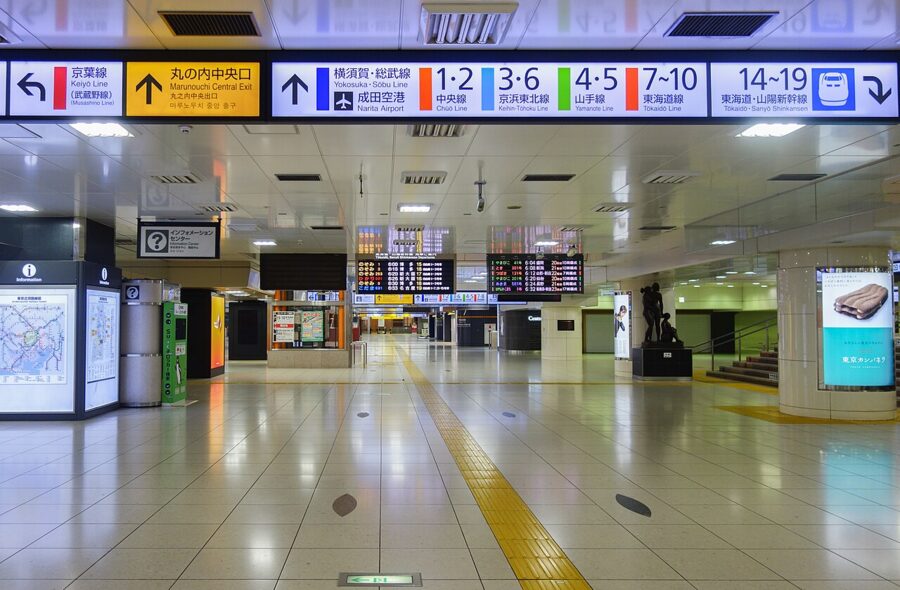
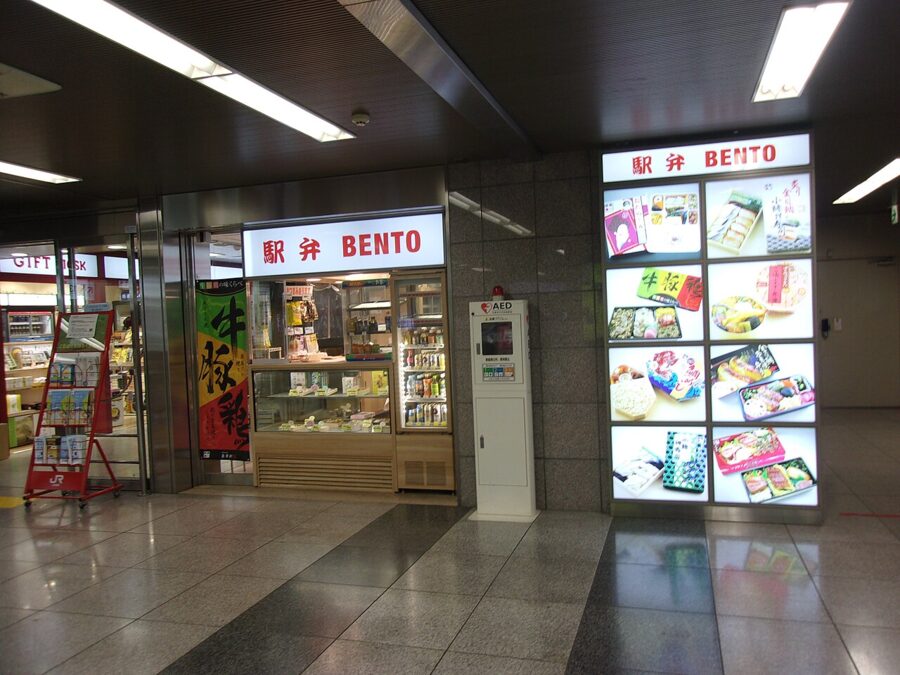
Eleven minutes before your Shinkansen leaves, the queue at Ekibenya Matsuri (駅弁屋 祭) is four deep and the shelves hold around 150 boxed lunches from stations all over Japan. There is beef over rice from Yonezawa, ox tongue from Sendai that heats itself when you pull a string, and a glazed clay pot of chicken rice from a mountain station in Gunma, heavier than it looks. The till takes Suica, the queue moves, and the transfer gate is at the end of the passage.
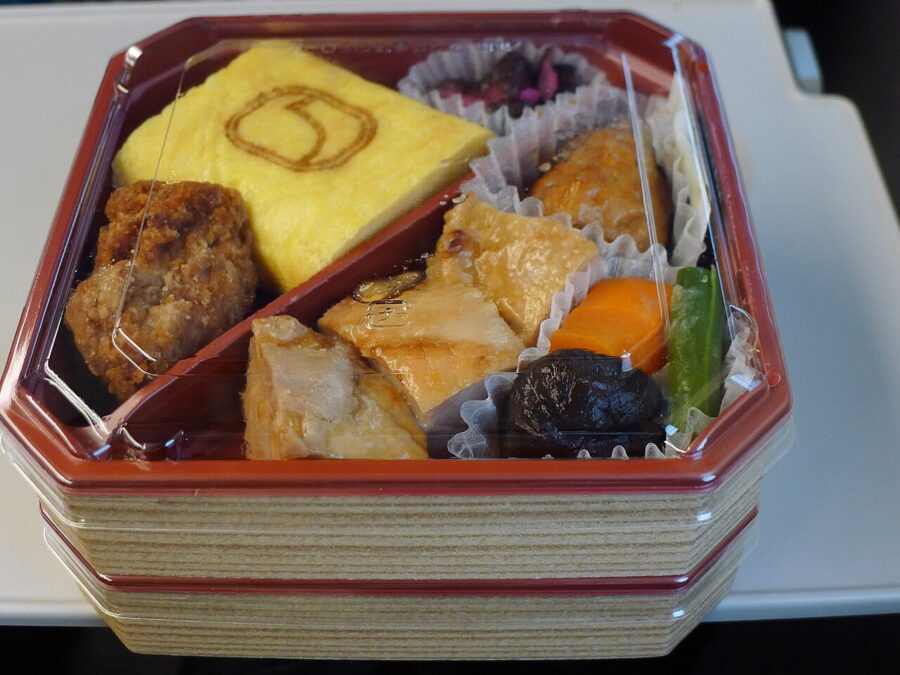
Whichever you pick, you have bought an ekiben (駅弁), the station box lunch, and it is not the same thing as the bento in a convenience-store chiller. A konbini bento is made to be microwaved at the counter and eaten within the hour. An ekiben is made for the journey: it is eaten at whatever temperature the carriage happens to be, so the rice is cooked to stay soft and the seasoning is pitched to taste right cold. Most carry the name of a station, and the good ones carry the food of the country around it.
Tokyo is now the easiest place in Japan to buy one, which would have puzzled the people who invented them. Ekiben were born on provincial platforms and sold through carriage windows during a ten-minute stop. The regional boxes come to the capital because the trains that once stopped long enough for lunch no longer do.

The word joins eki, station, to ben, short for bento. The trade body is the Nihon Tetsudō Kōnai Eigyō Chūōkai (日本鉄道構内営業中央会), the association of companies licensed to sell food on railway premises, and in 1988 it created the ekiben mark: a box with a cross-shaped divider, a red sun for the plain rice-and-plum hinomaru lunch, and the word EKIBEN. Only members may print it and there is no fee, so the mark tells you the maker holds a station concession, not that the food is good.
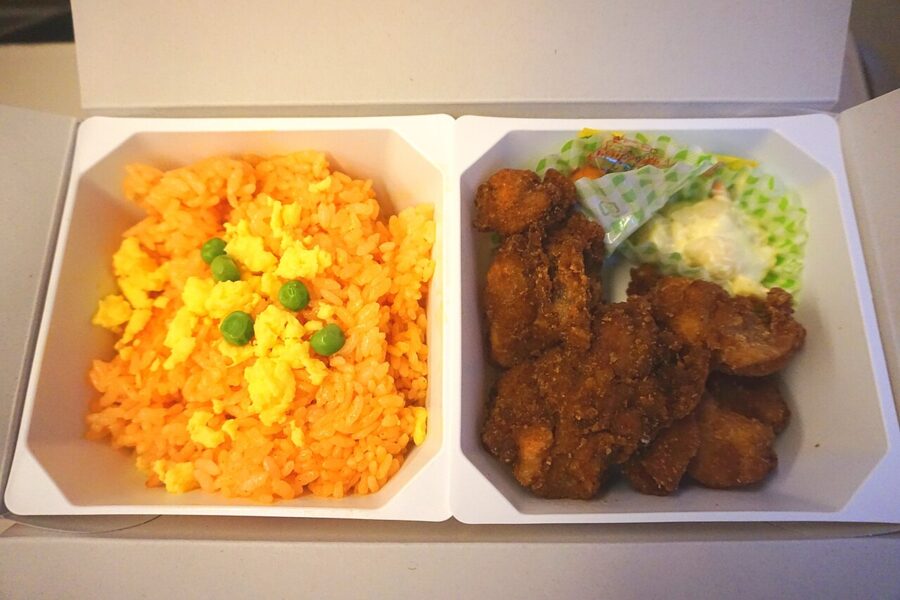

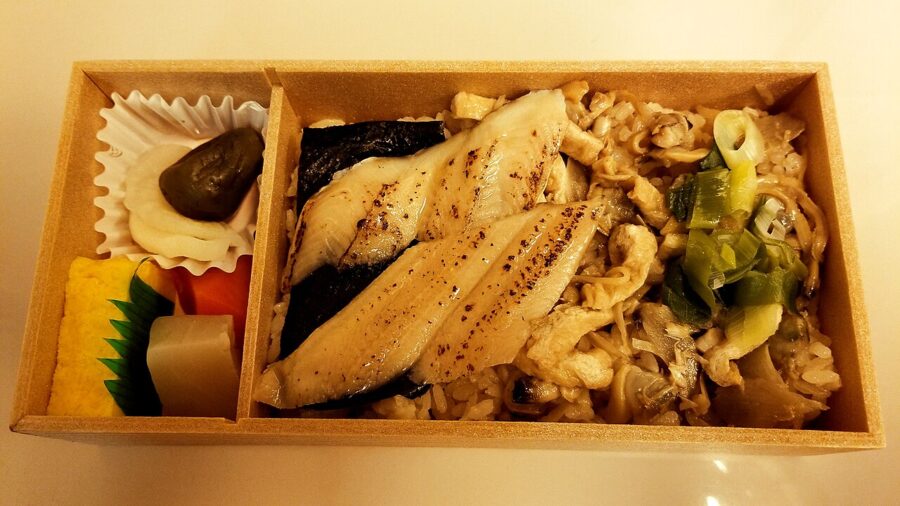
Tokyo has its own boxes as well as everyone else’s. Nihonbashi Daimasu, in business since 1900 and now part of JR East’s catering arm, makes the Chicken Bento that has been on sale since 1964 and a Fukagawa-meshi of clams simmered with ginger over clam-stock rice, a dish of the old Fukagawa waterfront east of the Sumida.

From rice balls at Utsunomiya to the January fair
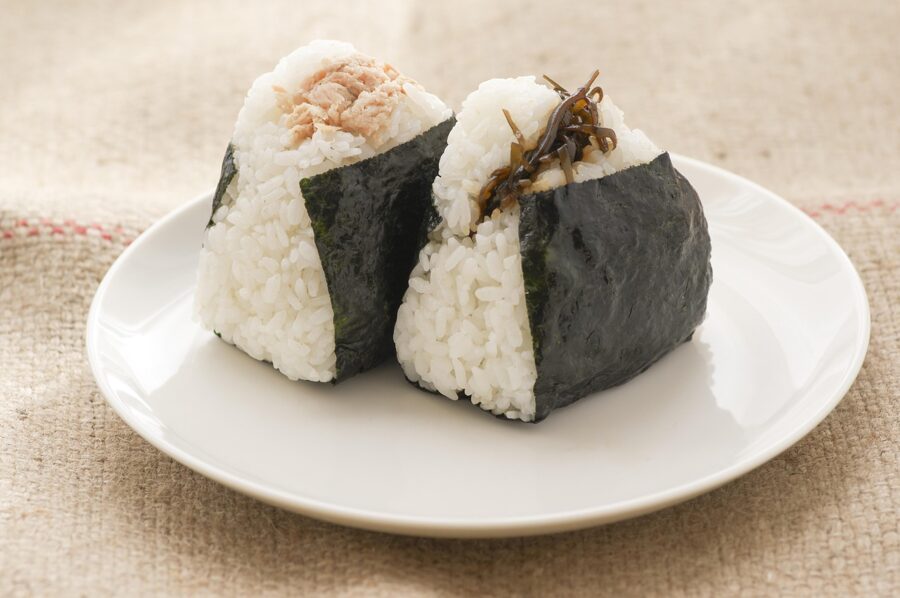
The story every Japanese reference repeats starts at Utsunomiya on 16 July 1885, the day the Nippon Railway opened its station there on the line from Ueno. Saitō Kahei, who kept an inn called Shirakiya, sold two rice balls with pickled plum, sprinkled with black sesame, and two slices of takuan, wrapped in bamboo sheath, for five sen. That is the account the caterers’ association gives, and it adds that it is one theory among several.
Kobe and Osaka claim 1877, Nagahama 1882, Ueno and Kumagaya 1883. Most early vendors were small traders who kept no company records, and the city ones lost theirs in the 1923 earthquake and the war, so nobody can settle it. The first box with rice and side dishes, the ancestor of the makunouchi ekiben, is usually given as Himeji on the Sanyo Railway, in 1888 or 1889; sources differ on the year.
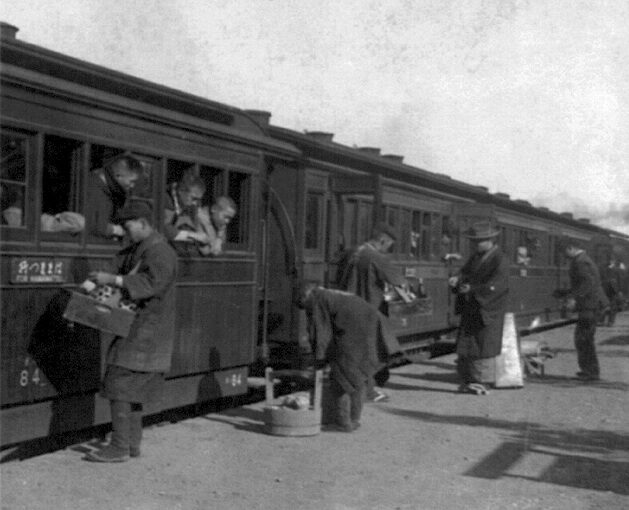
For eighty years the ekiben was sold through the window. Trains stood for ten minutes at junctions and engine changes, and vendors with trays slung from their necks walked the platform calling the name of the station’s box. You leaned out, paid, and the train pulled away with your lunch and, often, a clay pot of tea.
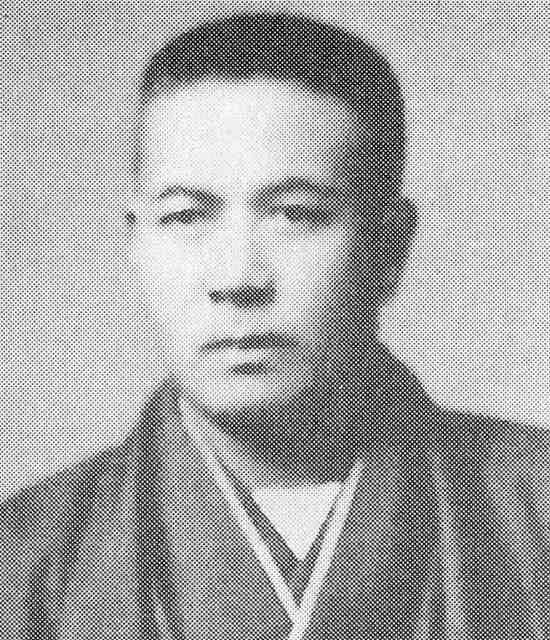
The boxes turned regional early. At Sapporo, Higo Yosakichi took over the station’s ekiben in 1899, found that copies of Tokyo and Osaka boxes did not sell, and switched to grilled salmon, char and herring. In 1923 he introduced a two-tier box that kept the rice apart from the side dishes, a pattern copied across the country.
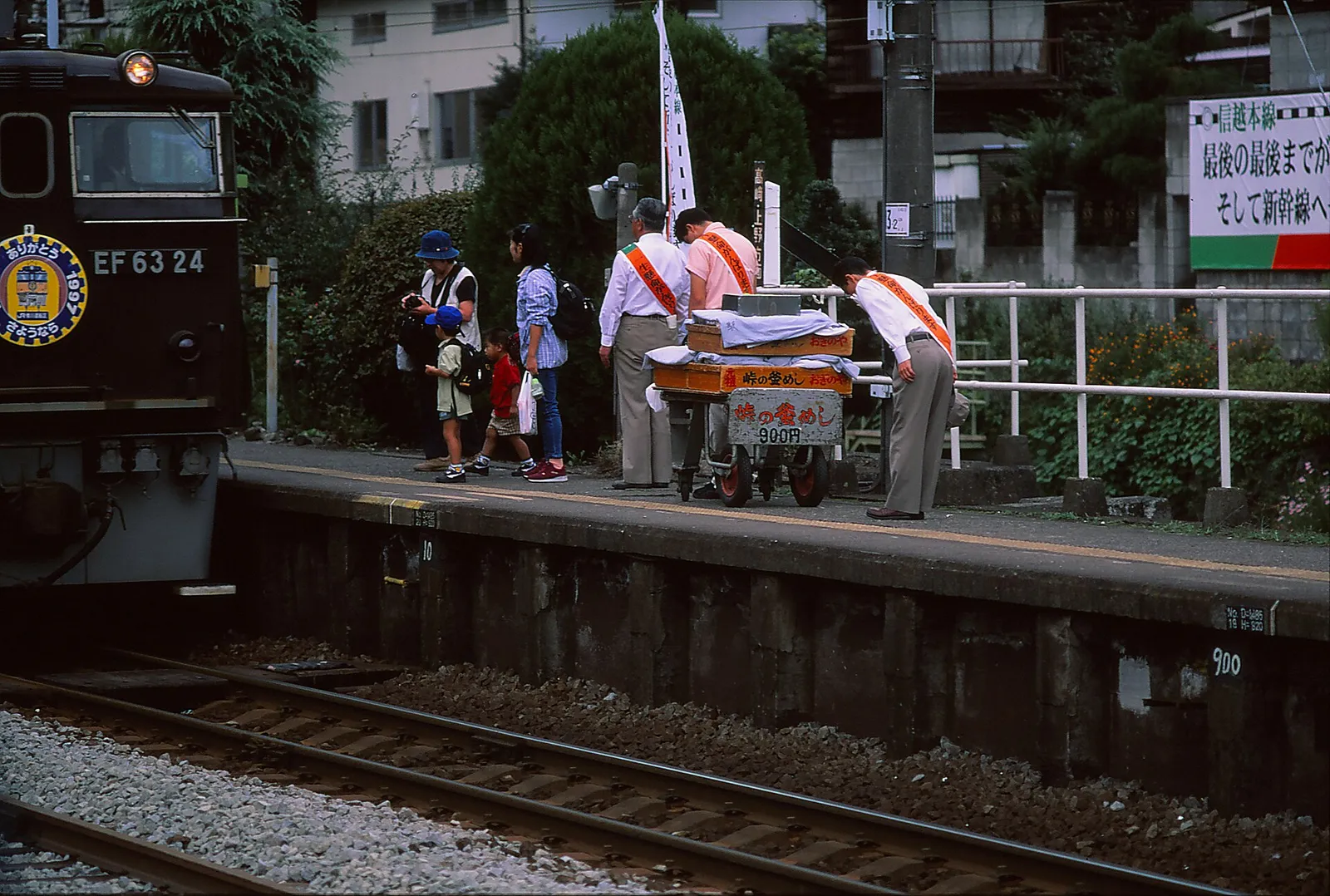
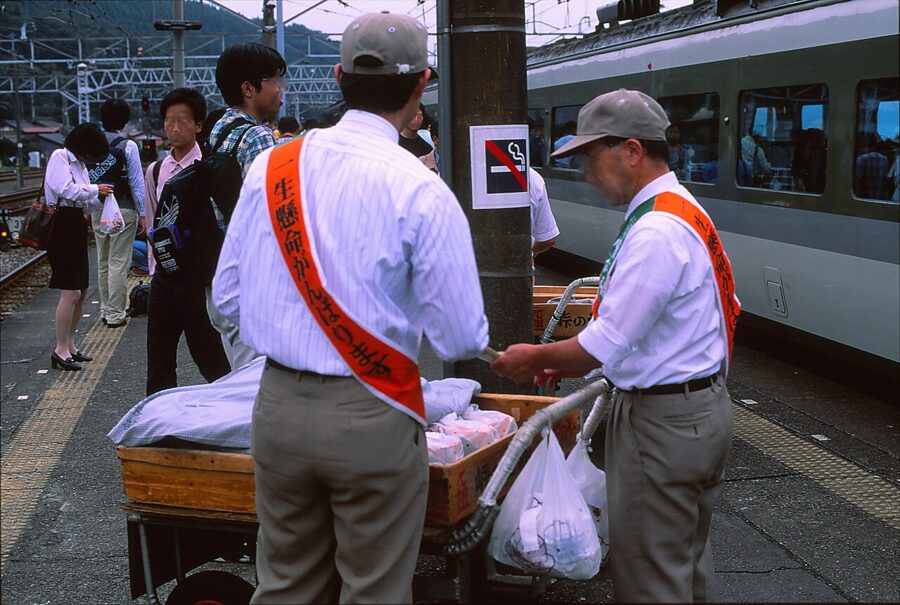
Yokokawa, at the foot of the Usui Pass, was the classic ekiben stop. Every train waited there while banking locomotives were coupled on for the climb to Karuizawa, and Oginoya’s staff worked the length of it selling Tōge no Kamameshi. The line over the pass closed in 1997, when the Nagano Shinkansen opened and took the traffic through a tunnel.

Faster trains finished the long stop. Air-conditioned carriages with sealed windows ended window sales, the Shinkansen ran past the junctions where vendors had worked, and many small makers closed. The trolley went the same way: JR East took bento off its Shinkansen trolleys in March 2019, and JR Central ended trolley sales on the Tokaido altogether at the end of October 2023.
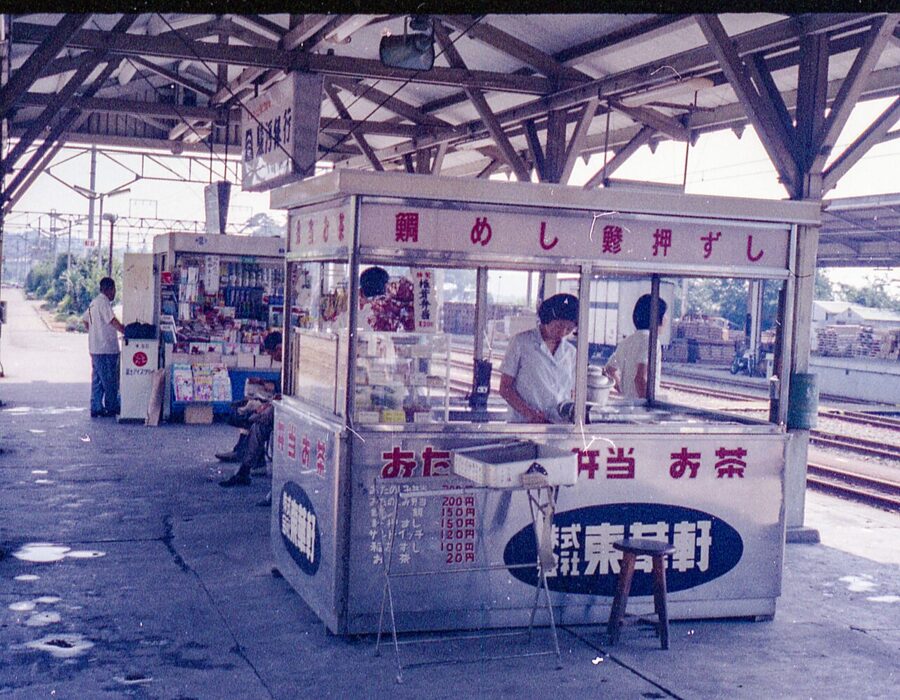

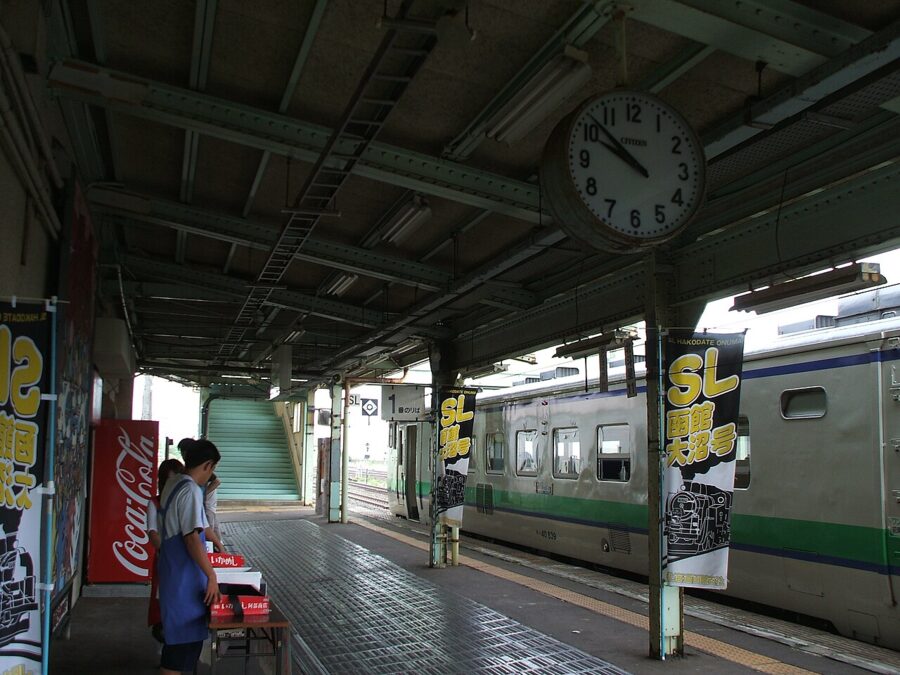

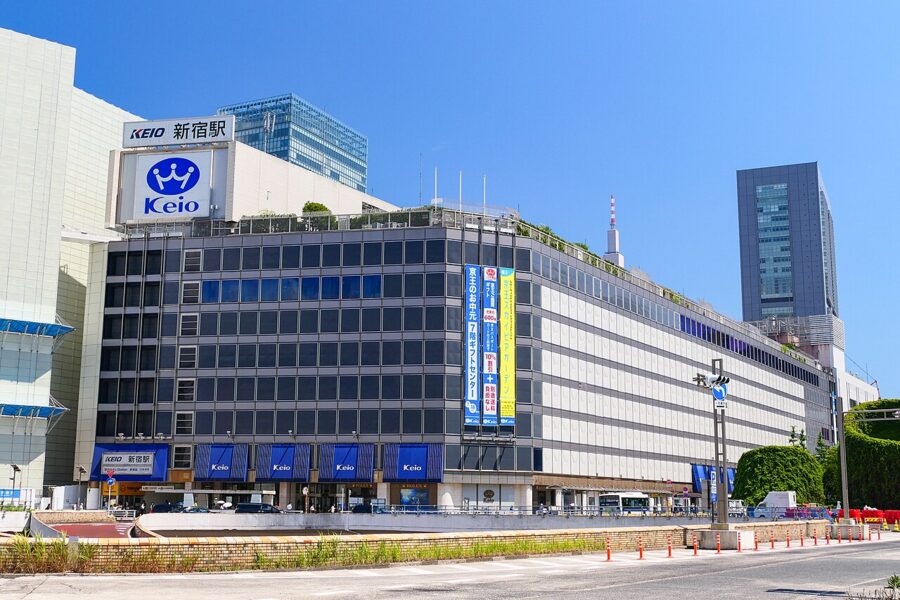
What kept the regional ekiben alive was the department store. Keio held its first ekiben fair at its Shinjuku store in February 1966 and has held one every year since, with makers travelling to Tokyo to cook their boxes on the spot. The station shops followed: Matsuri, in effect, turned the fair into a permanent counter inside the gates.
Where to buy ekiben in Tokyo
Every terminus sells them, but Tokyo Station has the range. The shops below are run by JR East’s catering company, JR East Cross Station, unless noted, and the hours are from its shop listings as of November 2026; all are open every day.
| Shop | Where | Hours (as of November 2026) |
|---|---|---|
| Ekibenya Matsuri | Tokyo, ground-floor central passage, inside JR East’s gates | 05:30–22:00 |
| Ekibenya Odori | Tokyo, central passage, by the Tokaido Shinkansen central transfer gate | 06:00–21:00 |
| Ekibenya Matsuri Select | Tokyo, in front of the Tohoku Shinkansen south transfer gate | 06:00–21:00 |
| Ekibenya platform kiosks | Tokyo, Shinkansen platforms 20–21 and 22–23 | 06:00–21:00 (20–21 middle); 07:00–20:00 (20–21 north end); 08:00–20:00 (22–23) |
| ecute Shinagawa deli shops | Shinagawa, inside the JR gates | Mon–Sat 09:00–22:00; Sun and holidays 09:00–20:30 (some open earlier) |
| Ekibenya Ueno Central Gate | Ueno, straight ahead inside the central gate | 06:00–21:00 |
| Ekibenya Ueno Shinkansen | Ueno, inside the gates on the Shinkansen passage | 06:30–19:00 |
| Ekibenya Matsuri Select Shinjuku | Shinjuku, inside the south gate, 2F concourse | 06:30–21:00 |
| Ekibenya, platforms 9–10 | Shinjuku, middle of the Chuo Line limited-express platform | 06:30–20:00 |
| Keio ekiben fair | Keio Department Store Shinjuku, 7F | January only; 2026: 6–21 January, 10:00–20:00 |
Tokyo Station
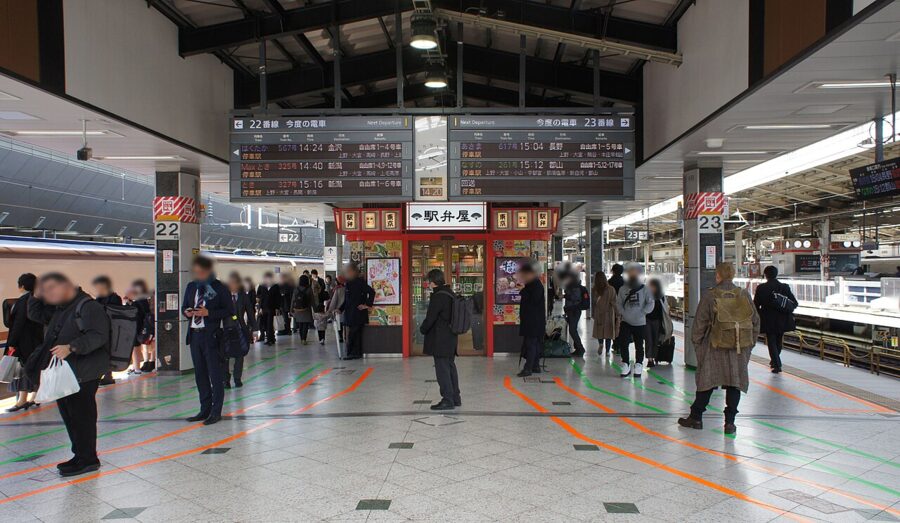
Ekibenya Matsuri stocks about 150 kinds and opens 05:30 to 22:00 every day. It is on the ground-floor central passage inside JR East’s gates, between the stairs to platforms 5–6 and 7–8, a short walk from the Shinkansen transfer gates. The shop was refitted in summer 2026, closing completely from 6 to 14 July 2026 and reopening on 15 July. It takes no reservations.
Ekibenya Odori (駅弁屋 踊), on the same passage in front of the Tokaido Shinkansen central transfer gate, stocks only the best sellers and opens 06:00 to 21:00. It is also where you collect a box ordered on JR East’s JRE MALL Order service, which needs the order three days ahead. Ekibenya Matsuri Select, in front of the Tohoku Shinkansen south transfer gate, carries Matsuri’s most popular boxes from 06:00 to 21:00.
Past the JR East transfer gates, small Ekibenya kiosks stand on the Shinkansen platforms themselves. The one in the middle of platforms 20–21 opens 06:00 to 21:00; the others open at 07:00 or 08:00 and close at 20:00. They are the answer when the passage queue is too long, with a fraction of the choice.

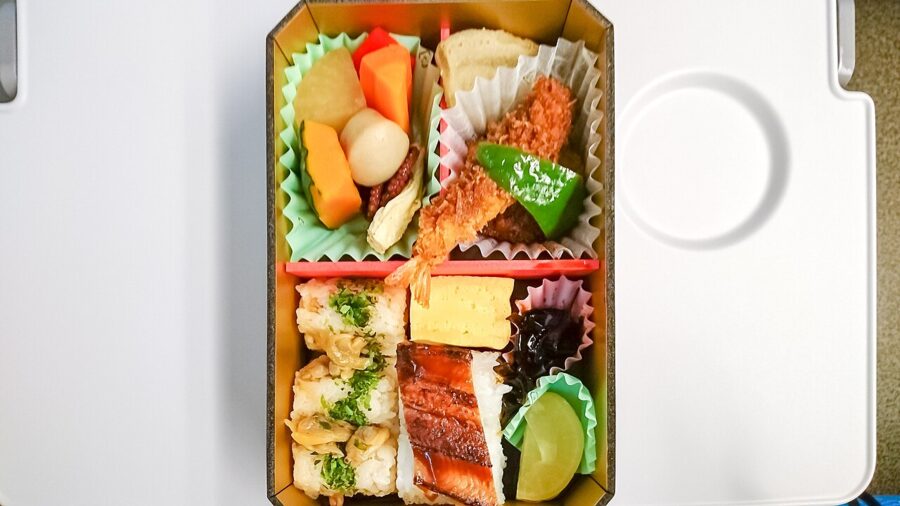
On the Tokaido side, JR Central’s shops are run by its own retail company, JR Central Retailing Plus, and they sell JR Central’s boxes as well as some of JR East’s. Its standard is the Tokaido Shinkansen Bento, a makunouchi of food from along the line, relaunched on 21 July 2026 at ¥1,300 (about US$8): Nagoya miso katsu, Kyoto simmered vegetables and wheat gluten, Shin-Osaka beef-tendon stew and dashi rice with whitebait. It is sold at Tokyo, Shinagawa, Shin-Yokohama, Nagoya, Kyoto and Shin-Osaka.


Shinagawa
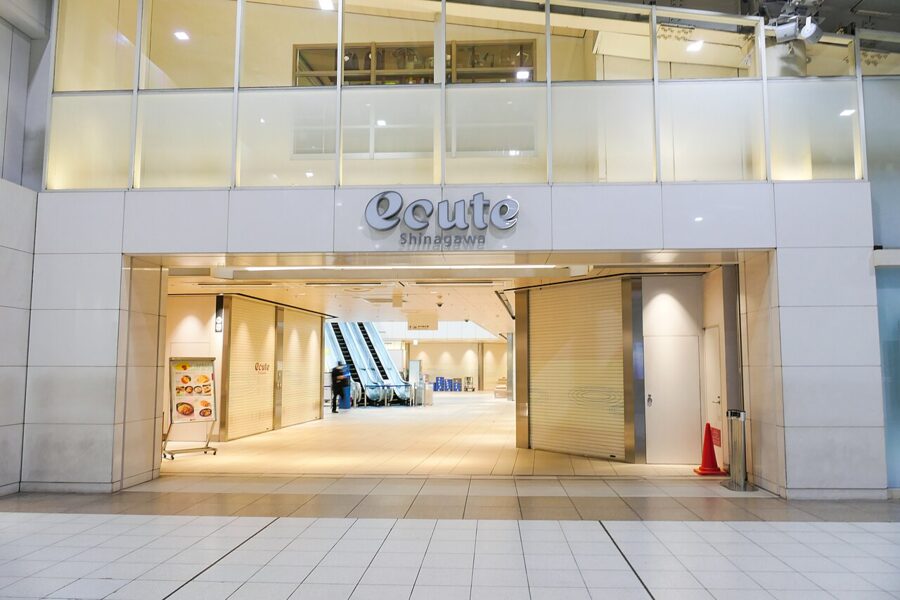
Shinagawa is the better place to board the Tokaido Shinkansen if you are staying south of the centre, and its ekiben are inside the gates. JR East’s ecute Shinagawa has a run of deli and bento counters, open 09:00 to 22:00 Monday to Saturday and to 20:30 on Sundays and holidays, with some opening at 07:00. JR Central’s kiosks on the Shinkansen side carry the Tokaido Shinkansen Bento.

Ueno
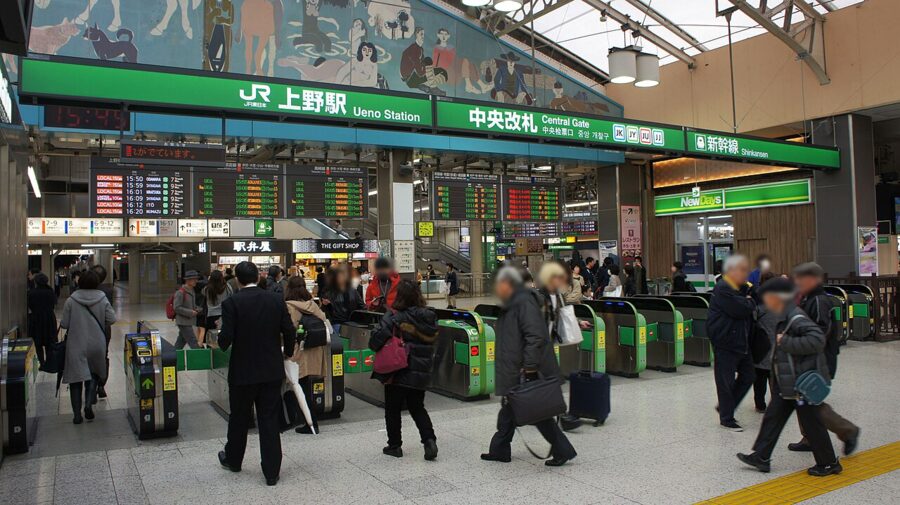
Ueno is where the Tohoku, Joetsu and Hokuriku Shinkansen make their first stop, and it has two Ekibenya counters. One is straight ahead as you pass the central gate, open 06:00 to 21:00; the other is on the passage to the Shinkansen gates, open 06:30 to 19:00. JR East listed Fukagawa-meshi at ¥1,180 and the Chicken Bento at ¥980 there in February 2026.

Shinjuku
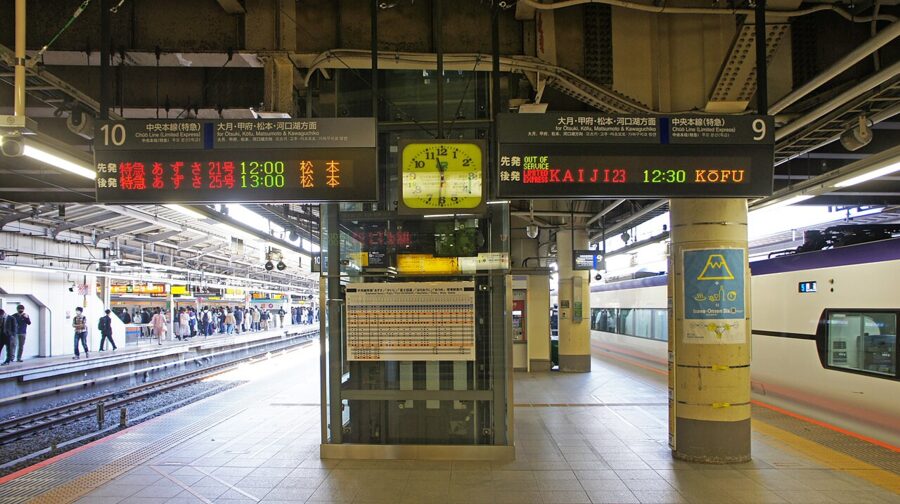
Shinjuku is the terminus for the Chuo Line limited expresses, and its ekiben are aimed at them. Ekibenya Matsuri Select Shinjuku is inside the south gate on the second-floor concourse, open 06:30 to 21:00, and a small Ekibenya kiosk stands halfway along platforms 9–10, where the Azusa and Kaiji leave, open 06:30 to 20:00. If you are heading for Mount Fuji on the Chuo Line, the platform kiosk saves going back through the crowds of Shinjuku Station.

The January fair at Keio
The Keio Department Store fair, the Ganso Yūmei Ekiben to Zenkoku Umaimono Taikai, is the big one. The 61st ran on the seventh floor of the Shinjuku store from 6 to 21 January 2026, 10:00 to 20:00 with early closing at 17:00 on the 14th and the 21st, with 41 makers cooking on the spot and more than 380 kinds counting the ones shipped in. Gyuniku Domannaka has been in the top ten of the boxes made on site there for 25 years.
Keio had not announced the dates for January 2027 by late November 2026; the fair is held every January, and in 2026 it ran for 16 days. Each live-made box has a daily quota, so the first weekday mornings are the time to go.


The regional boxes worth seeking
Matsuri’s range rotates, but a core of famous boxes is there most days, and more arrive for the fairs. Prices below are from JR East’s and the makers’ own listings in 2026.
Yamagata: Gyuniku Domannaka
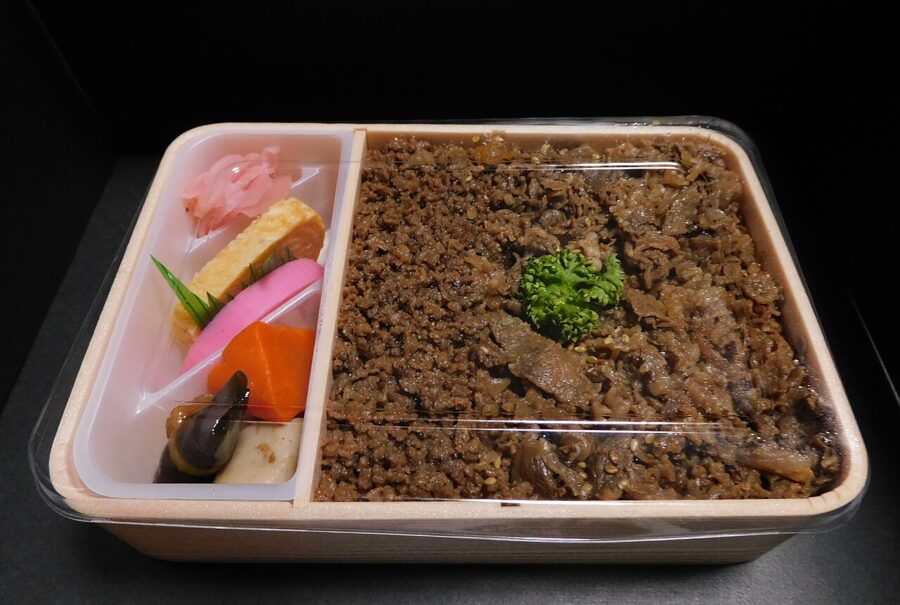
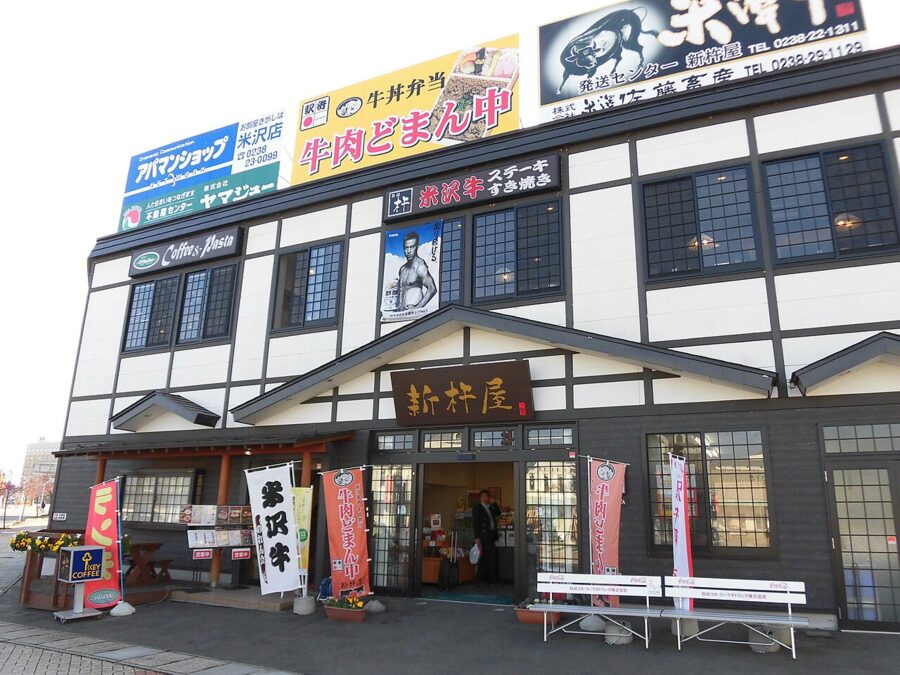
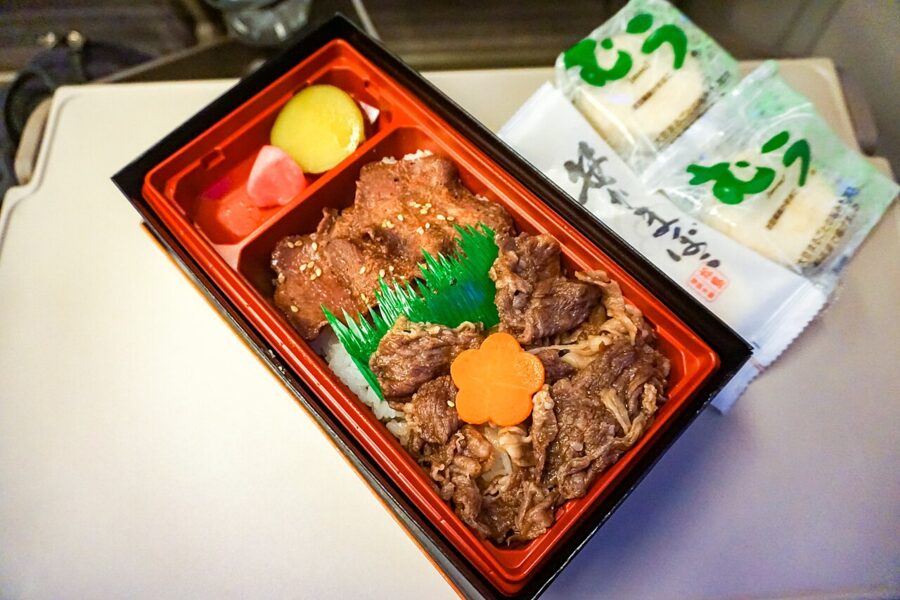
Shinkineya of Yonezawa created Gyuniku Domannaka for the opening of the Yamagata Shinkansen in 1992: Yamagata’s own Domannaka rice under a layer of beef soboro and slices of beef simmered in a sweet soy sauce. It was Matsuri’s best seller in JR East’s count for the first half of 2024, and JR East listed it at ¥1,620 (about US$10) in 2026. Eat the soboro first, then the beef, then mix what is left.


Sendai: gyutan
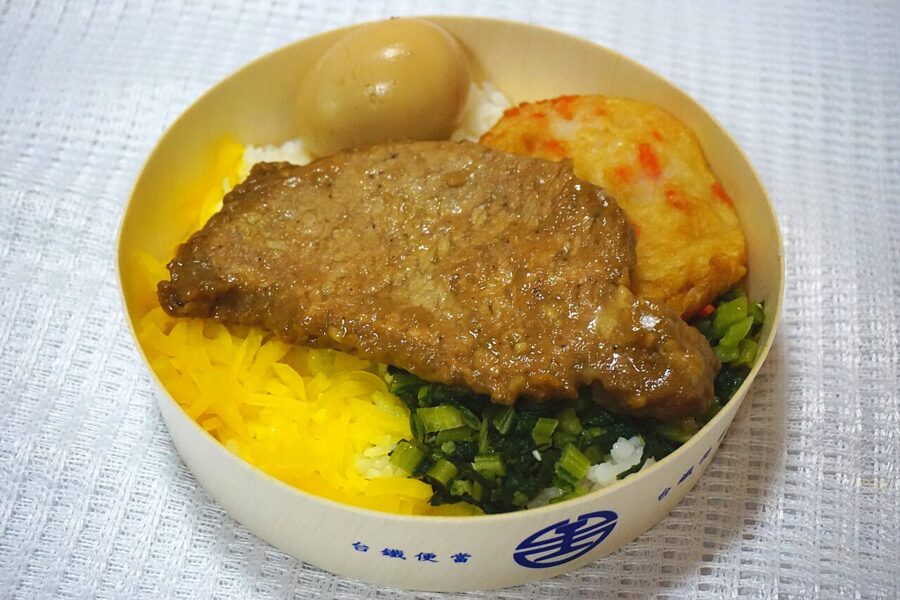
Grilled ox tongue is Sendai’s dish, and the ekiben version became possible only once the box could be heated, because tongue toughens as it cools. Kobayashi of Sendai, founded in 1920, is credited with the first string-heated gyutan box, sold from around 1990. At Tokyo Station, Matsuri and Odori sell JR East’s own charcoal-style gyutan box with a heating container, seasoned with Shiogama sea salt, for ¥1,480 (about US$9).

Yokokawa: Tōge no Kamameshi
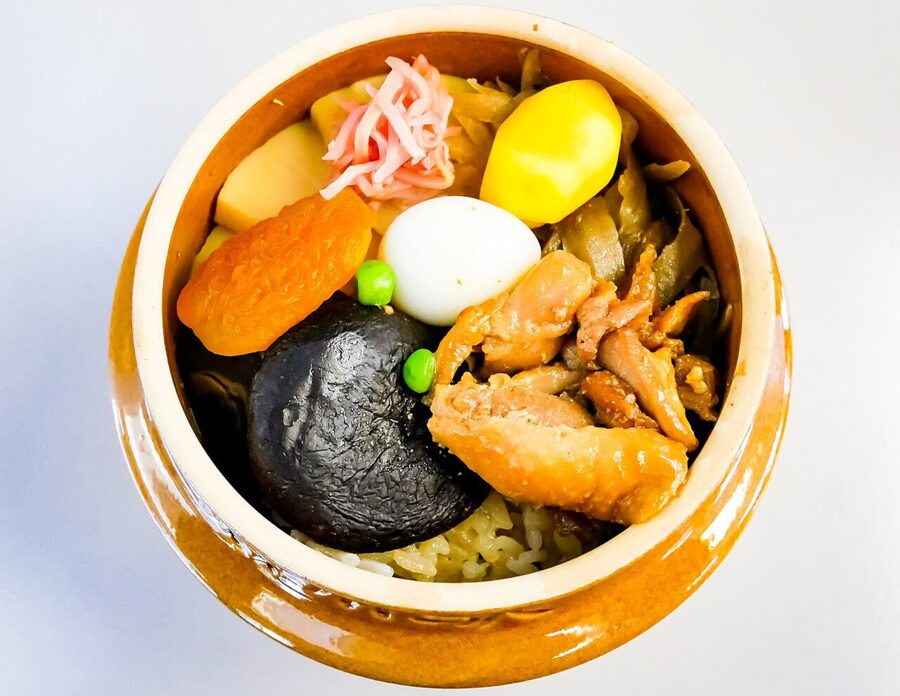
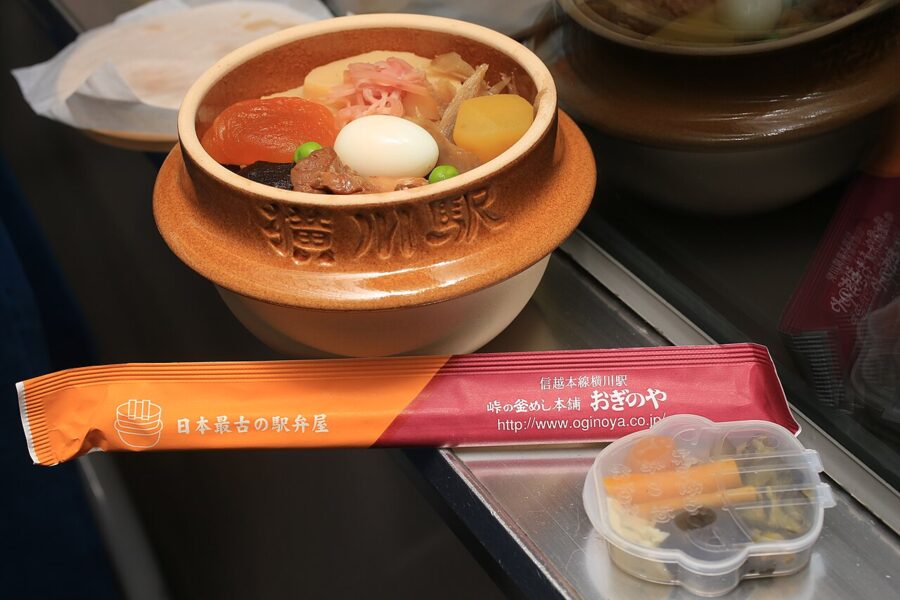
Tōge no Kamameshi went on sale at Yokokawa on 1 February 1958. Oginoya’s fourth president, Takamizawa Mineji, had asked passengers on the platform what they wanted and was told something warm and homely, so the rice went into a single-serving clay pot. Inside are tea-coloured rice cooked in light dashi, chicken, burdock, shiitake, bamboo shoot, a quail’s egg, peas, a chestnut and an apricot, with the pickles in a separate tub.
Oginoya says it has sold about 170 million. At its Yokokawa main store a takeaway pot is ¥1,500 (about US$9), and the company sells it at Karuizawa and Tokyo Station as well as on the expressway.

Niigata: Ebi Senryō Chirashi
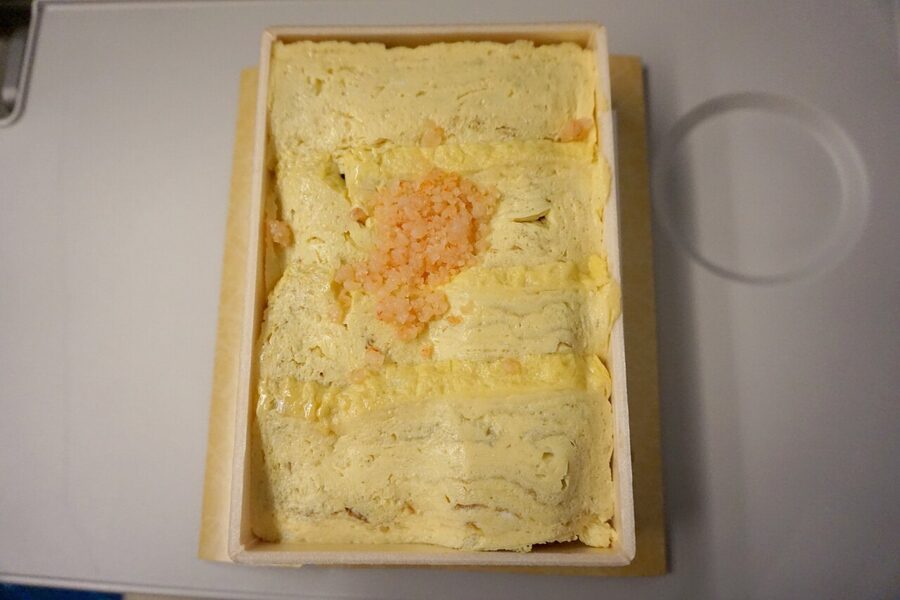
From Shibata Sanshinken, the Ebi Senryō Chirashi looks like a box of omelette. Lift the omelette and there are eel, gizzard shad, squid and prawn over sushi rice made with Niigata rice, under a scatter of prawn flakes. It was in Matsuri’s top ten in 2024 and cost ¥1,800 (about US$11) at Odori in 2026.

Hokkaido: salmon, squid and crab
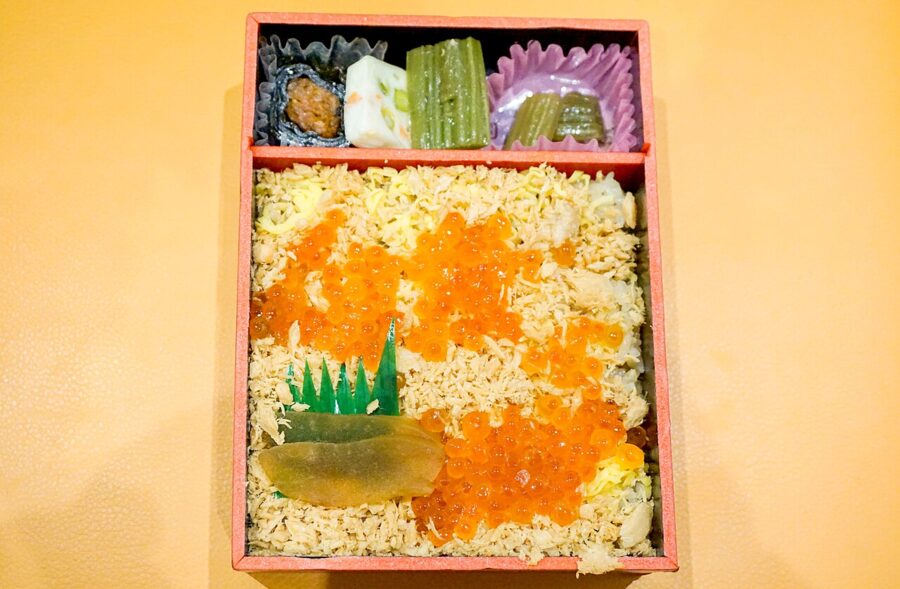
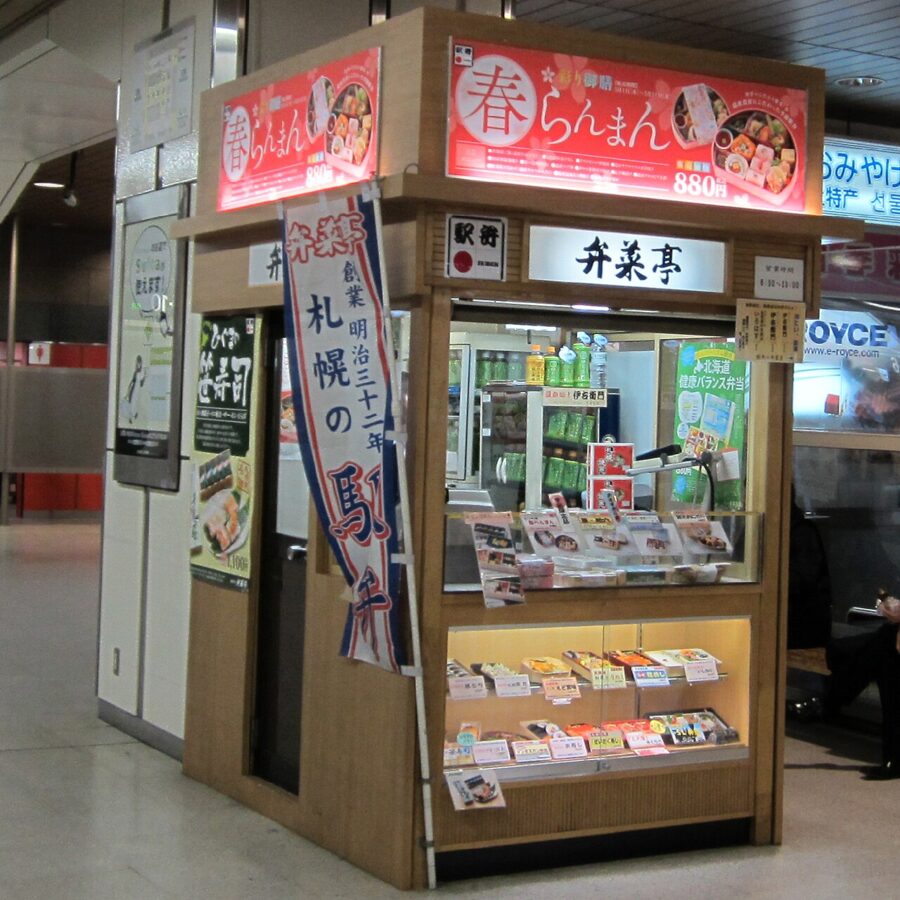
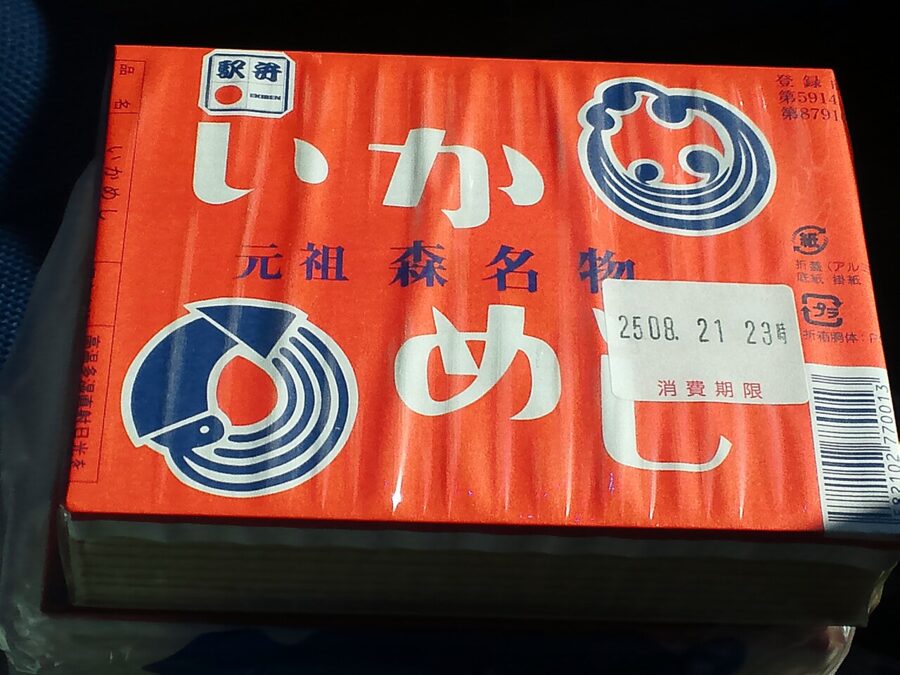
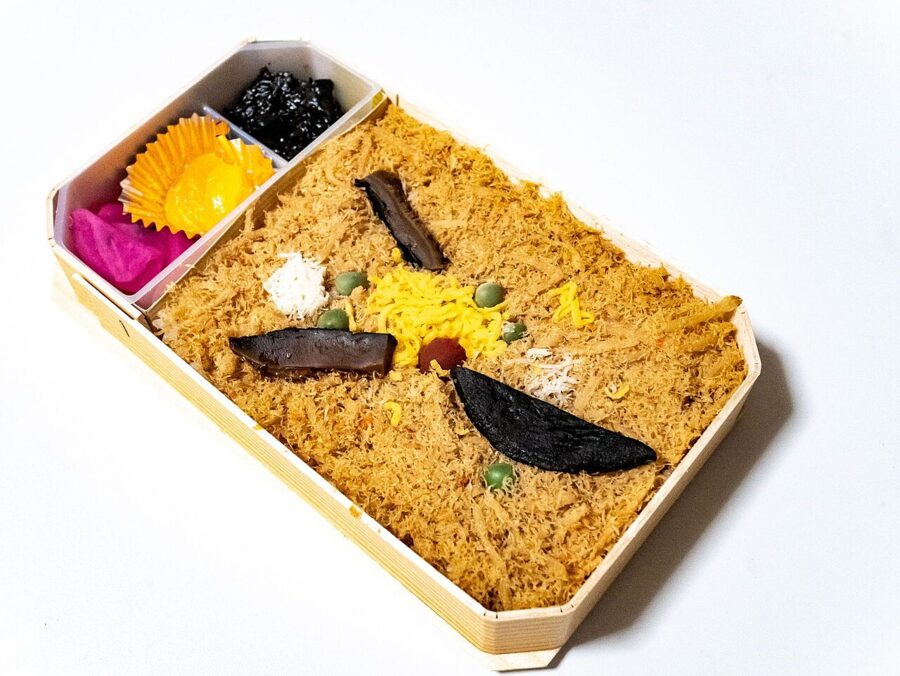
Hokkaido’s boxes are seafood, and in Tokyo they mostly turn up at the January fair. Ishikari Sakemeshi, salmon flakes and roe over rice, has been sold at Sapporo Station since 1923 by the company that carried on Higo Yosakichi’s trade. Ikameshi, whole squid stuffed with rice and simmered in a sweet soy sauce, has come from Mori since 1941, and Oshamambe’s kanimeshi is shredded crab over rice.



Kyushu: kashiwa-meshi
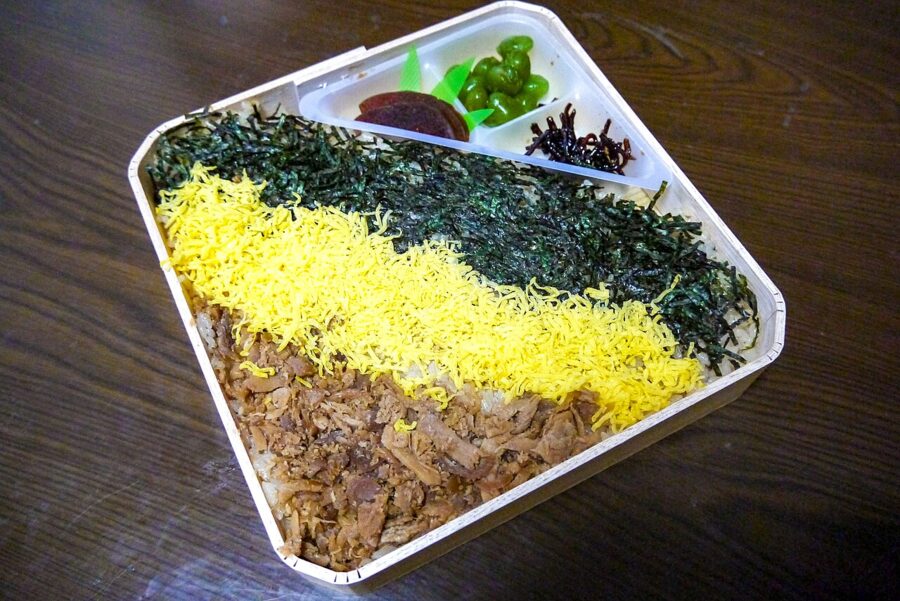
In northern Kyushu, kashiwa means chicken. Tochikuken of Orio in Kitakyushu has made its kashiwa-meshi since 1921: rice cooked in chicken stock, topped with stripes of chicken, egg and nori. It costs ¥860 (about US$5) for the small box and ¥970 for the large, and it reaches Tokyo mainly at the fairs.

On the way to Kamakura
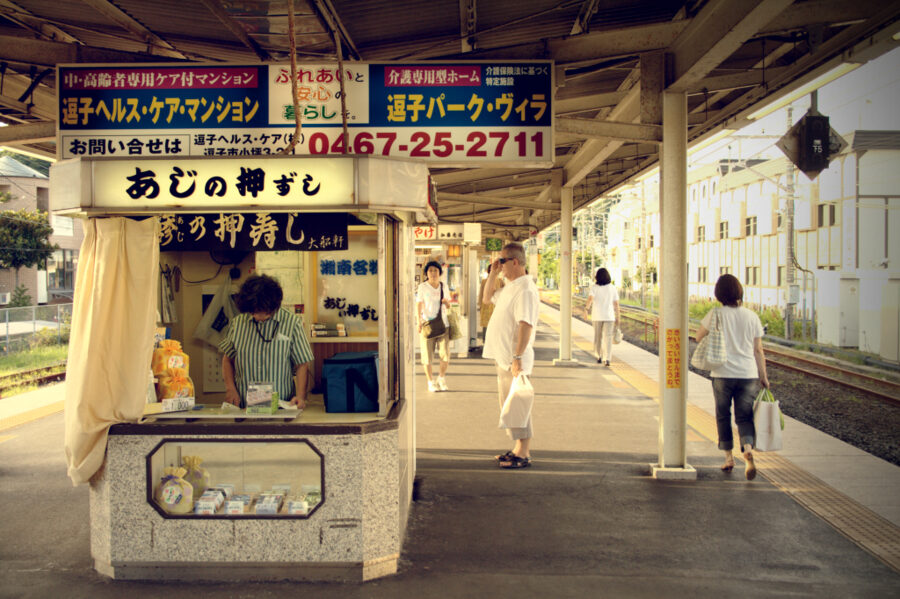
Ofunaken of Ofuna, the junction for Kamakura and Enoshima, has sold its pressed horse-mackerel sushi, aji no oshizushi, since 1913. JR East listed it at ¥1,200 at Ueno in February 2026, but it tastes better bought where it is made.

Self-heating boxes and clay pots
The self-heating box was a Kobe idea. Awajiya, a Kobe ekiben maker, launched the first in 1987, developed with Fukubi Chemical Industry of Fukui. Under the food is a sealed pouch of quicklime beside a pouch of water; you pull the string, the two meet, and the reaction steams the food from below.
Set the box flat on the table, keep the lid on, and wait: about eight minutes by Awajiya’s reckoning, about five for Kobayashi’s gyutan. The box gets hot and lets out steam, so it is no place for a lap or a phone. Heated containers cannot be taken onto an aircraft, so eat it on the train.
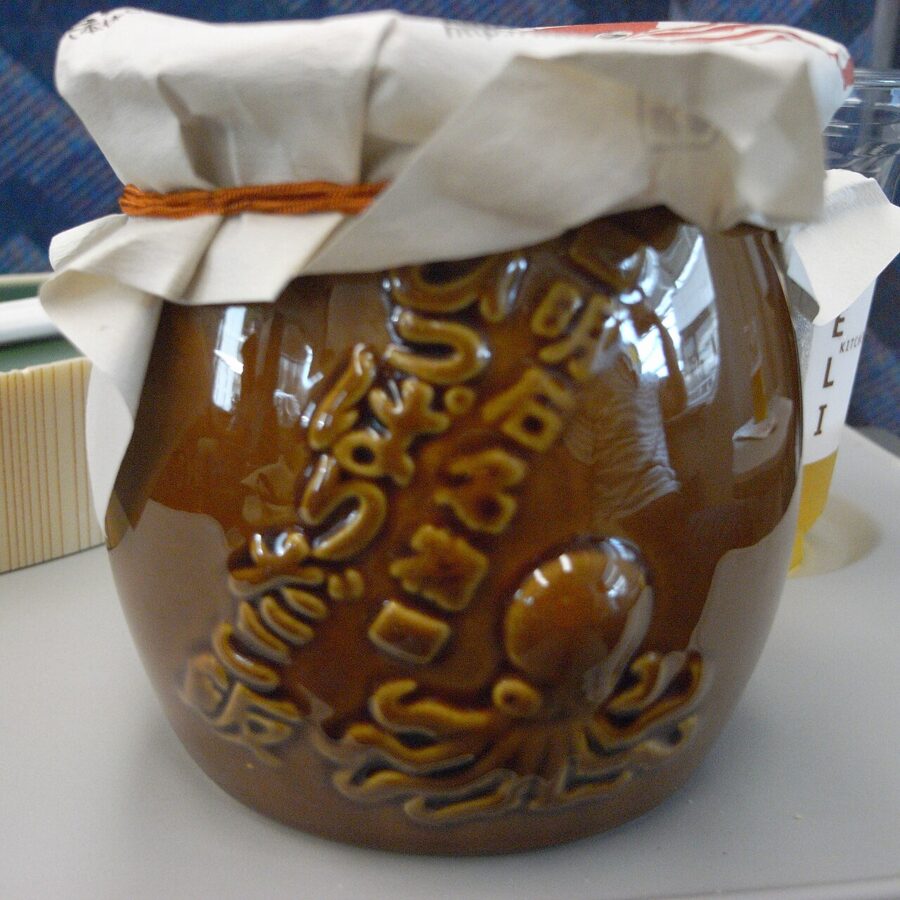
Clay is the other way to keep food warm. The Tōge no Kamameshi pot is Mashiko ware from the Tsukamoto kiln, about 14 centimetres across and 725 grams, and Awajiya’s Hipparidako-meshi, octopus and rice, comes in a pot shaped like an octopus trap.

Prices, and when the good ones sell out
A good ekiben in Tokyo costs ¥1,000 to ¥2,000 as of 2026. The Chicken Bento is ¥1,000, Gyuniku Domannaka ¥1,620, Ebi Senryō Chirashi ¥1,800; seafood and wagyu boxes go past ¥2,000. Prices differ by a few yen between shops, so treat any printed price as a guide.
The regional boxes are made in limited numbers each day and shipped in, and Matsuri takes no reservations, so the box you want may simply be gone. If one particular box matters, order it on JRE MALL Order three days ahead and collect it at Odori. At the Keio fair, each live-made box has a daily quota and the well-known ones go first; at their home stations some do not see the afternoon, and Keio’s own notes say Miyajimaguchi’s anago-meshi often sells out by early afternoon.
Eating on the train: where it is normal and where it is not
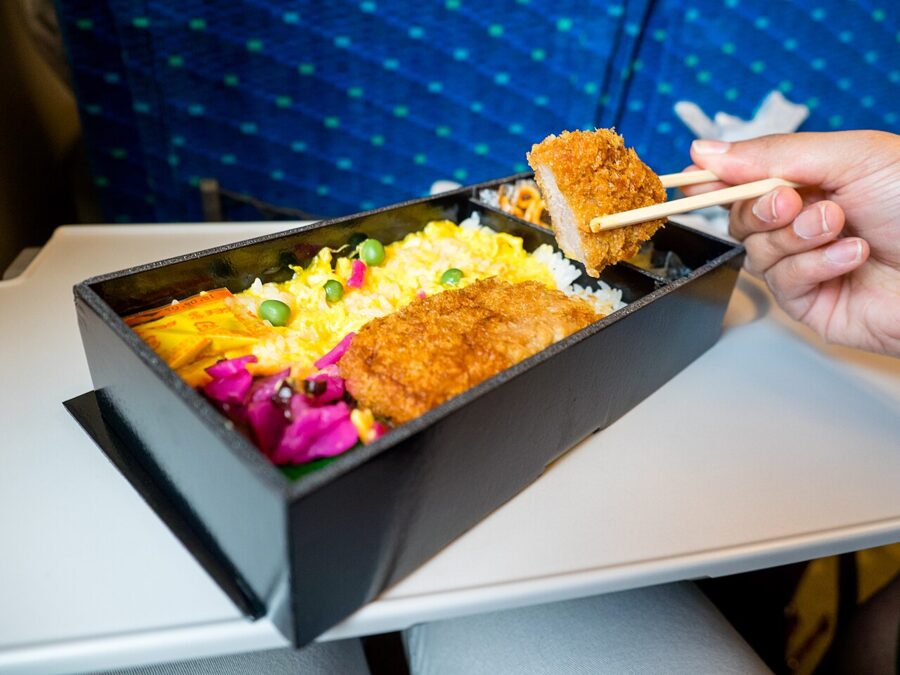
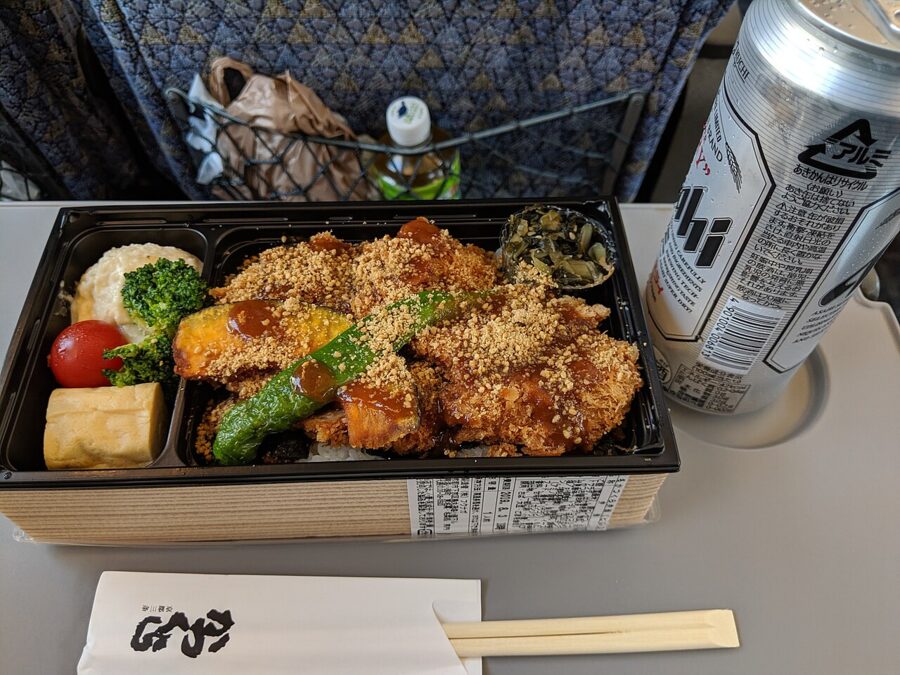
On the Shinkansen and the limited expresses, eating at your seat is normal and the fold-down table is made for it. Nobody minds the smell of a beef box on a Hayabusa or an Odakyu Romancecar, a can of beer with it included.


On commuter trains, do not. The Yamanote Line, the subway and the other city lines have long bench seats facing each other, and eating a meal there is not done, even when the car is half empty. A drink is fine; a box of rice with an audience is not.
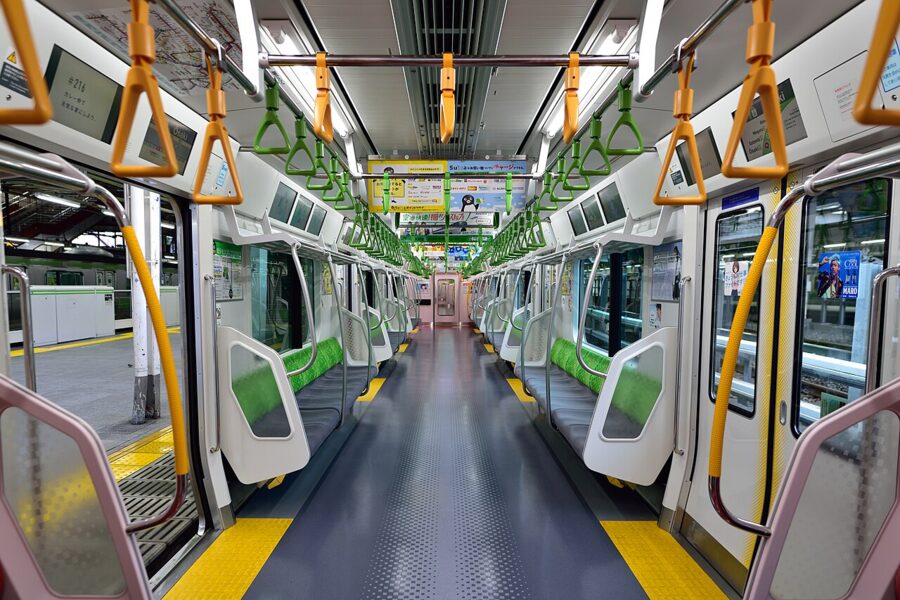

Take the rubbish with you to the bins on the platform or at the end of the car, and close the lid on anything strong-smelling until you are ready to eat it. Chopsticks come with the box; tea comes from a vending machine.
Tokaido versus the northern lines
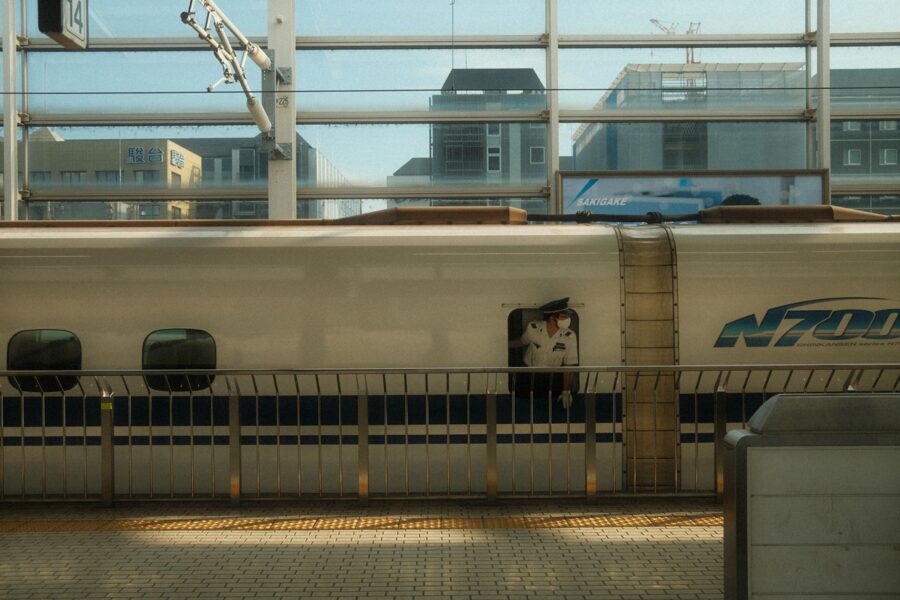
For the Tokaido Shinkansen, there is no trolley to fall back on. JR Central ended it in October 2023 and offers only a mobile ordering service in the Green Car of the Nozomi and Hikari, started in November 2023. Buy before you go through the transfer gate: Odori is right in front of the Tokaido central transfer gate, and JR Central’s own kiosks are behind it.
The catch is the entrance. Matsuri and Odori are inside JR East’s gates, so with a paper ticket or a pass, enter through JR East’s ordinary gates on the Marunouchi or Yaesu side, not JR Central’s own Shinkansen entrances on the Yaesu side, and walk along the central passage to the transfer gate.

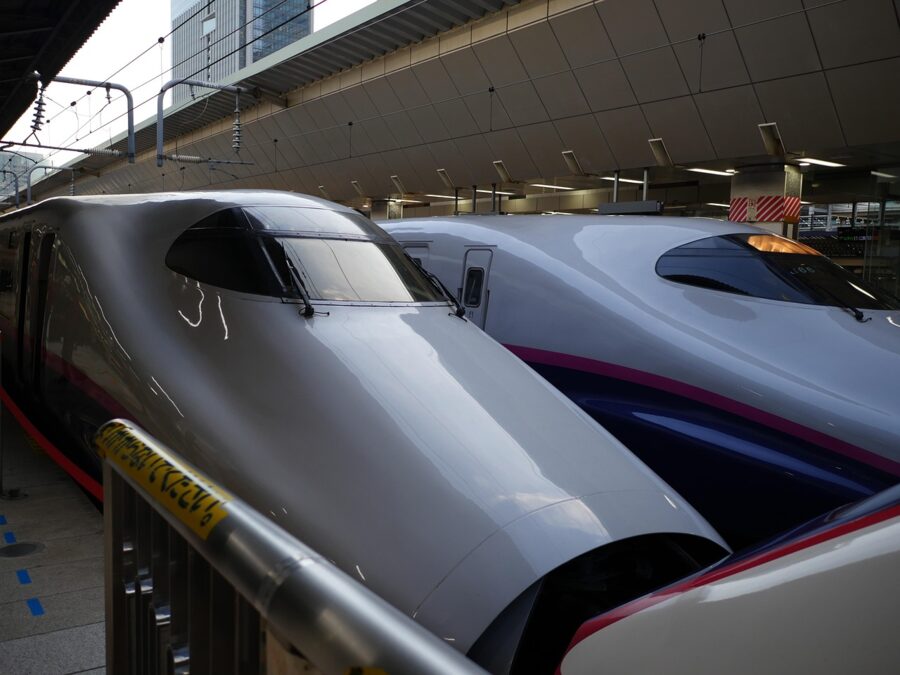
For the Tohoku, Joetsu and Hokuriku Shinkansen, JR East’s trolley still runs on some trains but has sold only drinks and snacks since 2019. You have more places to buy: Matsuri Select at the south transfer gate, the kiosks on platforms 20 to 23, and the Ekibenya counters at Ueno if you board there. The boxes made for these lines, gyutan from Sendai and Domannaka from Yonezawa, are the ones Matsuri stocks deepest.
Keeping the containers
The Tōge no Kamameshi pot is meant to be kept. Oginoya publishes instructions for cooking rice in it: one go of rice (about 150 grams) and 180 ml of water, soaked, then about 15 minutes on a low gas flame and 15 minutes resting with the lid shut, which leaves a crust on the bottom. It also warns that the pot is not built for a direct flame and can crack, so the recipe is at your own risk.
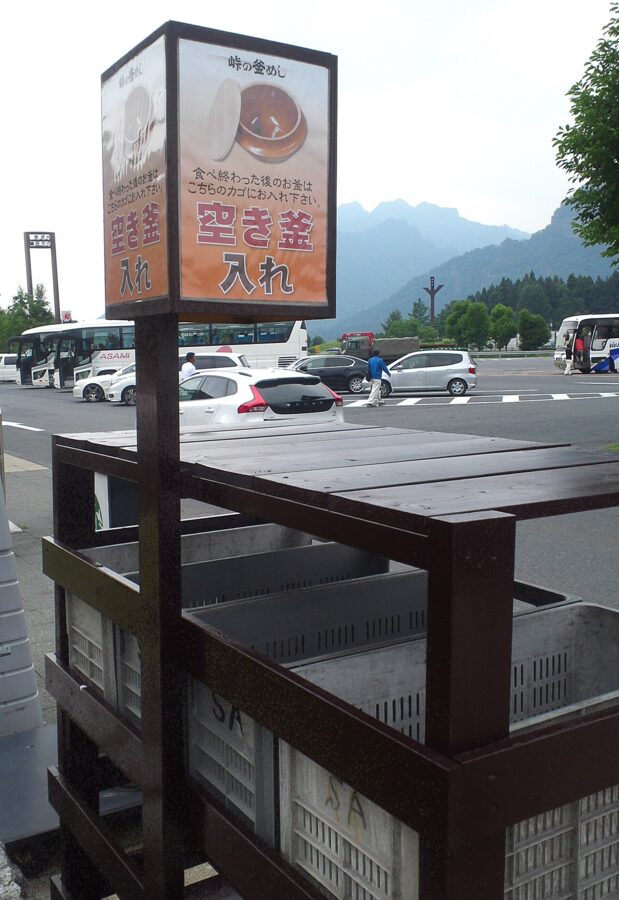
If you do not want it, give it back. Oginoya’s shops take empty pots, some with a collection box by the door, and the company checks, steam-cleans and reuses the sound ones. Since 2012 some outlets have also sold the kamameshi in a moulded pulp pot.

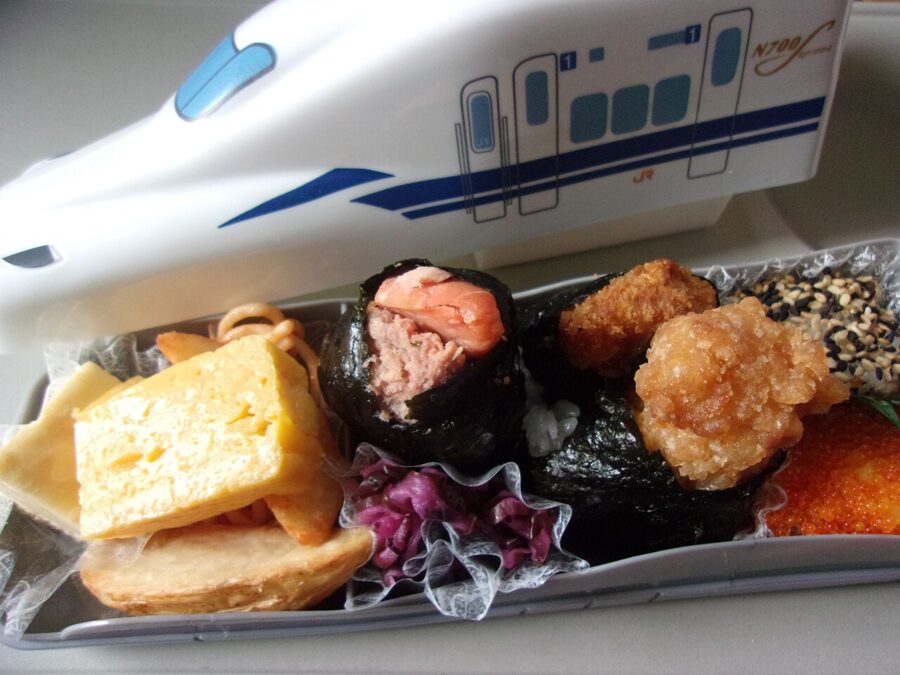
The plastic boxes are kept for other reasons. Several makers sell lunches in boxes moulded as a Shinkansen nose, and children keep them as toys; Awajiya’s octopus pot makes a pen pot. Wash them on the day, before the soy sauce sets.

So, back to the queue at Matsuri with eleven minutes to go. Take the Domannaka, or the gyutan if you want it hot and the Tōge no Kamameshi if you have a bag to spare, pay with Suica, and walk to the transfer gate. Eat it after the first station, when the city has thinned out.